A Practical Guide to the Jewelry Drill Press
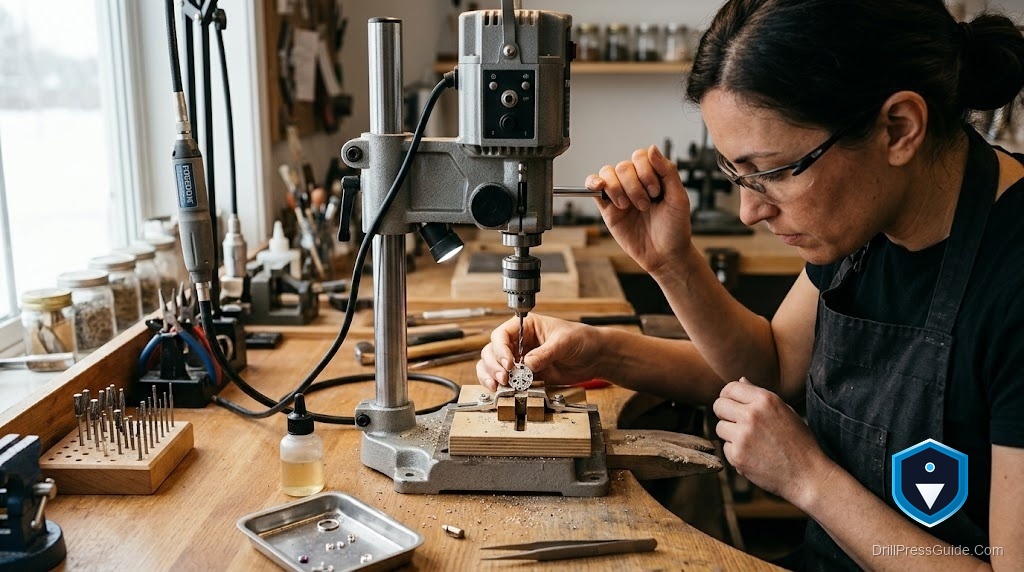
Drilling a bead, a pendant, or a thin sheet of silver is not a scaled-down version of drilling a plank, it is a different problem. The holes are tiny, the material is precious, and the bits are fragile enough to snap if the press runs too fast or wanders a hair. A full-size shop drill press is usually the wrong tool for this; jewelry work rewards a small, precise machine and careful technique. Here is what makes a drill press suitable for jewelry, and how to use one so you drill clean holes without cracking a stone or breaking a bit.
A jewelry drill press is a small, precise benchtop machine for drilling tiny, accurate holes in beads, metal, and stone. It works best with a fine chuck that grips small bits, steady low-to-moderate speeds, secure holding of the small workpiece, light feed pressure, and a drop of lubricant on metal. Precision and control matter far more than power for jewelry.
What makes a press right for jewelry
Jewelry asks for the opposite of a shop press. The features that matter are a chuck that closes down on very small bit shanks, low runout so tiny bits do not wobble and snap, smooth speed control, and a compact size that fits a bench. Power is almost irrelevant. A precision benchtop machine such as this mini benchtop drill press is built around a small chuck and fine control, which is exactly what beads, findings, and thin metal need. The goal is a bit that spins true and a feed you can meter by feel.
Holding tiny work safely
Small pieces are the hard part. A bead or a metal blank is too small to grip by hand safely and too easy to spin, so use a small vise, a pin vise fixture, or a clamp with soft jaws to hold it. For stones and glass, support the piece fully so it cannot flex. Holding the work also keeps your fingers away from the bit, the point-of-operation caution that CCOHS and OSHA stress even at this small scale, and eye protection still applies.
Speed, bits, and feed
Match the approach to the material:
| Material | Speed | Feed and lubricant |
|---|---|---|
| Soft metal (silver, copper, brass) | Moderate | Light feed, a drop of lubricant |
| Hard metal | Lower | Light feed, lubricant, sharp bit |
| Beads and soft stone | Low to moderate | Very light feed, water on stone |
| Glass and hard stone | Low | Diamond bit, water, patience |
Use fine, sharp bits, feed lightly so the small bit does not snap, and let the tool cut at its own pace. On metal, a drop of lubricant keeps the edge cool; on stone and glass, water cools a diamond bit and clears grit. The diameter-and-material logic behind these speeds is the same one in the Dynabrade chart, just at the small end.
The verdict
A jewelry drill press is a small, precise machine for tiny, accurate holes, and it works when you pair a fine low-runout chuck with steady speeds, secure holding, light feed, and the right lubricant for the material. Three takeaways: precision and control beat power for jewelry, holding tiny work in a vise or fixture is both safer and more accurate than fingers, and light feed with sharp bits is what keeps fragile bits from snapping. Who should skip a full-size press? Anyone doing mostly small, delicate work, a compact precision machine suits it far better.
Frequently asked questions
What is a jewelry drill press? A small, precise benchtop machine made for drilling tiny, accurate holes in beads, metal findings, and stone. It emphasizes a fine chuck, low runout, and smooth speed control over the power a full-size shop press offers.
Can I use a regular drill press for jewelry? You can for some metal work, but full-size presses often will not grip very small bits well and may run too fast, snapping fine bits. A compact precision machine with a small chuck and low speeds suits delicate jewelry far better.
What speed should I use for jewelry drilling? Moderate speeds for soft metals like silver and brass, lower for hard metals, and low speeds for stone and glass with a diamond bit and water. Fine bits break at high speed, so err slower and feed lightly.
How do I hold small jewelry pieces to drill them? Use a small vise, a pin-vise fixture, or a clamp with soft jaws so the piece cannot spin and your fingers stay clear. Support stones and glass fully so they do not flex or crack under the bit.
How do I drill stone or glass beads without cracking them? Use a diamond-coated bit at low speed with water to cool the tip and clear grit, support the piece fully, and feed with very light pressure. Let the bit wear its way through slowly rather than forcing it.
Do I need cutting fluid for jewelry metal? A drop of lubricant helps when drilling silver, brass, or harder metal by cooling the bit and easing the cut. For stone and glass, use water instead, which cools the diamond bit and washes away grit.
Why do my small drill bits keep breaking? Usually from too much feed pressure, too high a speed, or a workpiece that shifts. Slow the speed, feed lightly and let the bit cut, hold the piece firmly, and keep bits sharp so they do not bind.
References
- Dynabrade, HSS Drill Speed Recommendation Chart. https://www.dynabrade.com/pdf/lit/D1201_Singles/D12.01_pg134.pdf
- CCOHS, Metalworking Machines: Drill Presses. https://www.ccohs.ca/oshanswers/safety_haz/metalworking/drillpresses.html
- OSHA, Woodworking eTool: Drill Press. https://www.osha.gov/etools/woodworking/production/machines-tools/drill-press