Craftsman 15-1/2 Inch Drill Press: What to Know About These Vintage Machines
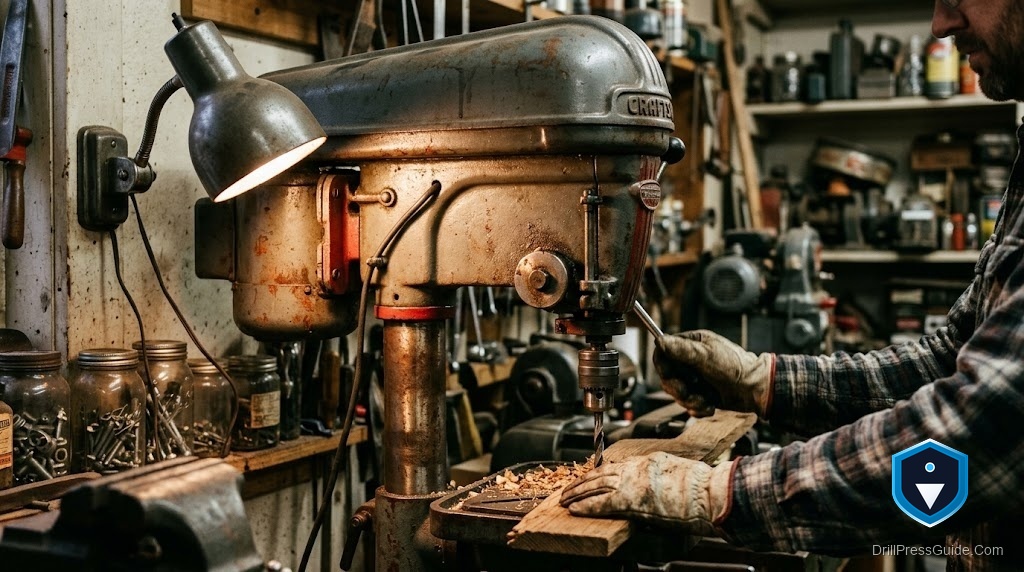
Open the classifieds in any part of the country and you will find a Craftsman 15-1/2 inch drill press for sale, usually cheap, usually described as “runs great,” usually decades old. These machines were sold by the thousands through Sears, they landed in home shops everywhere, and now they form a huge slice of the used drill press market. If one has caught your eye, the smart questions are not about horsepower ratings on a faded sticker. They are: who actually built it, can you still get parts, and is this specific unit a bargain or a project?
The Craftsman 15-1/2 inch drill press refers to a family of floor-standing and bench models sold under the Sears Craftsman brand, commonly carrying model numbers beginning with 113 (such as 113.21371), built for Sears by outside manufacturers like Emerson Electric and King-Seeley. Typical examples run a 1/2-horsepower motor at around 1,725 RPM through a stepped-pulley belt system, with the 15-1/2 inch figure describing the swing.
Short answer: a clean Craftsman 15-1/2 inch press is a solid, repairable machine for general home-shop drilling, and its Sears-era parts are more findable than most vintage tools thanks to Sears PartsDirect. Buy one if the chuck and quill are healthy and you want heavy, simple capability for little money. Skip it if you need modern conveniences like variable speed or a warranty. Here is how to read these machines.
Who actually built your Craftsman
This is the key to everything with vintage Craftsman tools: Sears did not manufacture them. It contracted the work out and stamped its own brand and model numbers on the result. The model number prefix tells you the maker, and that matters for parts and quality:
- 113.xxxxx points to Emerson Electric, the maker behind many of the best-regarded Craftsman stationary tools, including a lot of 15-1/2 inch drill presses.
- Other prefixes point to other contractors, with varying reputations.
So when you read the model number off the plate, you are not just identifying the machine, you are identifying its pedigree. An Emerson-built 113-series Craftsman is generally a well-made tool worth restoring. Note the full number before you do anything else.
Typical specs and what they mean
A representative Craftsman 15-1/2 inch press carries a 1/2-HP induction motor spinning around 1,725 RPM, feeding a stepped-pulley system that gives you a handful of speeds by moving the belt. The 15-1/2 inch swing puts it between a small benchtop machine and a full 17-inch floor press, enough to reach toward the center of a fairly wide board. These are general-purpose machines: good for wood, capable in light metal at low speed, and built heavy enough that the castings outlast everything else.
What they lack is modern convenience. No variable-speed dial, no digital readout, no laser. Speed changes mean opening the cover and moving the belt. That simplicity is also why they keep running for fifty years.
The honest flaws
Age-related wear. These machines are old, so expect a tired chuck, a glazed belt, a sticky switch, or a weak quill return spring. None are hard to fix, but a used unit almost always needs something.
Belt-change speeds. Like other vintage presses, changing speed is a manual belt swap. Fine if you settle on one speed, tedious if you switch often.
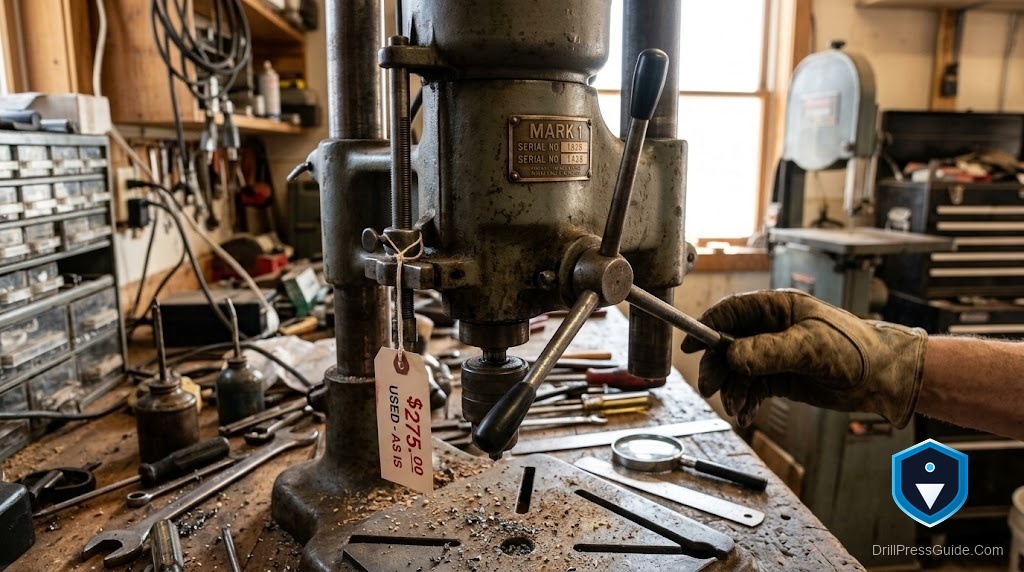
Sold as-is. No warranty, no support line. The condition of the individual machine is the whole deal, so inspect before buying.
Parts and restoration
Here is where the Craftsman 15-1/2 inch press has a real edge over other vintage tools: Sears PartsDirect maintains diagrams and parts listings for many 113-series machines, so belts, switches, springs, and chuck-related parts are often still orderable by model number. A generic replacement 5/8-inch or 1/2-inch chuck (confirm your machine’s arbor) drops the runout issue, and a fresh belt cures most bogging complaints. A typical restoration is clean, de-rust, new belt, new chuck, done, and you have a machine that will outlive its next owner too.
Before buying, check chuck runout by spinning a bit by hand, rock the extended quill for bearing play, and listen to the motor start. Our Craftsman drill press parts guide covers ordering by model number in detail.
Who should buy it, and who should skip it
Buy a Craftsman 15-1/2 inch press if you want heavy, honest, repairable capability for very little money, you can inspect the machine, and you do not mind belt-change speeds. An Emerson-built 113-series example is a genuine value.
Skip it if you want variable speed, a laser, a warranty, or a machine that needs nothing on arrival. In that case a current benchtop press like the WEN 4214T gives you modern convenience and a fresh start, and a current floor model does the same at larger capacity.
The verdict
The Craftsman 15-1/2 inch drill press is one of the best value entry points into a serious, heavy drill press, provided you buy with your eyes open. Read the model number to learn who built it, favor the Emerson-made 113-series machines, and count on Sears PartsDirect for the belt, switch, or chuck it will probably need. Inspect the chuck, quill, and motor before buying, since these are as-is machines. Do that, and a modest sum plus a weekend of cleanup buys you a press that drills straight and lasts for decades. Want new-machine convenience instead? Buy current. Want the most iron for the least money? This is it.
Frequently asked questions
Who made the Craftsman 15-1/2 inch drill press? Sears contracted the work to outside makers. Model numbers beginning with 113, such as 113.21371, point to Emerson Electric, the maker behind many well-regarded Craftsman stationary tools.
What are the specs of a Craftsman 15-1/2 inch drill press? A typical example has a 1/2-HP motor running around 1,725 RPM, a stepped-pulley belt speed system, and a 15-1/2 inch swing, placing it between a benchtop machine and a full 17-inch floor press.
Can you still get parts for a Craftsman drill press? Often yes. Sears PartsDirect maintains diagrams and parts for many 113-series machines, so belts, switches, springs, and chuck parts are frequently orderable by model number.
How do I find the model number? Look for the ID plate on the head, column, or base. The full number, including the prefix, identifies both the machine and its manufacturer.
Is a vintage Craftsman drill press worth buying? A clean Emerson-built 113-series press is a strong value, being heavy, simple, and repairable. Inspect the chuck, quill, and motor first, since these are sold as-is with no warranty.
How do you change speed on a Craftsman drill press? By opening the belt cover and moving the belt across the stepped pulleys. There is no variable-speed dial on these vintage machines.
What chuck fits a Craftsman 15-1/2 inch drill press? Commonly a 1/2-inch or 5/8-inch keyed chuck depending on the model. Confirm the arbor style before ordering a replacement so the mount matches.
References
- Sears PartsDirect, Craftsman drill press parts and diagrams by model number: https://www.searspartsdirect.com
- VintageMachinery.org, Craftsman and Emerson-built tool documentation: https://vintagemachinery.org
- Popular Woodworking, buying and restoring vintage drill presses