Magnetic Drill Press Vise: Fit, Capacity, and Setup Explained
Search for a magnetic drill press vise and you get a confusing pile of results: portable steel-drilling machines that weigh forty pounds, magnetic mounts the size of a hockey puck, and plain cast iron vises with no magnet anywhere on them. That is because the phrase does not describe one product. It describes three different ideas people mash together, and buying the wrong one is an easy, frustrating mistake to make.
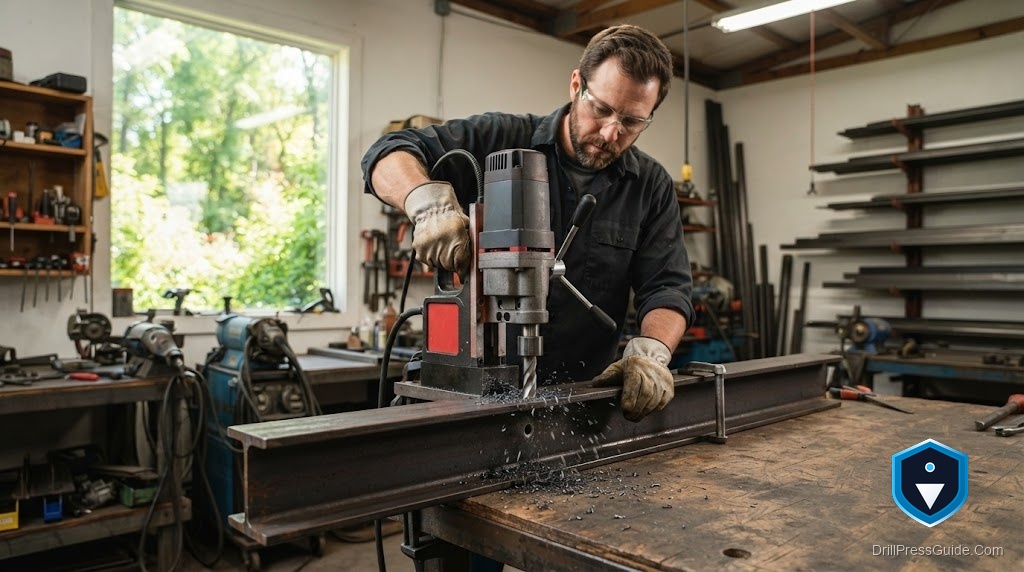
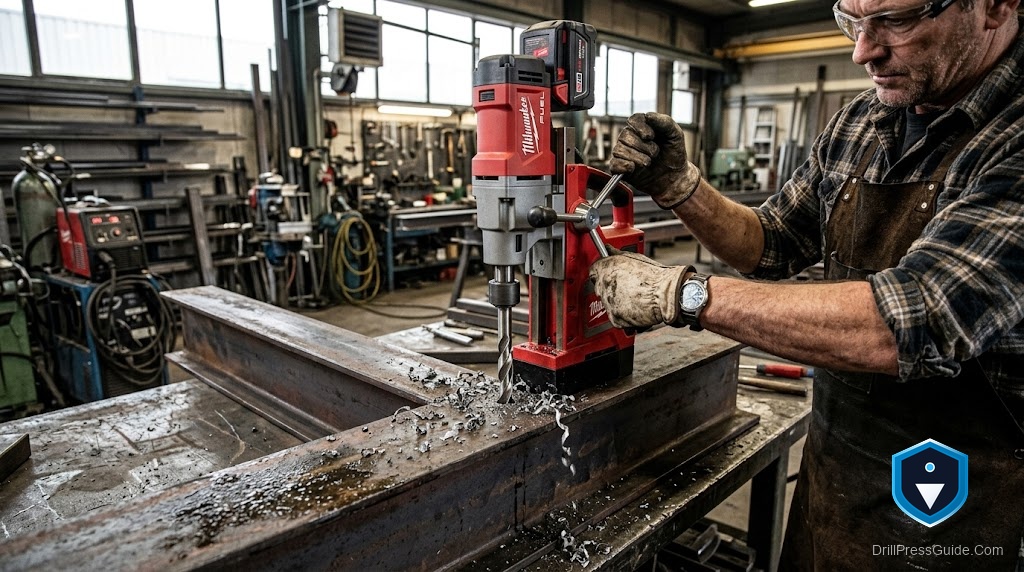
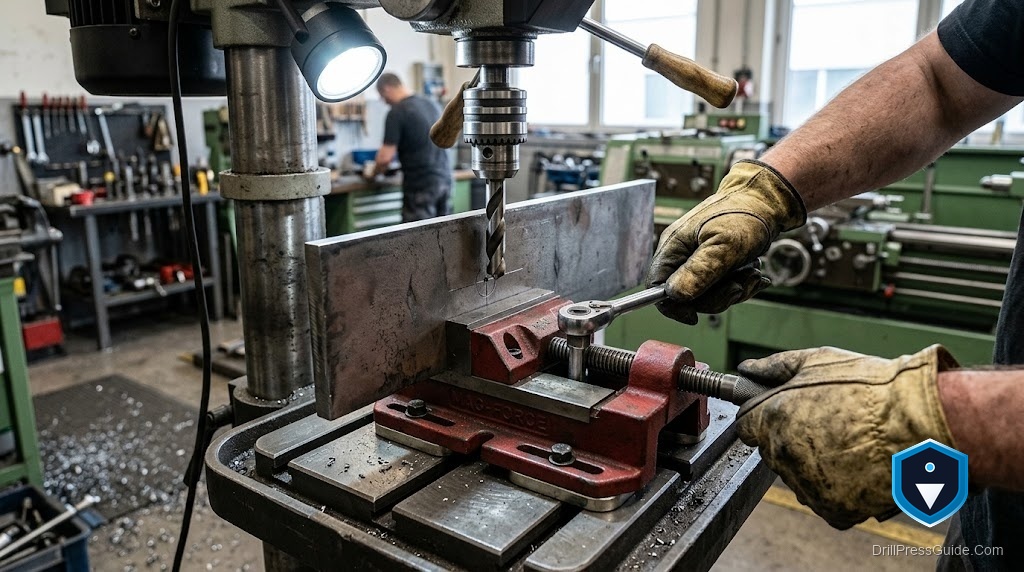
Let me untangle it. A drill press vise is a clamp with two jaws that holds your workpiece on a drill press table. A magnetic base is a separate device that uses magnets to lock something to a steel surface. A magnetic drill, often called a mag drill, is a portable drilling machine with its own magnetic base that sticks to steel beams and plates. “Magnetic drill press vise” usually means one of two things: a magnetic mount that positions a normal vise on your drill press table, or someone conflating a mag drill with drill press workholding.
Short answer: for a standard drill press, you want a good vise, bolted or clamped to the table, and optionally a magnetic mount to reposition it quickly on a steel table. A true magnetic-base drilling machine is a different tool for steel fabrication in the field, not an accessory for your benchtop press.
Why a magnet alone is a poor way to hold work on a drill press
There is a reason machinists get twitchy about magnetic workholding on a drill press. Magnetic chucks shine on surface grinders, where all the cutting force pushes the work sideways and down against a stop, and the forces are gentle. Drilling is different. When the bit grabs, especially on breakthrough, it tries to spin the workpiece. A magnet resists lifting well, but it can let a part rotate under sudden torque. That is how a small plate becomes a spinning blade.
So the honest guidance is this: use a magnet to hold or position a vise, and use the vise to hold the workpiece. Do not rely on a bare magnet to be the only thing between a drill bit and a loose piece of steel.
The vises that do the real work
For most people, a solid cast iron vise bolted to the table is the answer, and it should be the first thing you buy.
The WEN Drill Press Vise, 4-Inch (DPA424) is the sensible starting point. The 4-inch jaws open a full 4 inches, the cast iron body damps vibration, and four onboard mounting slots let you bolt it straight to the table. The 1-inch throat depth is its limit: reach past an inch or so from the jaw face and the piece is unsupported, so this is a vise for smaller stock.
Step up in size with the Yost LDPV-6 Drill Press Vise, 6-Inch. The wider jaws grip larger workpieces and the slotted base makes positioning easy. It is a light-duty design, so treat it as a holder for wood, plastic, and light metal rather than a machinist’s vise for heavy milling-style loads. Owners note the mounting holes don’t always line up with every table’s slots, so plan to clamp it down if the bolt pattern doesn’t match.
When you need to move the workpiece precisely between holes, a cross-slide vise changes the game. The Wilton Cross-Slide Drill Press Vise (Model CS4) shifts the work in X and Y with dial knobs, so you can drill a row of accurately spaced holes without unclamping and re-measuring. The fine-grain cast iron and hardened V-groove jaws hold round stock too. The trade is stiffness: any cross-slide has more moving parts than a fixed vise, so it flexes more under heavy cuts, and it is aimed at careful positioning rather than brute holding.
Where the magnet actually belongs
If your drill press table is steel and you want to reposition a vise fast without chasing bolts, the Magswitch Drill Press Vise Mount is the closest thing to a genuine magnetic drill press vise setup. It uses switchable magnets to lock a vise to the table, then releases so you can slide and re-lock it. This is the real, honest use of magnetism here: holding the vise, not the workpiece. Its limits are clear. It needs a ferrous (steel or cast iron) table to grip.
The tool people are actually thinking of: a mag drill
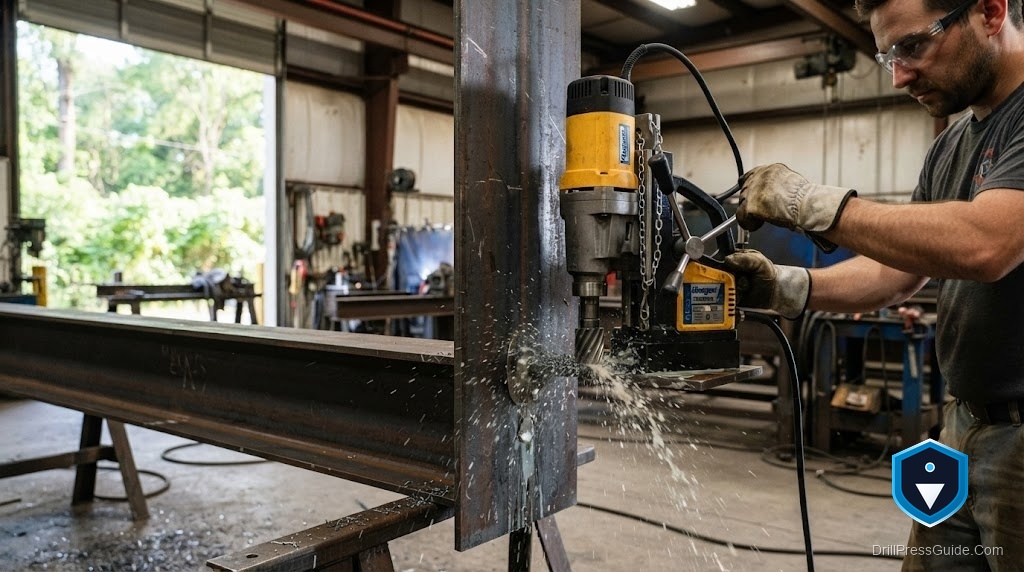
If your work is structural steel, beams, or thick plate out in the field, you are not looking for a drill press accessory at all. You want a mag drill, a portable drilling machine with an electromagnetic base that clamps itself to steel so you can drill overhead or on a vertical face.
Something like the EUROBOOR Magnetic Drill Press (ECO.36+) shows the category: an electromagnetic base with strong holding force, a motor tuned for steel, and a spindle built to run annular cutters rather than twist bits. Annular cutters need a specific holder, often a 3/4-inch Weldon arbor, and a pilot pin to eject the slug. A set like the S&F STEAD & FAST Annular Cutter Set with Pilot Pins is what feeds a mag drill.
These machines are far more tool than a benchtop drill press owner needs, and they carry real responsibilities: the ferrous stock has to be thick enough for the magnet to hold, you use a safety strap in case the magnet lets go, and you flood the cut with cutting fluid, often with a drip loop so it reaches the cutter.
Setup, whichever route you take
- Bolt or clamp the vise to the table. A vise that holds the part but slides freely itself is still a hazard.
- Center the workpiece under the bit and mark it. Use the vise jaws to grip on the flats, and V-grooves for round stock.
- Set the depth stop so the bit clears the vise body and the table.
- Eye protection on, chips managed. Metal throws hot swarf. Clear it with a brush after the spindle stops, never a bare hand and never while running.
FAQ
Is there really such a thing as a magnetic drill press vise? Not as a single product. The term blends two ideas: a magnetic mount that locks a normal vise to a steel table, and a mag drill, which is a separate portable machine. For a standard drill press, buy a vise and, if you want, a magnetic mount to reposition it.
Can I hold my workpiece with just a magnet on a drill press? It is risky. Magnets resist lifting but can let a part spin when the bit grabs, especially on breakthrough. Use a magnet to hold or position a vise, and let the vise grip the workpiece.
What size drill press vise should I get? A 4-inch vise suits most small parts, while a 6-inch handles wider stock. Check the throat depth too, since a shallow throat leaves parts unsupported far from the jaws.
What is the difference between a mag drill and a drill press? A drill press is a stationary machine you bring work to. A mag drill is portable and clamps itself to steel with a magnetic base so you can drill beams and plates in place, usually with annular cutters rather than twist bits.
What is a cross-slide vise good for? Precise, repeatable hole spacing. It moves the workpiece in two directions with dial knobs, so you can drill a row of holes without unclamping and re-measuring. It flexes more than a fixed vise, so it is best for positioning rather than heavy cuts.
References
- WEN Drill Press Vise 4-Inch (DPA424): Check on Amazon
- Yost LDPV-6 Drill Press Vise 6-Inch: Check on Amazon
- Wilton Cross-Slide Drill Press Vise CS4: Check on Amazon
- Magswitch Drill Press Vise Mount: Check on Amazon