Milwaukee Electromagnetic Drill Press 4202 Manual: Setup and Reference Guide

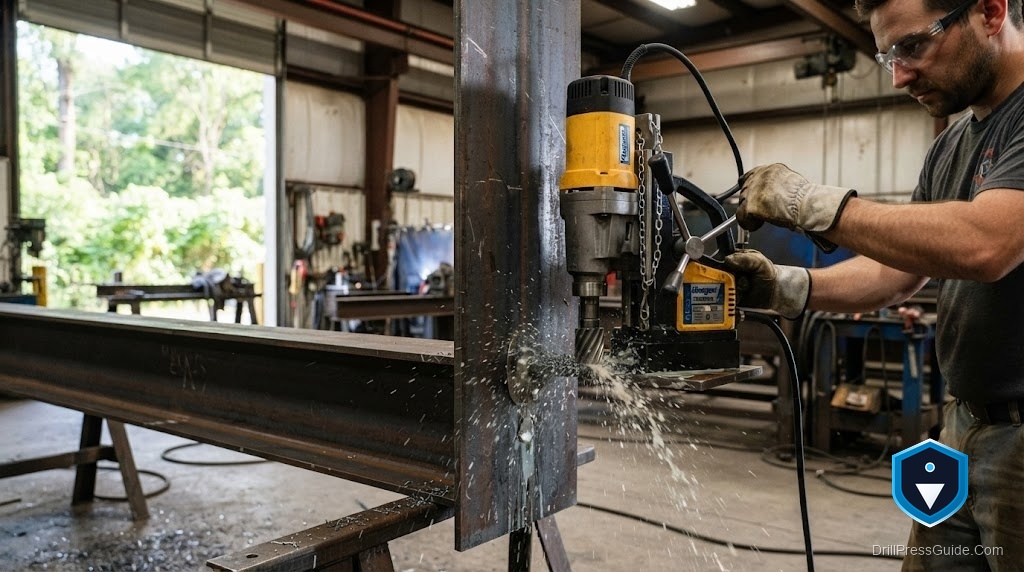
I still remember the first time I watched a mag drill grab a steel beam like a limpet and core a clean hole in seconds. No clamping, no bolting to a table — just magnetic force doing work that a benchtop drill press could never touch. If you’ve got a Milwaukee 4202 and you’re wrestling with the manual, or you’ve inherited this beast without documentation, this guide is what you actually need.
What the Milwaukee 4202 Actually Is
The Milwaukee 4202 is not a benchtop drill press. It’s a magnetic drill press — a “mag drill” — built to clamp magnetically to ferrous metal surfaces like steel beams, plates, and columns.
It runs on 120V AC, draws up to 12.5 amps, and gives you 9 inches of drill travel. The electromagnetic base locks to any flat ferrous stock that’s ½ inch or thicker.
The 4202 at a glance:
- 120V AC only, 12.5A max
- 9-inch drill travel
- Fixed-position, variable-speed base
- Works on flat ferrous material ½” and thicker
- Solid-state electronic switching
- Motor/magnet lockout to prevent de-mag during operation
- Feedback speed control for consistent RPM under load
The official manual is available directly from Milwaukee at milwaukeetool.com and as a free PDF from ManualsLib.
How Mag Drills Work vs. Standard Drill Presses
A standard benchtop drill press bolts to a table and uses a fixed spindle you lower by hand. The workpiece comes to the tool. A mag drill flips that relationship entirely: the tool clamps to the workpiece. You can use it on a horizontal steel plate on the floor, a vertical beam mid-air on a construction site, or overhead on a structural member.
The 4202 uses an electromagnetic base powered by AC. The motor/magnet interlock means the drill will not run unless the magnet is fully engaged.
What the 4202 will NOT attach to:
- Non-magnetic stainless steel grades
- Aluminum, brass, or any non-ferrous metal
- Ferrous material thinner than ½”
- Curved surfaces
Getting the Manual: Where to Find It
- Milwaukee’s official site: milwaukeetool.com
- ManualsLib: Search “Milwaukee 4202” at manualslib.com
- Milwaukee documents CDN: The parts list PDF for the 4202 base is
54-46-2229.pdf
Step-by-Step Setup on Ferrous Stock
1. Prepare the Surface
Clean the contact surface before engaging the magnet. Paint, rust, mill scale, chips, and burrs all reduce holding power dramatically. Use a wire brush or grinder to expose bare metal.
2. Choose the Right Motor
The 4202 base ships alone. Milwaukee offers four compatible drill motors:
| Motor | Amps | No-Load RPM | Chuck |
|---|---|---|---|
| 4253-1 | 6.2A | 600 | ½” keyed chuck |
| 4262-1 | 11.5A | 350 | ¾” chuck |
| 4292-1 | 11.5A | 750/375 (2-speed) | No. 3 Morse Taper |
| 4297-1 | 11.5A | 500/250 (2-speed) | No. 3 Morse Taper |
3. Position the Tool
Place the 4202 on the prepared ferrous surface with the cutting tool centered over your mark.
4. Engage the Magnet
Press the MAGNET button. The button will illuminate. The magnet interlock means you cannot start the drill motor until the magnet is engaged — if the drill won’t start, check the magnet indicator first.
5. Safety Chain — Non-Negotiable
Always attach the safety chain before drilling vertically or overhead. The 4202 ships with a 6-foot safety chain. If power is interrupted, the magnet releases — the safety chain is the only thing stopping a 41-pound machine from falling.
6. Set Speed and Drill
Engage the FWD button to start the motor. Use the speed dial to set RPM.
Annular Cutters vs. Twist Drills
Annular cutters cut only the annulus of the hole, ejecting a solid slug. They’re dramatically faster in steel than twist drills, produce cleaner holes with no pilot required, and generate far less heat. Milwaukee’s HSS annular cutter line is available directly from milwaukeetool.com.
Twist drills work fine with the appropriate motor and chuck, but for production drilling in steel plate, annular cutters will save you time and tooling costs.
Cutting Fluid: Required, Not Optional
Apply cutting fluid directly to the cutter with a brush or through the pilot pin hole on annular cutters. Reapply every 15–20 seconds during deep cuts.
Do not use cutting fluid in overhead positions — it will travel down the cord and create a shock hazard. The manual calls this out explicitly.
Comparison: 4202 Fixed vs. 4203 Adjustable
| Feature | 4202 | 4203 |
|---|---|---|
| Position | Fixed | Adjustable |
| Drill travel | 9” | 11” |
| Base weight | 41 lbs | 49 lbs |
| Lateral adjustment | None | ¾” front-to-back |
| Angular adjustment | None | ±20° left/right |
| Best for | Production drilling, fixed setups | Complex layout, tight alignment |
Verdict
The Milwaukee 4202 is a production workhorse. The manual earns its length — the safety chain section alone is critical reading. Get the official PDF from milwaukeetool.com, read the safety section before you do anything else, and confirm your contact surface is clean and ferrous before engaging the magnet.
FAQ
Q: Where can I download the Milwaukee 4202 manual for free? Directly from Milwaukee at milwaukeetool.com/Support/Manuals-and-Downloads or from ManualsLib.com.
Q: What motors are compatible with the 4202 base? The 4253-1, 4262-1, 4292-1, and 4297-1.
Q: Can I use the 4202 on aluminum or stainless steel? No. The electromagnetic base will not hold on non-ferrous materials or non-magnetic grades of stainless steel.
Q: Do I have to use the safety chain on flat horizontal surfaces? Mandatory on vertical and overhead surfaces. Strongly recommended on horizontal as a precaution against power interruptions.
Q: Can I use annular cutters with the 4202? Yes — it’s the intended use. You need the correct arbor for your motor’s chuck style.
Q: What does the motor/magnet interlock do? Prevents the drill motor from operating unless the electromagnetic base is fully engaged.
Q: Can I switch from forward to reverse while the drill is spinning? Yes — the 4202 features electronic switching that allows direction changes without stopping the motor first.
Q: Where do I find replacement parts for the 4202 base? The parts list (document 54-46-2229) is available at milwaukeetool.com.
Q: My 4202 won’t hold on a steel surface. What’s wrong? Check three things: surface cleanliness (paint, scale, or debris reduces holding force), material thickness (below ½” won’t achieve rated hold), and whether the material is non-magnetic stainless steel.
Q: What’s the maximum steel thickness I can drill with the 4202? Maximum hole capacity depends on the drill motor: ½” for the 4253-1 up to 1¼” for the 4292-1 and 4297-1.
References
- Milwaukee Tool 4202 Product Page: https://www.milwaukeetool.com/products/details/electromagnetic-drill-press-base-fixed-position/4202
- Milwaukee Tool Manuals & Downloads: https://www.milwaukeetool.com/Support/Manuals-and-Downloads?search=4202
- Milwaukee 4202 Parts List (document 54-46-2229): https://documents.milwaukeetool.com/54-46-2229.pdf
- Milwaukee Annular Cutters: https://www.milwaukeetool.com/products/accessories/metal-drilling/annular-cutters