Which VEVOR Magnetic Drill Press Belongs in Your Shop?
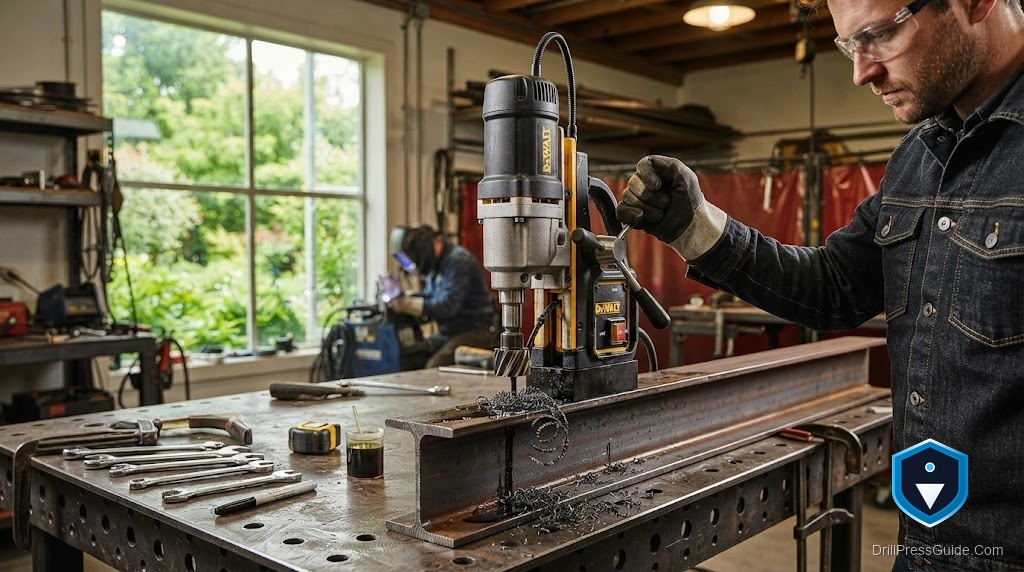
Picture a steel beam clamped waist-high, twelve bolt holes to cut, and a hand drill that keeps wandering off your center punch. Now picture a heavy little machine that clamps itself to the steel with a magnet, sinks a clean 1-inch hole in under a minute, and holds dead still while it does it. That’s the pitch for a VEVOR magnetic drill press, and for a lot of fabricators the surprise is how much of that pitch actually holds up in a value tool.
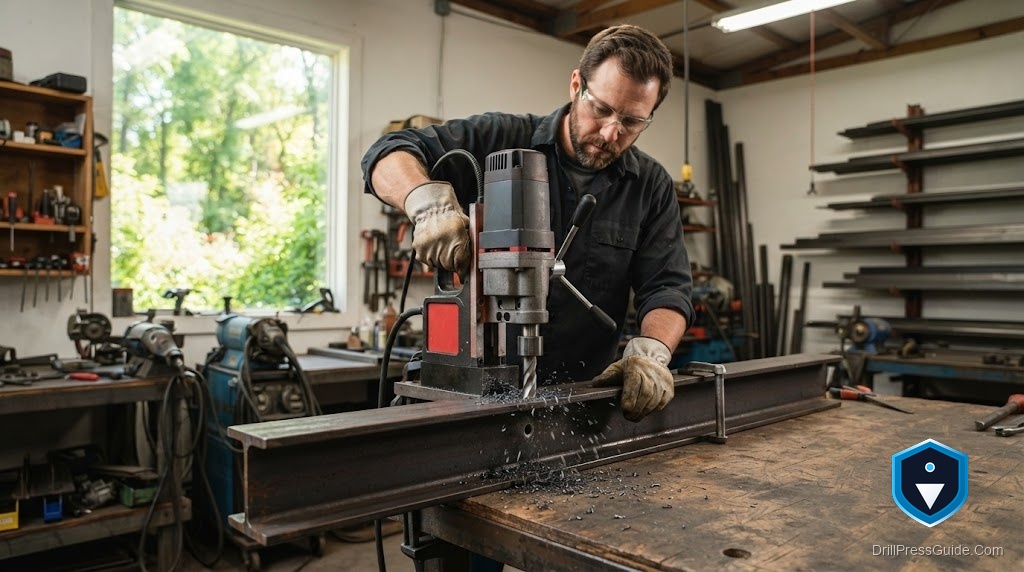
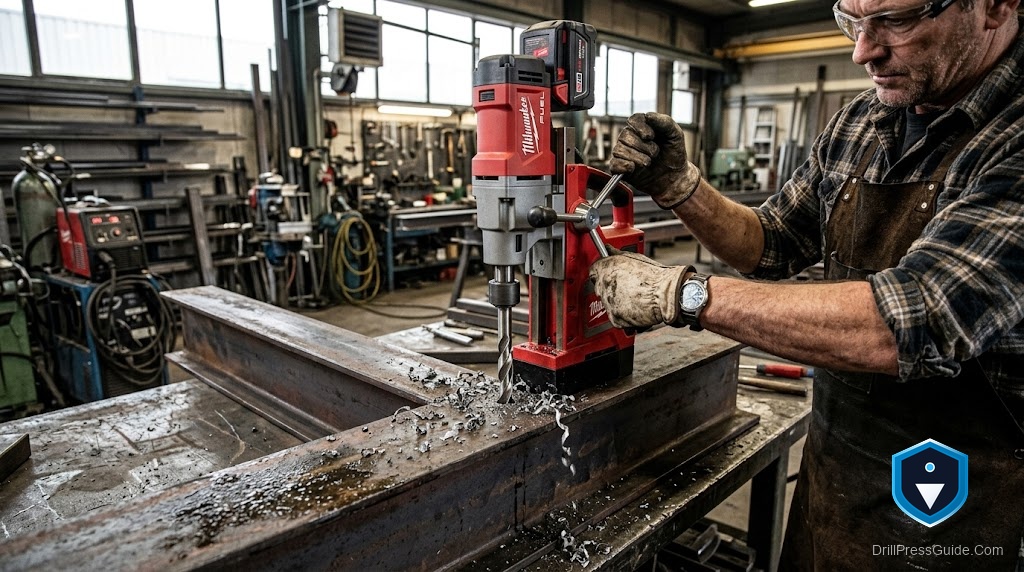
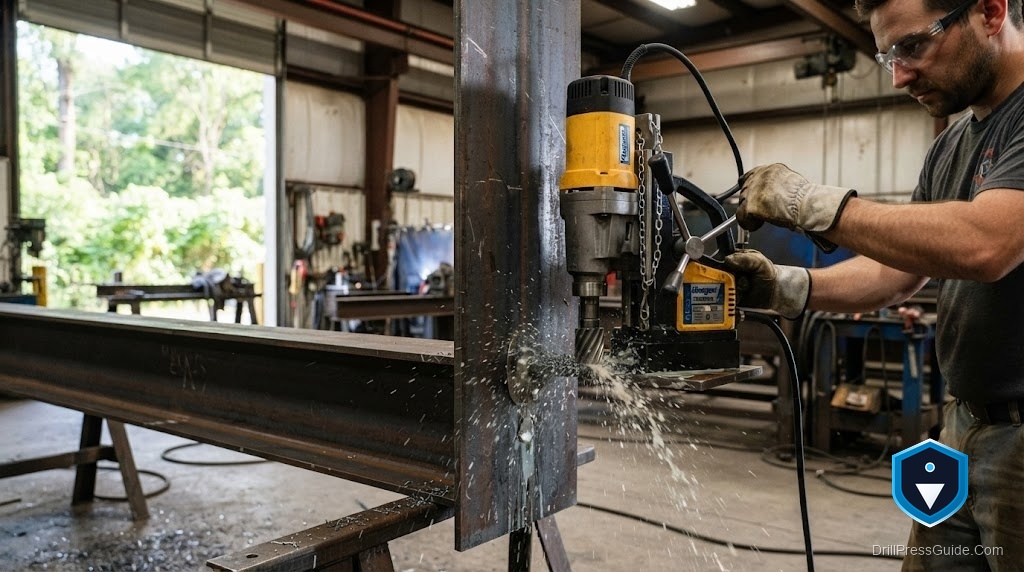
A magnetic drill, or mag drill, is a portable drill with an electromagnetic base. Flip the magnet on and it locks to any flat steel surface, vertical or overhead, so the tool provides the downforce instead of your arms. Most mag drills run annular cutters, which are hollow, ring-shaped bits that only cut the edge of the hole and leave a solid slug behind, so they clear big holes in steel far faster than a twist bit.
Here’s the direct answer on VEVOR. Their mag drills are honest value tools that pick by two numbers: boring diameter (the biggest annular cutter they’ll swing) and speed. For occasional steel work and light fabrication, a VEVOR is a lot of capability in one package. For daily professional use, a Milwaukee or Hougen still holds a clear edge in speed control and durability, and it’s fair to think of VEVOR as the tool you buy first and those two as what you graduate to.
VEVOR’s lineup, sorted by hole size
VEVOR sells several mag drills, and the model names roughly track their maximum boring diameter.
The MD40 is the smaller unit, with a 1100W motor, a 1-1/2-inch (40mm) maximum boring diameter, roughly 2810 pounds of magnetic hold, and a single speed near 670 RPM, usually packed with a 6-piece HSS annular cutter set.
The VEVOR 1300W mag drill sits in the middle, cutting up to about 1.57 inches across and 2 inches deep at 810 RPM, with 2922 lbf (13,000 N) of electromagnet force and an 11-piece bit set.
The MD50 class tops the range at a 2-inch (50mm) boring diameter. The VEVOR 1550W 2-inch mag drill and the stepless-speed VEVOR 1680W MD50 both push the same 13,000 N hold. The 1680W version is the interesting one, because its 0 to 300 RPM stepless dial lets you slow down for a big 2-inch cutter, which the fixed-speed models can’t.
The numbers that decide the buy
Four specs matter on a mag drill, and skipping any of them leads to a bad purchase.
Boring diameter is the biggest annular cutter the machine will hold and drive. Buy for the largest hole you actually cut, not the largest you can imagine.
Speed matters more than beginners expect. Big cutters need slow RPM. A 2-inch annular cutter wants to spin somewhere near 200 RPM, so a machine locked at 500 to 850 RPM is fighting itself at the top of its range. That’s why the stepless 1680W is the smarter pick if you plan to run 2-inch cutters often.
Magnetic force, listed around 2900 lbf or 13,000 N on VEVOR’s mid and large units, is what keeps the tool from tearing loose under cutting load. It relies on clean, flat, thick steel. On thin or painted stock, real hold drops well below the rated number.
Travel, near 8 inches on the MD50 units, is how far the motor carriage slides down the frame, and it sets how deep and how flexibly you can position a cut.
The honest flaws
I won’t pretend these are pro machines. The most common complaint, echoed by owners across forums, is the coolant system: the flow is weak, and you often end up brushing cutting fluid onto the cutter by hand to keep it alive. That’s a real annoyance on a long job and it shortens cutter life if you ignore it.
Fixed-speed VEVOR models are also too fast for their own biggest cutters, as noted above. And some VEVOR units use a sliding motor carriage rather than a true quill feed, which feels less refined than a Milwaukee’s feed handle. Finally, at the weight these carry, they’re a two-hand lift onto a beam, so plan your setup and always use the safety strap.
VEVOR vs WEN, and vs Milwaukee and Hougen
People searching “VEVOR vs WEN drill press” are often comparing two different tools. A WEN is a benchtop or floor drill press that sits in one spot and drills parts you bring to it. A VEVOR mag drill goes to the work and clamps to steel in place. If your holes come to you, buy a WEN. If you go to your holes, buy the mag drill. VEVOR also makes a 12-inch benchtop drill press, which is a stationary tool and not the same thing as its mag drills, so don’t cross-shop those two by name alone.
Against the pros, the gap is about control and life span. The Milwaukee 4272-21 electromagnetic drill runs a 13-amp motor with a two-speed gearbox (475 RPM for annular cutters, 730 for twist bits), auto-stop lift detection, and a 1-5/8-inch cutter capacity. Hougen’s portable mag drills, built in the USA, are known for tight speed matching and long service life, and Hougen’s own guide is the plain-language reference for cutters, coolant, and safety. VEVOR doesn’t match their refinement, but it does cover the same core job for far less, which is the whole point.
Cutters, pilot pins, and accessories
VEVOR mag drills use HSS annular cutters with a Weldon shank, held by set screws, with a pilot pin that centers the cut and ejects the slug at the end. Keep the pilot pin in and let coolant reach the teeth, and the cutters last far longer.
Two accessory questions come up often. A mag drill does not use a drill press vise; the magnet is the clamp, and a vise belongs on a stationary bench press. Same for a mortising attachment, which is a woodworking add-on for a benchtop drill press, not something a mag drill accepts. If you need mortising or vise work, that’s a benchtop-press job.
Who should buy a VEVOR mag drill
Buy one if you drill structural steel, do on-site fabrication, build trailers or frames, or handle repair work where the steel can’t move. For those jobs, even the mid 1300W unit changes how you work.
Skip it if your steel is small enough to bring to a bench press, or if you’re cutting holes all day every day for a living, where a pro machine’s speed control and durability pay for themselves.
The verdict
A VEVOR magnetic drill press is a genuinely good value for occasional and light-professional steel work. It cuts real holes, holds hard on clean steel, and delivers most of what the name brands do. Its weak coolant flow and fast fixed speeds are the trade-offs you accept for that value.
Concrete takeaways:
- Choose by boring diameter first, then by speed. If you’ll run 2-inch cutters, get the stepless 1680W MD50, not a fixed-speed model.
- Magnetic hold depends on clean, flat, thick steel. Always rig the safety strap, especially overhead.
- Expect to help the coolant along by hand, and keep the pilot pin and fluid on the cutter to protect it.
- A VEVOR is the buy-first tool. If you cut holes for a living, plan to step up to a Milwaukee or Hougen.
FAQ
What size holes can a VEVOR magnetic drill press cut? It depends on the model. The MD40 tops out near a 1-1/2-inch (40mm) boring diameter, while the MD50 class reaches 2 inches (50mm) with annular cutters.
Why does my VEVOR mag drill spin too fast for a big cutter? Fixed-speed models run around 500 to 850 RPM, which is faster than a 2-inch cutter likes. The stepless 1680W model solves this with a 0 to 300 RPM dial for large cutters.
How strong is the magnet, really? VEVOR’s mid and large units list about 2900 lbf (13,000 N). That figure assumes clean, flat steel at least about 1/4 inch thick. Thin, rusty, or painted steel reduces the hold, so use the safety strap.
Is the coolant system any good? It works but flows weakly. Many owners add cutting fluid to the cutter by hand during the cut. Doing so also extends cutter life.
Can I use a drill press vise or mortising attachment with a mag drill? No. The magnet is the clamp, so there’s no vise, and mortising attachments are for woodworking benchtop presses. Those belong on a stationary drill press.
VEVOR vs WEN, which should I buy? Different tools. A WEN benchtop or floor press drills parts you bring to it. A VEVOR mag drill clamps to steel in place. Pick based on whether the work comes to you or you go to the work.
What cutters fit a VEVOR mag drill? HSS annular cutters with a Weldon shank, secured by set screws with a pilot pin. Common sets run from about 9/16 inch up to 2 inches in diameter with a 2-inch cutting depth.
How does VEVOR compare to Milwaukee? The Milwaukee 4272-21 offers a two-speed gearbox, auto-stop lift detection, and pro-grade durability. VEVOR covers the same basic hole-cutting job for far less money, with less speed control and a shorter expected life.
References
- VEVOR, MD40 Magnetic Drill Press product page: https://www.vevor.com/magnetic-drill-c_11000/md40-magnetic-drill-press-7pc-1-hss-cutter-set-annular-cutter-kit-mag-drill-p_010343839784
- Milwaukee Tool, 1-5/8-inch Electromagnetic Drill Kit (4272-21): https://www.milwaukeetool.com/products/details/1-5-8-electromagnetic-drill-kit/4272-21
- Hougen, HMD904 Magnetic Drill specifications: https://hougen.com/product-hmd904-magnetic-drill/
- CCOHS, Metalworking Machines: Drill Presses: https://www.ccohs.ca/oshanswers/safety_haz/metalworking/drillpresses.html