Magnetic Light for Drill Press: What It Is, Where It Fits, and What to Check
You line up a hole, lower the bit, and your own hand throws a shadow right across the mark. Every drill press owner has fought this, squinting past the chuck at a layout line that disappears the moment the quill comes down. A magnetic work light fixes it for the cost of a nice lunch, and it is one of the few shop upgrades that pays off the very first time you switch it on.
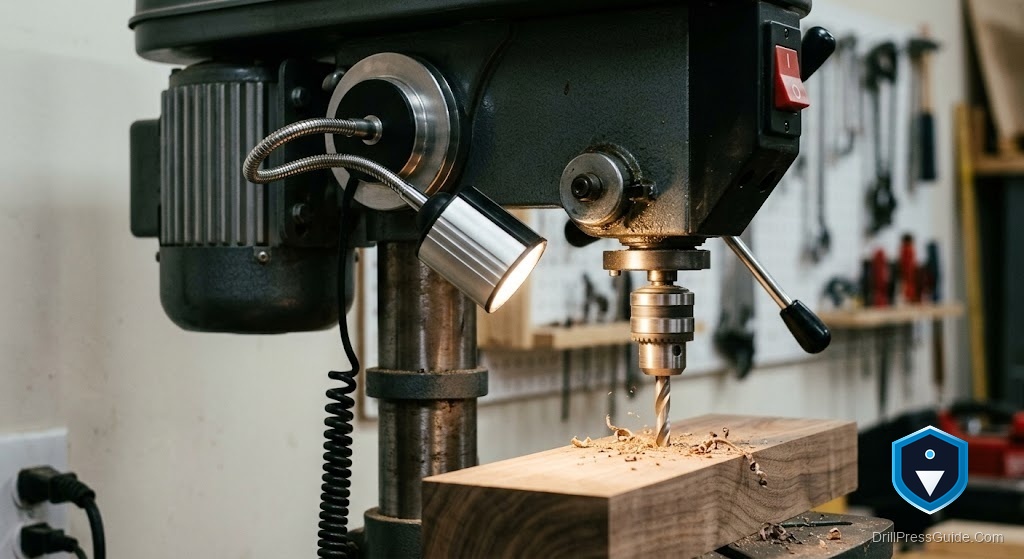
A magnetic light for a drill press is a small LED work lamp on a flexible gooseneck with a strong magnetic base, so it clamps to any steel surface on the machine, the head, the column, the table, and bends to throw light exactly where the bit meets the work. It is an add-on, not a built-in feature, which is why it fits almost any drill press regardless of age or brand.
Short answer: yes, get one, and choose it on three things. A strong magnetic base that actually stays put, a gooseneck long and stiff enough to hold a position, and enough brightness in a daylight color to kill shadows without glare. Everything else is preference.
Why the magnetic base is the whole point
The magnet is what makes this light better than a clamp lamp. A drill press is almost all steel, so a magnetic base sticks anywhere on it, and you can move the light in seconds when a tall workpiece or a fence gets in the way. The trade is that a weak magnet creeps under vibration, and a light that slowly droops mid-cut is worse than no light. Look for a base that grips hard and a flat magnet face that sits solidly on the head casting or column. If the light drifts when the machine runs, the magnet is too weak for the job.
Gooseneck, brightness, and color
The gooseneck decides whether the light stays where you point it. A short or floppy neck sags, so you want one long enough to reach over the chuck and stiff enough to hold that reach without nodding. For brightness, more lumens help, but placement matters more than raw output; a moderate light aimed right beats a bright one throwing glare into your eyes. A daylight or neutral white color, around 4000K to 6000K, shows layout lines and grain better than a warm yellow. And confirm the voltage suits your outlet, since some machine lights are wired for 110 to 120 volt shop use and others run on low-voltage adapters.
Options worth a look
For a simple, flexible fix, the POWKER 30 LED magnetic mount work light uses a bank of LEDs on a bendable gooseneck with a magnetic base, and it is the kind of light that suits a drill press, a lathe, or a bench equally. It is bright enough for close work and easy to reposition, though the lightweight magnet is best on a solid steel surface rather than a thin bracket, where it can nudge loose under heavy vibration.
If you want more output for a machine that lives in a dim corner, a higher-lumen gooseneck lamp like this magnetic machine light with a stronger base puts out around 500 lumens on a stiff 300mm neck and is built for shop voltage. It costs you a bit of flexibility because the heavier head needs the sturdier magnet to stay put, but for pure shadow-killing brightness over the chuck it does the job. Between the two, pick the first for easy repositioning and the second for a machine you can barely see at.
Setting it up so it stays put
Wipe the mounting spot clean, because chips and oil weaken the grip. Set the magnet on a flat steel surface high on the head or column so the light aims down at the bit, not across it. Bend the gooseneck so the beam hits just in front of the chuck, which lights the layout line without blinding you. Then run the machine for a few seconds and watch the light; if it walks, move it to a flatter, thicker surface or step up to a stronger base. A light that holds through vibration is a light you forget about, which is exactly what you want.
Conclusion
A magnetic light for a drill press is the rare upgrade that is cheap, universal, and useful the first time you use it. The magnet is the feature that matters most, because a base that drifts undoes everything else, so buy grip first, then a gooseneck stiff enough to hold a position, then enough daylight-colored output to erase shadows. The POWKER 30 LED light is the easy, reposition-anywhere choice, and a higher-lumen shop lamp is the move for a machine in a dark corner. Mount it clean, aim it just ahead of the chuck, and you will wonder how you drilled without it.
Frequently asked questions
Will a magnetic light stick to any drill press? Yes, as long as the surface is steel, which covers almost every drill press head, column, and table. The stronger the magnet, the better it holds through vibration.
How bright should a drill press work light be? Bright enough to erase shadows over the bit without glare. Aim matters more than raw lumens, but a few hundred lumens in a daylight color suits most shops.
What color temperature is best for a shop light? A neutral to daylight white, roughly 4000K to 6000K, shows layout lines and material better than a warm yellow light.
Why does my magnetic light droop when the machine runs? The magnet is too weak for the surface or the gooseneck is too soft. Move it to a flatter, thicker steel surface or choose a light with a stronger base and stiffer neck.
Can I use a magnetic light on a lathe or bandsaw too? Yes. A gooseneck magnetic work light works on any steel machine, which is part of why it is such a practical buy.
Do these lights need special wiring? Check the voltage. Some run on standard 110 to 120 volt shop power, others use a low-voltage adapter. Match it to your outlet before buying.
References
- OSHA, Machine Guarding eTool: Drill Presses, osha.gov
- Illuminating Engineering Society, workplace task lighting guidance, ies.org