Magnetic Base Drill Press: What It Is, Where It Fits, and What to Check

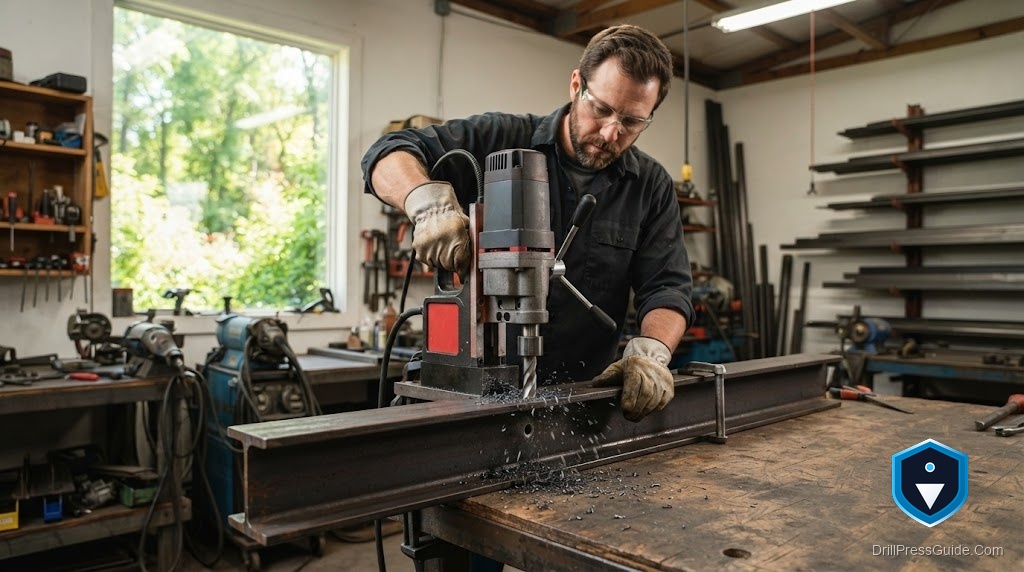
A magnetic base drill press does not sit on a bench. It clings to steel like a magnet to a refrigerator, except the magnet is strong enough to hold a drilling motor steady while it bores a 2-inch hole through I-beam. If you have ever tried to drill a straight hole in vertical steel with a hand drill, you already know why these machines exist. The bit walks, your shoulder burns, and the hole looks like it was made by a nervous woodpecker.
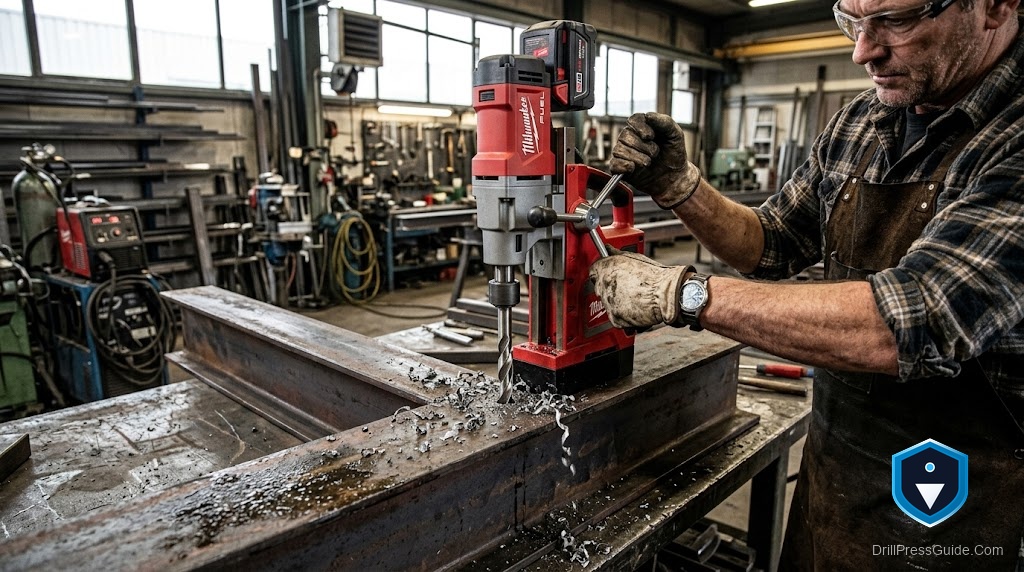
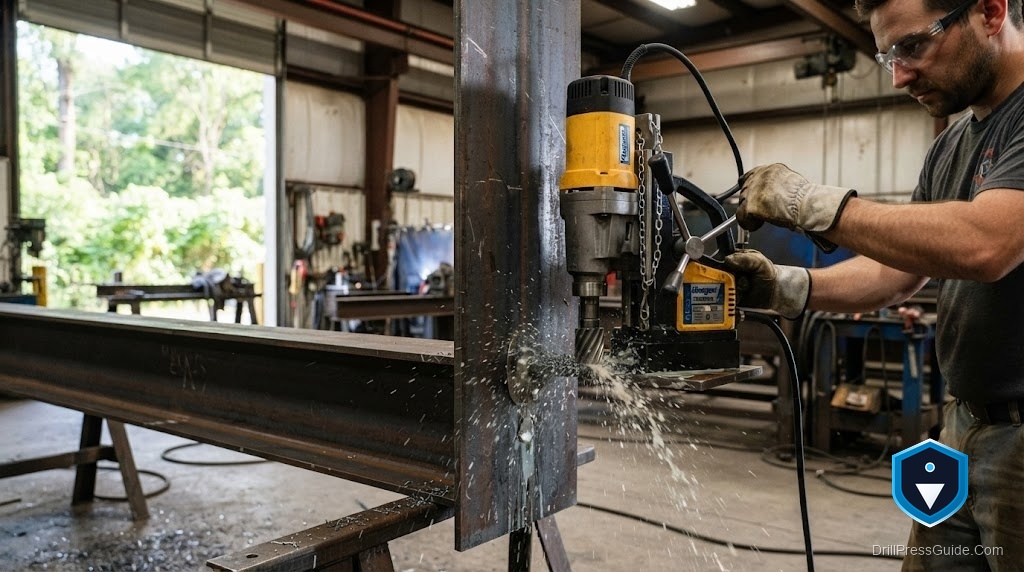
A magnetic base drill press is a portable drilling machine that uses a powerful electromagnet or permanent magnet to lock onto ferrous metal surfaces. The magnet base lets you drill horizontally, vertically, or overhead without clamping the workpiece to a table. You see them on construction sites, in shipyards, and in fabrication shops where the work is too large to move to a benchtop press.
The core question most people ask is whether a magnetic drill press is worth buying over a standard bench model. The answer depends on what you drill and where you drill it. If your work involves steel beams, truck frames, or large structural pieces that cannot be moved, a magnetic base drill press is the right tool. If you mostly drill wood or small metal pieces on a workbench, a standard drill press is the better fit.
How a Magnetic Drill Press Actually Works
The base contains either an electromagnet or a permanent magnet. Electromagnetic models need power to engage the magnet; permanent magnet models use a mechanical switch to activate the magnetic field. When engaged, the base clamps to flat steel with enough force to resist the torque and thrust of drilling.
The motor sits on top of a column that slides up and down. You feed the drill bit into the workpiece by turning a handle that lowers the quill. Most magnetic drill presses use annular cutters, which are ring-shaped bits that cut only the perimeter of the hole, leaving a slug in the center. This requires less horsepower than a twist drill of the same diameter and produces a cleaner hole.
Some models also accept a chuck adapter for standard twist drill bits. The chuck adapter fits into the arbor and lets you use the same bits you already own. If you need to switch between annular cutters and twist drills, look for a model that includes both a Weldon arbor and a chuck adapter.
Where Magnetic Drill Presses Earn Their Keep
Structural steel fabrication is the obvious home for these tools. If you are drilling bolt holes in steel plate, angle iron, or I-beams, a magnetic drill press lets you take the tool to the work instead of wrestling the work onto a bench. Bridge construction, ship repair, and truck bed modification all benefit from this portability.
Metalworking shops that build custom frames, trailers, or machinery also reach for mag drills when the workpiece is too bulky for the shop drill press. Even a heavy floor-standing drill press has limits on throat depth and table size. A magnetic drill press has no throat depth limit because the workpiece itself becomes the table.
Overhead drilling is another scenario where mag drills shine. Drilling upward into a steel ceiling or beam with a hand drill is awkward and inaccurate. A magnetic drill press locks to the underside of the beam and gives you controlled, straight holes without the gymnastics.
Our Top Picks for Magnetic Base Drill Presses
ZELCAN 1550W Magnetic Drill Press
The ZELCAN 1550W Magnetic Drill Press comes with six core drill bits and a motor rated at 1550 watts. It drills up to 2 inches in diameter and 2 inches deep, with a stepless speed range from 0 to 580 RPM. The electromagnet generates 2922 pounds of force, which is enough to keep the machine planted on thick steel plate while you drill.
What stands out is the reversible motor direction. If an annular cutter binds, you can reverse the motor to back the bit out without breaking the cutter or the arbor. The included core drill bits are a genuine convenience because quality annular cutters are not cheap, and buying them separately adds to the cost of entry.
The honest flaw is the weight. At roughly 39 pounds, this is not a tool you casually carry up a ladder one-handed. The case helps, but you will feel it at the end of a long day. If you need something lighter for occasional overhead work, this is not the right choice. It is built for shops and job sites where the work is heavy and the machine can sit on a cart between uses.
Who should skip it: hobbyists who drill metal only occasionally and do not need 2-inch capacity. For light home use, a benchtop drill press with a vise is more versatile and easier to store.
VEVOR 1450W Mag Drill Press
The VEVOR 1450W Mag Drill Press is similar in concept to the ZELCAN but with a slightly different feature set. The 1450-watt motor drives the spindle at 0 to 750 RPM, and the electromagnet produces 2922 pounds of holding force. It handles 2-inch diameter holes through 2-inch steel plate, which covers most structural drilling needs.
VEVOR includes six annular cutters in the kit, which is a solid value. The machine also has a stepless speed control, so you can dial in exactly the RPM you need for the cutter diameter and material thickness. This matters more than it sounds because running an annular cutter too fast burns the teeth and too slow stalls the motor.
The feed handle is positioned to give good leverage, but the handle itself is a single piece of steel with no ergonomic grip. After a few dozen holes, your hand will notice. It is a small detail, but it is the kind of detail that separates a tool you tolerate from a tool you enjoy using.
Who should skip it: anyone who needs to drill non-ferrous materials like aluminum or stainless steel with poor magnetic response. The magnet needs thick, flat steel to grip properly. Thin sheet metal or curved surfaces will not hold the machine securely.
DEWALT DWE1622K 2-Speed Magnetic Drill Press
DEWALT is a name most people know from cordless drills and job site radios. The DWE1622K is their entry into magnetic drilling, and it carries the same yellow-and-black DNA. The 10-amp motor has two fixed speeds rather than a stepless range, and it uses a 3/4-inch Weldon arbor for annular cutters. The kit includes a 5/8-inch by 2-inch HSS annular cutter.
The build quality is immediately noticeable. The castings are thicker, the switches feel industrial, and the magnet engagement is a two-button system that requires intentional action to activate. This is a safety feature, not a nuisance. A mag drill that falls off a vertical plate because someone bumped the switch is a dangerous thing.
The two-speed design is a limitation in some ways. You get either 300 or 450 RPM, which is fine for larger cutters but less flexible than a stepless machine when you need to run small-diameter holes or use a twist drill adapter. The DWE1622K is also heavier than the import options, which is good for stability but bad for portability.
Who should skip it: budget-conscious buyers or those who need a wide speed range. The DEWALT costs more than the ZELCAN or VEVOR, and you get fewer included accessories. You are paying for the brand reputation and the service network, which matters if you use the tool professionally and need warranty support.
Hougen HMD900 Magnetic Drill
The Hougen HMD900 is the established professional standard in a compact package. It is made in the USA, weighs 27.7 pounds, and drills holes from 7/16 inch to 1-1/2 inch in diameter up to 2 inches deep. The magnet is rated for 1952 pounds of dead lift on 1-inch plate, which is conservative compared to the import ratings but tested in real conditions.
Hougen invented the portable magnetic drill, and the HMD900 is the descendant of that original design. The 450 RPM single-speed motor is matched to Hougen’s own 12,000-series annular cutters and Copperhead carbide cutters. The integrated coolant system is a small detail that extends cutter life significantly when drilling thick steel.
The flaw is the price. This is not a hobbyist tool. It is built for ironworkers and fabricators who drill holes every day and need a machine that lasts years. The 1-1/2-inch maximum cutter diameter is also smaller than the 2-inch capacity of the ZELCAN and VEVOR, though 1-1/2 inches covers most structural bolt holes.
Who should skip it: anyone who drills metal less than once a week. The Hougen is overbuilt for occasional use, and the cost only makes sense if the tool earns its keep on a job site. For home shop use, the ZELCAN or VEVOR gives you 90 percent of the capability at a fraction of the price.
Comparison: Which Magnetic Drill Press Fits Your Work?
| Feature | ZELCAN 1550W | VEVOR 1450W | DEWALT DWE1622K | Hougen HMD900 |
|---|---|---|---|---|
| Motor | 1550W | 1450W | 10A (1200W) | 8A (1035W) |
| Max cutter diameter | 2 in | 2 in | 2 in | 1-1/2 in |
| Speed range | 0-580 RPM stepless | 0-750 RPM stepless | 300/450 RPM | 450 RPM |
| Magnet force | 2922 lbf | 2922 lbf | 2900 lbf | 1952 lbf |
| Weight | ~39 lb | ~39 lb | ~33 lb | 27.7 lb |
| Included cutters | 6 bits | 6 bits | 1 bit | None |
| Country of origin | China | China | China/USA | USA |
The ZELCAN and VEVOR are nearly identical on paper. Both offer 2-inch capacity, stepless speed, and included cutter sets. The ZELCAN has the reversible motor, which is a real advantage when cutters bind. The VEVOR has a slightly higher top speed, which helps with smaller cutters. For most buyers, the decision comes down to current pricing and which kit includes the cutter sizes you actually need.
The DEWALT sits in a different category. It is the choice for professionals who value warranty support and job site durability over raw specifications. The Hougen is the legacy pick for tradespeople who prioritize reliability and American manufacturing over the lowest cost.
Safety and Setup Tips for Magnetic Drill Presses
The magnet will not stick to aluminum, stainless steel, or painted steel with thick primer. Always test the surface before you engage the drill motor. Most machines have a lift-off detection circuit that shuts off the motor if the magnet loses grip, but you do not want to rely on it.
Use a safety strap. The safety strap is a nylon or chain tether that connects the drill press to the workpiece or structure. If the magnet fails or the workpiece shifts, the strap prevents the machine from falling. It is a simple piece of equipment that can save a toe or a floor.
Cutting fluid is not optional when drilling steel with annular cutters. The cutters generate heat at the cutting edge, and without lubrication, the teeth dull quickly. A spray bottle of cutting fluid or a stick lubricant applied to the cutter before each hole extends cutter life by a factor of three or more.
FAQ
Q: Will a magnetic drill press work on thin sheet metal?
A: No, not reliably. The magnet needs thick, flat steel to generate enough holding force. Thin sheet metal or curved surfaces will not provide sufficient grip. For thin material, clamp it to a thick steel backing plate or use a benchtop drill press.
Q: Can I use regular twist drill bits in a magnetic drill press?
A: Yes, if the machine has a chuck adapter. Most magnetic drill presses use a Weldon arbor for annular cutters. A chuck adapter converts the Weldon fitting to a standard keyed or keyless chuck for twist drills. Not all kits include the adapter, so check before you buy.
Q: What is the difference between an annular cutter and a twist drill?
A: An annular cutter is a ring-shaped bit that cuts only the perimeter of the hole, leaving a solid slug in the center. It requires less torque and produces a cleaner hole than a twist drill of the same diameter. Twist drills are the standard spiral bits most people recognize and are more versatile for smaller holes or non-ferrous materials.
Q: Do magnetic drill presses work on rusted or painted steel?
A: The magnet needs direct contact with bare steel. Thick paint, rust scale, or mill scale can reduce the magnetic grip significantly
Q: How do I know if a magnetic drill press is safe to use vertically?
A: Check the dead lift rating of the magnet and always use a safety strap. Test the magnet on a scrap piece of the same material before drilling the actual workpiece. If the machine feels loose or the magnet alarm sounds, do not start the drill motor.
Q: What maintenance does a magnetic drill press need?
A: Keep the magnet base clean of metal chips and debris. Chips trapped between the magnet and the workpiece create gaps that reduce holding force. Lubricate the quill and feed mechanism according to the manufacturer’s schedule. Inspect the power cord and safety strap before each use.
Q: Why is the magnet force rating lower on the Hougen than the imports?
A: Hougen rates their magnets using conservative, real-world testing conditions rather than theoretical maximums. The 1952-pound rating is what the magnet actually holds on 1-inch plate under load. Import ratings are often higher on paper but may not perform as reliably in the field.
References
- Hougen Manufacturing. HMD900 Econo Mag Drill Specifications. https://hougen.com/product-hmd900-magnetic-drill/
- DEWALT. DWE1622K Magnetic Drill Press Product Manual. https://www.dewalt.com/
- Occupational Safety and Health Administration. Drill Press Safety Guidelines. https://www.osha.gov/
SEO Metadata: