Magnetic Drill Press: Capacity, Setup, and Everyday Use
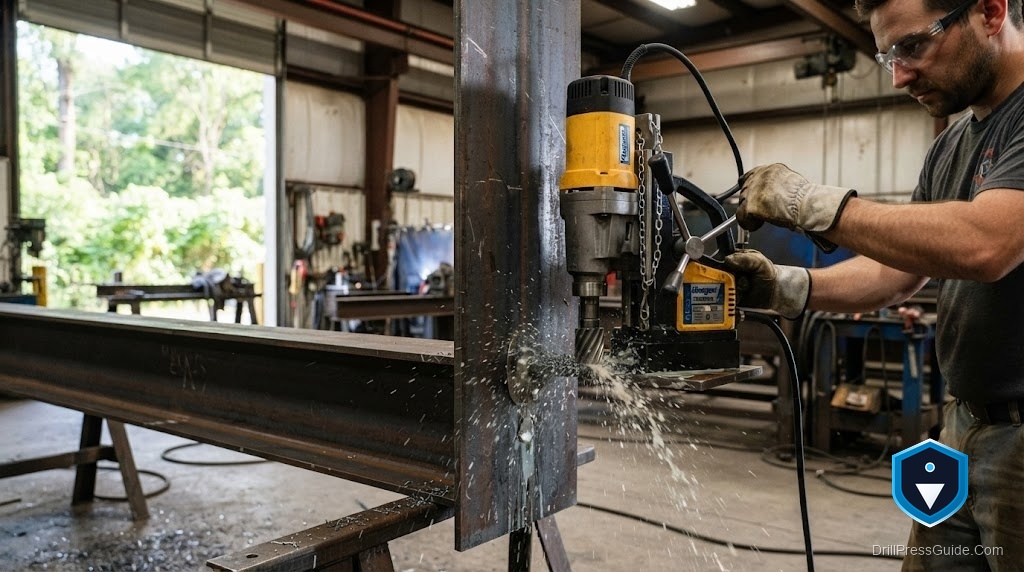
A magnetic drill press is not a tool you buy on impulse. It is a specialized machine for drilling accurate holes in steel, and it sits in a different category from the benchtop or floor presses that most home shops own. It clamps to the workpiece with an electromagnetic base, drills with annular cutters or twist drills, and handles jobs that would be impossible or dangerous with any other type of press.
I have used mag drills on construction sites, in metal fabrication shops, and in situations where the workpiece was a steel beam too heavy to move. They are portable, powerful, and precise. They are also expensive, heavy, and limited to ferrous metal. Understanding what a mag drill actually does, how to set it up safely, and when to use it is the difference between a tool that earns its keep and an expensive mistake.
What a Magnetic Drill Press Actually Is
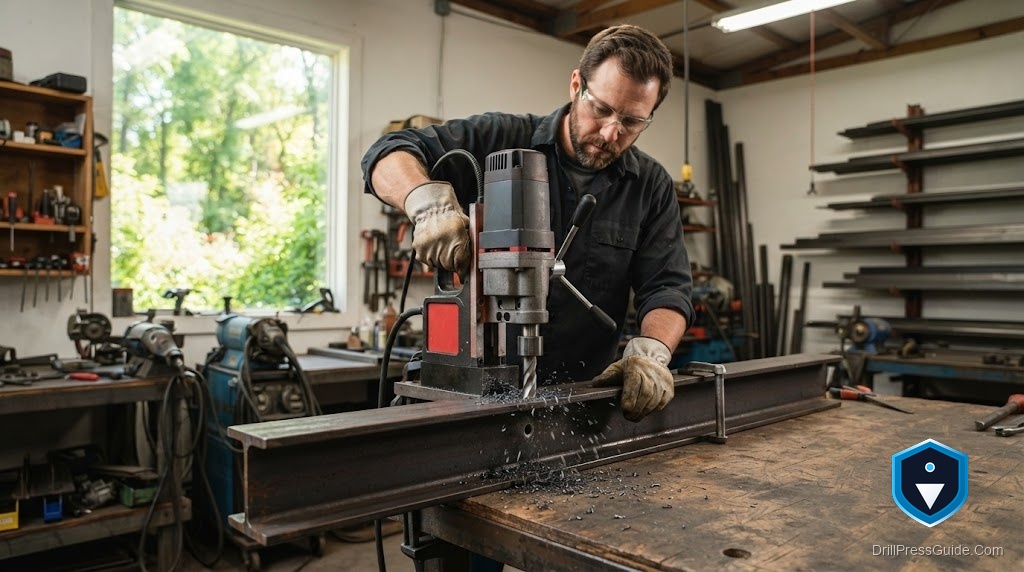
A mag drill is a portable drilling machine that uses an electromagnetic base to clamp itself to steel surfaces. The magnet is powerful, typically measured in thousands of pounds of holding force. Once engaged, the machine is locked in place. A motor drives a spindle that accepts annular cutters, which are ring-shaped bits that cut a hole by removing a perimeter slot rather than grinding through the entire core. The result is a clean, accurate hole with a solid slug left behind.
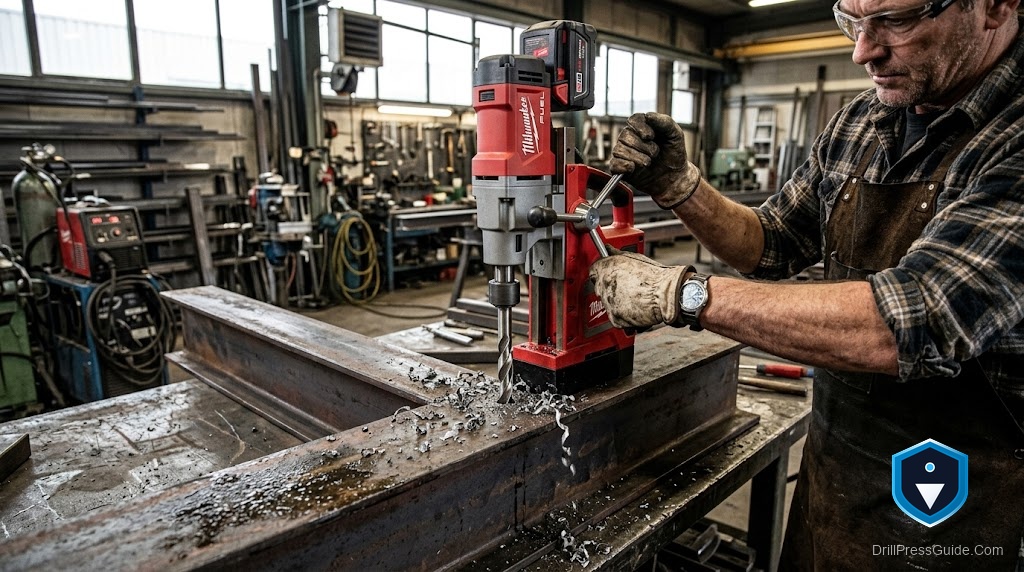
The machine has a feed handle, a quill, and a depth stop, just like a benchtop press. But it is designed to be carried to the work, not to have the work brought to it. The typical mag drill weighs between thirty and fifty pounds, and it is used on steel plate, I-beams, structural tubing, and any other ferrous metal that is too large or too heavy to move to a shop.
Capacity and What It Means
Capacity on a mag drill is defined by three numbers: the maximum cutter diameter, the maximum drilling depth, and the magnet holding force. A common mid-range machine handles cutters up to one and a half inches in diameter, drills up to two inches deep, and has a magnet rated at two thousand pounds or more. Larger machines handle two-inch cutters or more, with deeper drilling capacity and stronger magnets.
The cutter diameter determines the largest hole you can drill. The drilling depth determines the thickest plate you can penetrate. The magnet force determines how securely the machine holds to the surface. All three matter. A machine with a large cutter capacity but a weak magnet is dangerous. A machine with a strong magnet but shallow drilling depth is limited to thin plate. Match the machine to the work you actually do.
Setup and Safety
The first rule of mag drill setup is clean the surface. The magnet needs flat, clean, ferrous contact. Rust, paint, scale, and dirt all reduce the holding force. A wire brush or grinder should clean the area where the base will sit. The surface should be as flat as possible. A curved or irregular surface creates gaps, and gaps reduce the magnet’s grip.
Test the magnet before you drill. Engage the magnet and try to slide the machine by hand. It should not move. Most machines have a pilot light that indicates magnet engagement. Do not trust the light alone. The physical test is the real check. If the machine slides, the surface is not suitable. Clean it, flatten it, or move to a different location.
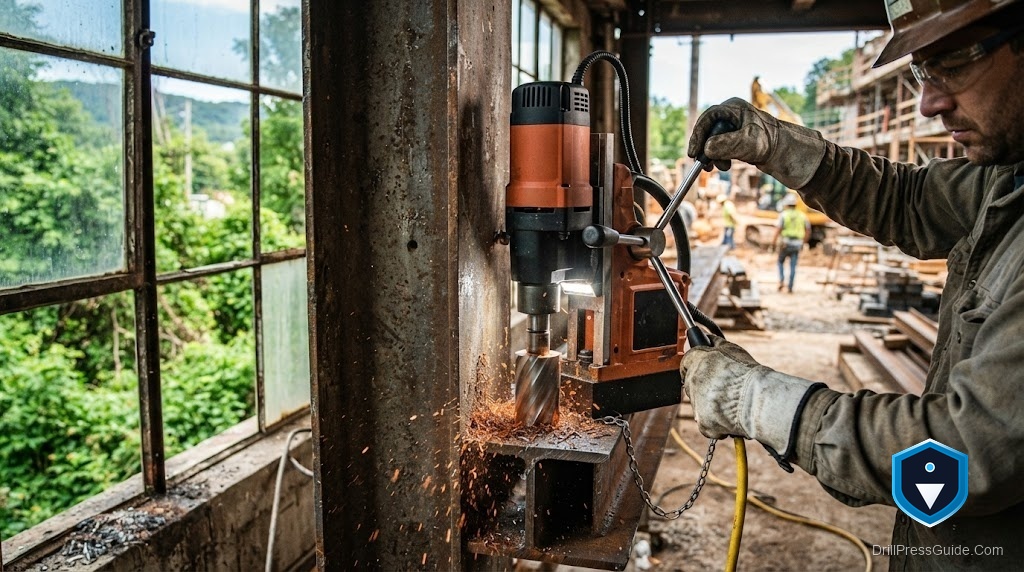
Never stand directly under the machine. If the magnet fails or the surface gives way, the drill and the cutter will fall. A forty-pound machine with a steel cutter falling from chest height is a serious hazard. Use a safety chain if the machine has one. Work to the side, not underneath.
Use cutting fluid. Steel gets hot fast, and a hot cutter dulls quickly. Dull cutters grab, stall, and break. Cutting fluid keeps the cutter cool and the chips flowing. It is not optional. It is part of the process.
Everyday Use
For a fabricator or steelworker, a mag drill is an everyday tool. It drills holes for bolts, rivets, and structural connections. It taps holes with the right attachments. It countersinks and counterbores with standard accessories. The accuracy comes from the rigid setup. Once the magnet is locked, the machine does not move. The depth stop lets you drill to an exact depth, which is critical for tapped holes or stacked plates.
For a home shop owner or hobbyist, a mag drill is an occasional tool. You might need it for a trailer repair, a steel gate, or a metal art project. In those cases, renting a mag drill or borrowing one from a maker space is often more practical than buying. A good mag drill is expensive, and it is not worth owning if it sits on a shelf for eleven months of the year.
Annular Cutters vs. Twist Drills
Annular cutters are the preferred tool for mag drills. They cut faster, use less torque, and produce a cleaner hole than a twist drill of the same diameter. They also leave a slug that can be reused or discarded. The downside is cost. Annular cutters are more expensive than twist drills, and they require cutting fluid.
Most mag drills also accept a chuck adapter for standard twist drills. This is useful for small holes, pilot holes, or situations where you do not have the right annular cutter. The adapter fits into the spindle and holds a standard keyed or keyless chuck. It is not as efficient as an annular cutter for large holes, but it is versatile.
Maintenance
Keep the magnet surface clean and free of chips. A chip trapped between the magnet and the steel creates a gap, and gaps reduce holding force. After each use, wipe the base with a clean rag. Check the power cord for damage. A cut cord on a machine that relies on electricity for its magnet is a hazard.
Lubricate the quill and the feed mechanism according to the manual. A sticky quill makes it hard to control the feed rate, which leads to broken cutters and poor hole quality. Keep the spindle taper clean. A dirty taper causes runout and poor cutter alignment.
Who Should Own One
A mag drill is for the steel fabricator, the structural ironworker, the maintenance mechanic who works on heavy equipment, and the serious metal artist who works with thick plate. It is for anyone who drills holes in steel on a regular basis and needs the accuracy and portability that only a mag drill provides.
It is not for the homeowner who drills occasional holes in thin metal. It is not for the woodworker. It is not for the hobbyist who works with aluminum or stainless steel, because the magnet does not grip those materials. If you are not working with ferrous metal regularly, a benchtop press with a good vise is the better tool.
The Verdict
A magnetic drill press is a specialized, powerful, and expensive tool for a specific job. It drills accurate holes in steel with a speed and precision that no other machine can match. But it is limited to ferrous metal, it requires clean surfaces, and it demands respect for the safety risks involved. If you work with steel regularly, it is a necessity. If you do not, it is an expensive curiosity. Buy it for the work you do, not the work you imagine doing.
FAQ
Can a magnetic drill press work on aluminum or stainless steel? No. The magnet needs ferrous metal to grip. Aluminum, copper, and most stainless steels are non-magnetic or weakly magnetic. For those materials, use a benchtop press or a clamped hand drill.
How thick a plate can I drill through? Check the spindle travel spec. Two inches is standard. Some machines handle more. For stacked plates, add the thicknesses and make sure the total is within the machine’s capacity.
What happens if the power goes out while the magnet is engaged? The magnet drops. The machine falls. That is why some models have permanent magnets or safety chains. Always use a chain when working overhead, and never stand directly under the machine.
Do I need special cutters? Annular cutters are the standard for mag drills. They are faster and cleaner than twist drills for large holes. You can use a chuck adapter for twist drills, but annular cutters are the right tool for the job.
How do I keep the cutter from overheating? Use cutting fluid. Steel conducts heat into the cutter quickly. A dull or hot cutter will grab, stall, and break. Cutting fluid is not optional. It is part of the drilling process.
Can I use a mag drill on a curved surface? Standard flat bases need a flat surface. Some models have swivel bases or adapters for curved pipe or round stock. Check the specs before buying if you need that capability.
How heavy is a typical mag drill? Thirty to fifty pounds is common. Some compact models are lighter, but they have smaller motors and weaker magnets. Heavier machines are more stable but harder to carry to the work.
What is the difference between a single-speed and variable-speed mag drill? Single-speed machines run at one fixed RPM. Variable-speed machines let you adjust the RPM for the cutter diameter and material. Variable speed is more flexible but adds cost. For most work, a single-speed machine with the right cutter is fine.
How do I know if the magnet is holding safely? Engage the magnet and try to slide the machine by hand. It should not move. Most machines have a pilot light, but the physical test is the real check. If it moves, clean the surface and try again.
Can I tap holes with a mag drill? Yes, with a tapping attachment. Some mag drills accept tapping heads that fit into the spindle and hold a tap. This is a common accessory for structural steel work. Check the spindle taper and capacity before buying a tapping attachment.