A Practical Buyer's Guide to the Magnetic Drill Press
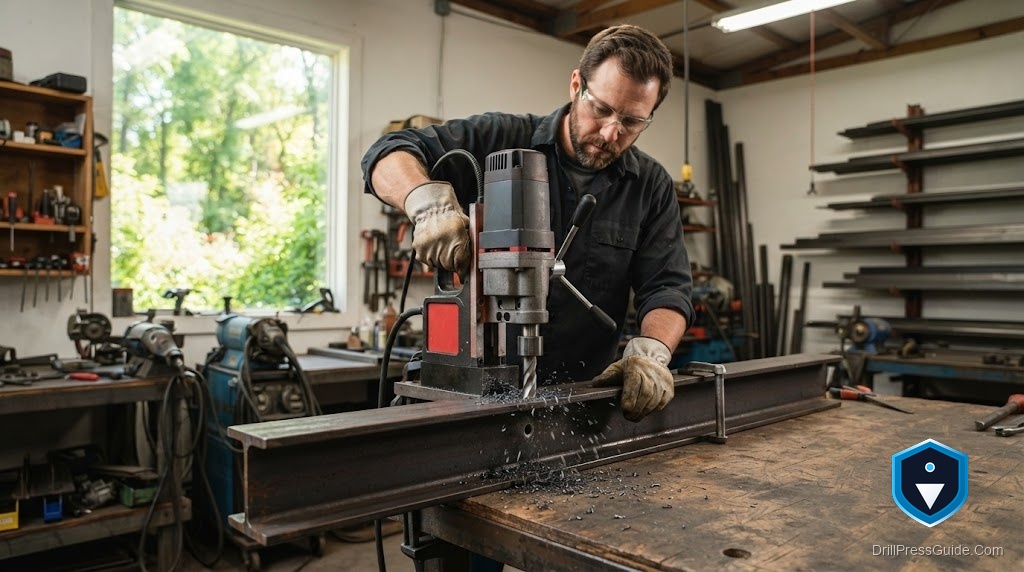
You are standing in front of a steel beam that needs a hole. The beam is too big for a benchtop drill press, too heavy to move to a shop, and too awkward to clamp to a table. A hand drill will wander, chew up the bit, and leave you with an oval hole that looks like it was made with a hammer. You need a magnetic drill press. It is a specialized machine, but when you need it, nothing else works.
I have used mag drills on construction sites, in metal fabrication shops, and in situations where the workpiece weighs more than the drill. They are not cheap, and they are not small. But for drilling accurate holes in steel plate, I-beams, and structural tubing, they are the only tool that makes sense.
What a Magnetic Drill Press Actually Does
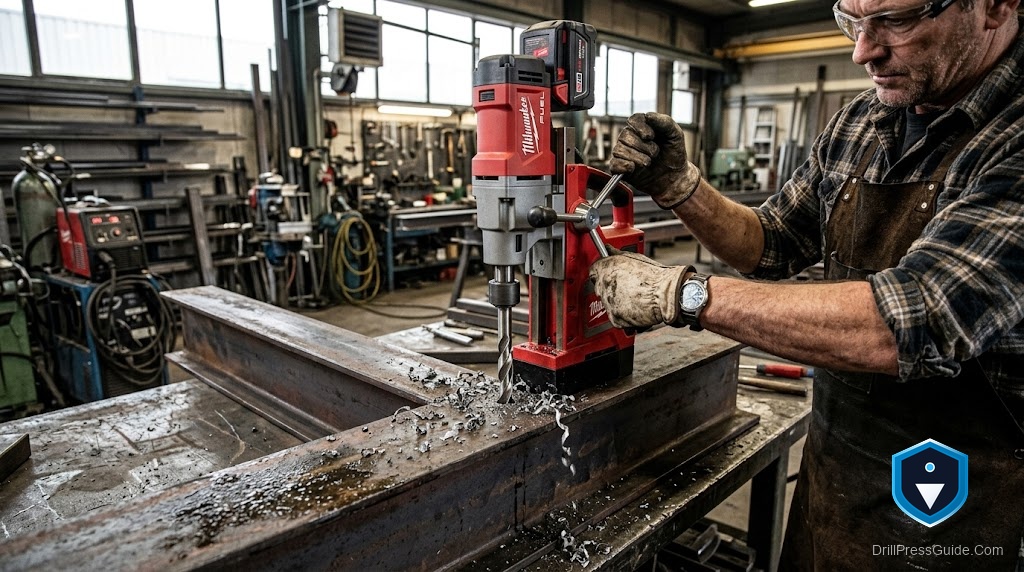
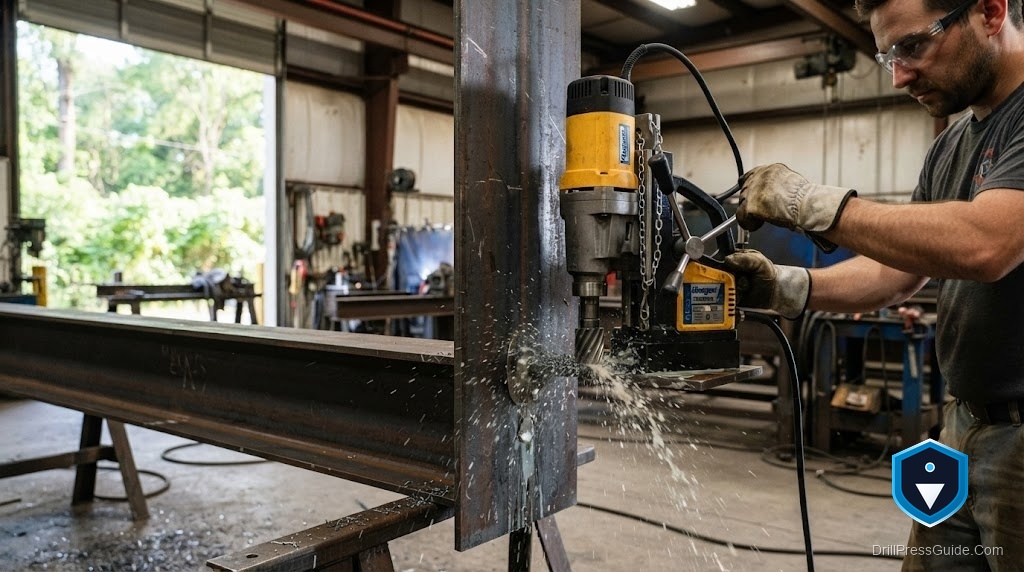
A mag drill is a portable machine that clamps to steel with an electromagnetic base. The magnet is powerful, usually measured in thousands of pounds of holding force. Once it locks to the surface, the drill is not going anywhere. A motor drives a spindle that accepts annular cutters or standard twist drills. Annular cutters are the preferred choice because they cut a ring-shaped slot, leaving a solid slug in the center. They drill faster, use less torque, and produce a cleaner hole than a twist drill of the same diameter.
The machine is called a drill press because it has a feed handle, a quill, and a depth stop, just like a benchtop press. But it is portable, and it is designed for one material: steel. You do not use a mag drill on wood or aluminum. The magnet needs ferrous metal to grip, and the cutters are optimized for steel.
Why You Need One (and Why You Might Not)
If you drill holes in steel plate, structural beams, or thick metal regularly, a magnetic drill press will save you hours and save your bits. The accuracy is unmatched because the machine is rigidly fixed to the workpiece. The depth stop lets you drill to an exact depth, which is critical for tapped holes or when you are stacking plates. The annular cutter design means the bit does not have to grind its way through the entire core of the hole. It only cuts the perimeter, which is why it is faster and cooler.
If you only drill occasional holes in thin metal, a good benchtop drill press with a vise might be enough. A mag drill is overkill for a homeowner who needs to hang a bracket twice a year. It is a tool for fabricators, steel workers, and anyone who drills steel on a regular basis.
What to Look For
Magnet strength is the first spec to check. For thin plate, a thousand-pound magnet might hold. For thick plate, uneven surfaces, or overhead drilling, you want two thousand pounds or more. Some machines have a two-stage magnet that increases power when the motor is running, which is a nice safety feature. If the power fails, the magnet drops, and the machine falls. That is why some models have a permanent magnet base or a safety chain.
Motor power matters because steel is tough. A ten-amp motor is a good baseline. More is better if you drill large holes. Variable speed is essential because different cutter diameters and steel thicknesses need different RPM. Large cutters in thick steel need slow speeds. Small cutters in thin plate can run faster. A good mag drill has a range from roughly one hundred to six hundred RPM.
Cutter capacity is the maximum diameter the spindle will accept. Common ranges are one inch, one and three-eighths inches, or two inches. Buy for the largest hole you expect to drill, not the average. It is frustrating to need a one-and-a-half-inch hole and discover your machine tops out at one inch.
Spindle travel and depth tell you how thick a plate you can drill through. Two inches of travel is standard. Some machines offer more. If you drill through flanges or stacked plates, depth matters.
Two Magnetic Drill Presses That Earn Their Keep
Evolution Power Tools EVOMAG42 Magnetic Drill
This is a mid-range machine that punches above its weight. It has a ten-amp motor, a magnet rated at two thousand eight hundred sixty pounds of force, and a cutter capacity of one and five-eighths inches. The spindle travel is two inches, which handles most structural steel. It includes a half-inch chuck adapter for twist drills, so you are not locked into annular cutters. The integrated coolant system helps keep cutters sharp, and the carrying case makes it easier to move between jobs. Evolution EVOMAG42 on Amazon
The flaw is the weight. At over forty pounds, it is not a tool you carry up a ladder one-handed. It is also not the most compact machine on the market. If you work in tight spaces or overhead, the size matters. For bench and floor work, it is excellent. For cramped quarters, look for a lighter model.
Hougen HMD904 Magnetic Drill
The Hougen HMD904 is the standard by which other mag drills are measured. It has a one and a half inch by two-inch capacity, a lightweight housing, and a two-stage magnet that boosts power when the motor runs. The pilot light helps you align the cutter in low light, and the feed handles swap from side to side for left-handed users or tight spaces. It is built for daily fabrication work. Hougen HMD904 on Amazon
The honest flaw is the price. It costs more than many benchtop drill presses. For a hobbyist or occasional user, that is hard to justify. It is also a single-speed machine, which means you change speeds by changing cutters or pulley arrangements, not by turning a dial. For a pro, that is fine. For a beginner, the Evolution might be friendlier.
Annular Cutters: The Other Half of the Equation
A mag drill is only as good as the cutters you feed it. Annular cutters cost more than twist drills, but they last longer and cut faster. The key is to match the cutter to the material. High-speed steel cutters work for mild steel and general fabrication. Cobalt or carbide-tipped cutters are needed for stainless steel, hard alloys, or high-volume work. Always use cutting fluid. Steel gets hot fast, and a dull cutter is an expensive mistake.
The Verdict
A magnetic drill press is not a luxury for steel workers. It is a necessity. The Evolution EVOMAG42 is the best starting point for a shop that needs mag drill capability without the top-tier price. The Hougen HMD904 is the machine for professionals who drill steel every day and need the reliability that justifies the investment. If you are not drilling steel regularly, stick with a benchtop press and a good vise. If you are, the mag drill will change how you work.
FAQ
Can I use a magnetic drill press on non-ferrous metal? No. The magnet needs iron or steel to grip. Aluminum, copper, and stainless steel will not hold the base. For non-ferrous metals, use a benchtop press or a clamped hand drill.
Do I need annular cutters, or can I use regular drill bits? You can use regular bits if the machine has a chuck adapter. Annular cutters are faster, cleaner, and cooler for large holes in steel. For small holes, a twist drill in the chuck adapter is fine.
How thick a plate can I drill through? Check the spindle travel spec. Two inches is standard. Some machines handle more. For stacked plates or flanges, add the thicknesses and make sure the total is within the machine’s capacity.
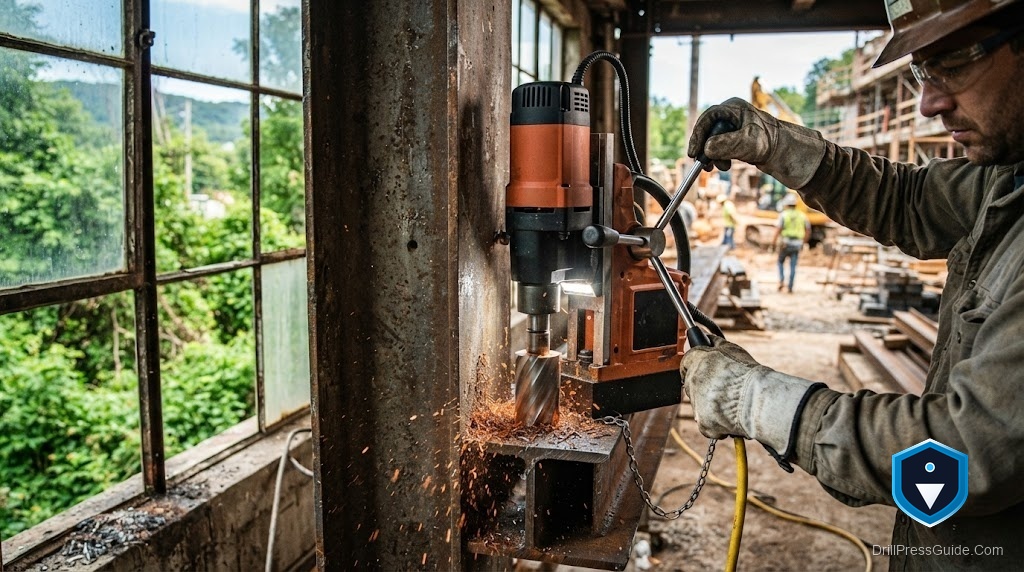
Is a magnetic drill press safe to use overhead? It can be, with care. Use a machine with a strong magnet, a safety chain, and a lift detector that warns if the magnet is losing grip. Never stand directly under the machine. The weight of the drill plus a steel cutter falling is a serious hazard.
What speed should I use for annular cutters? Slower than you think. A one-inch cutter in half-inch steel might run at two hundred fifty RPM. A half-inch cutter in thin plate might run at five hundred. The cutter manufacturer will provide a speed chart. Follow it.
Can I use a mag drill on painted or rusty steel? The magnet needs clean, flat contact. Rust, paint, and scale reduce the holding force. Grind the surface clean before mounting the drill. It takes an extra minute and might save the machine from falling.
How do I know if the magnet is holding safely? Most machines have a pilot light or indicator that shows magnet engagement. Test it by trying to slide the machine before starting the drill. If it moves, the surface is not suitable. Clean it and try again.
What is the difference between a single-speed and variable-speed mag drill? Single-speed machines run at one fixed RPM. You change cutting speed by changing cutter diameter or material. Variable-speed machines let you adjust the RPM for the cutter and material. Variable speed is more flexible but adds cost and complexity.
Do mag drills need a lot of maintenance? Keep the magnet surface clean, lubricate the quill, and use sharp cutters. The magnet itself needs no maintenance beyond cleaning. The motor bearings are sealed and should last for years. Replace worn feed handles and safety chains as needed.
Can I use a mag drill on curved surfaces? Standard flat bases need a flat surface. Some models have a swivel base or adapter for curved pipe or round stock. Check the specs before buying if you need that capability. For most structural work, flat is fine.