Heavy Duty Drill Press Vise: What to Measure Before You Buy
“Heavy duty” is the most oversold phrase in the workholding aisle. Every listing claims it. Few earn it. After years of clamping stubborn stock on a drill press, I can tell you that a genuinely heavy-duty vise is not about marketing, it is about mass, jaw quality, and how flat the thing sits on your table. Let me show you what to measure, then point you to the vises that back up the claim.
What actually makes a vise heavy duty
- Body mass and material. Ductile iron or thick cast iron resists flex under a real bite. Thin castings ring and chatter.
- Jaw hardness. Hardened, replaceable steel jaws keep their grip and can be swapped when worn. Soft jaws round over and slip.
- Base and bed flatness. A precise, flat base is what keeps your holes square. Cheap vises rock.
- Mounting. Real hold-down through solid mounting holes into your table slots, not a token bracket.
If a listing cannot tell you the material and jaw type, treat the “heavy duty” label as decoration.
Measure your press first
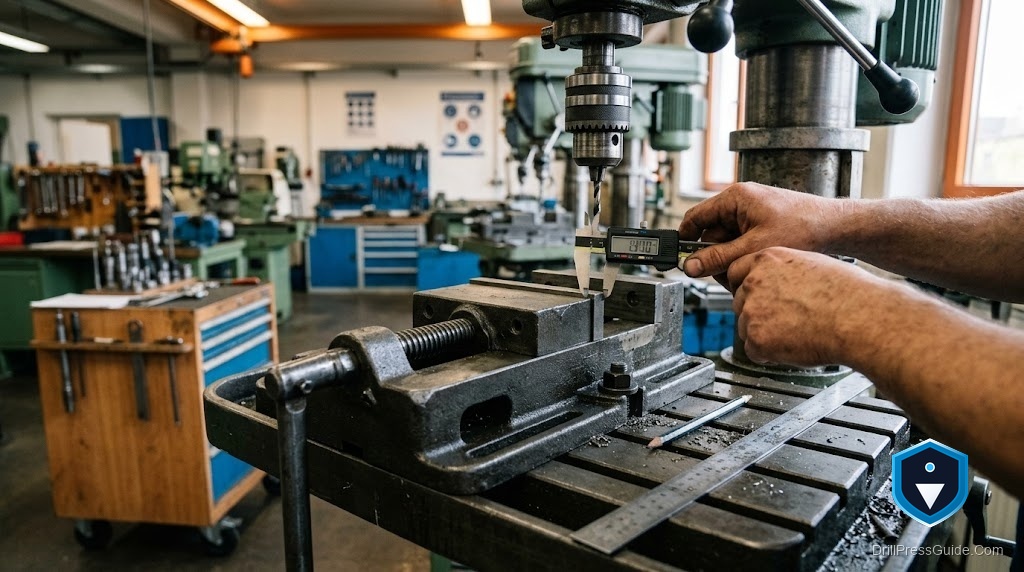
Before capacity, check clearance. A tall heavy vise steals working height between the workpiece and the rotating chuck, and it can overwhelm a light benchtop table. Confirm your table slot spacing, your quill travel, and how much room you have under the chuck. Then match jaw width and opening to the stock you actually drill.
The heavy-duty vises worth your money
The one I trust most here is the Yost Vises 6D Heavy-Duty Drill Press Vise, 6-Inch. It is a stationary-base, ductile iron casting with hardened, replaceable steel jaws, and the fixed jaw has horizontal and vertical V-grooves for gripping round stock. This is the vise you buy when you are tired of parts creeping. The honest catch: it is heavy and it sits tall, so on a small press you will feel it eat clearance. That mass is exactly the point, but plan for it.
If you want that Yost build quality in something lighter to reposition, the Yost LDPV-6 Drill Press Vise, 6-Inch trades outright rigidity for portability with textured jaws. I would not call it truly heavy duty - for hard clamping, get the 6D. For quick, lighter work, the LDPV-6 is friendlier.
For a low-profile heavy build where headroom is tight, the Wilton Low-Profile Drill Press Vise, 4-Inch (11744) is my pick. Fine-grained cast iron, a squat profile that keeps flex down, and it is made for drilling, tapping, and reaming in a cramped cutting area.
The PONY Drill Press Vise, 4-inch is the sensible medium-duty option for readers who do not need industrial mass but want a solid, planted clamp that mounts to most tables. Be honest with yourself about the work: if you are muscling thick steel, skip it and get the Yost.
When your real need is precise two-axis positioning under load, the Yost CSV8 Cross Slide Drill Press Vise, 8-Inch is a serious, heavy casting that moves the workpiece along X and Y. It is big, heavy, and demands a stout table and press.
My verdict
If you want one heavy-duty vise and you have the clearance, buy the Yost 6D. It is the honest expression of the phrase: mass, hardened replaceable jaws, and V-grooves that actually hold round stock. Choose the Wilton low-profile when headroom under the chuck is the constraint, drop to the PONY for medium-duty tasks, and step to the Yost CSV8 only when two-axis positioning is the whole point.
Safety with a heavy vise
Heavy vises tempt heavy cuts, so respect them. Bolt the vise down through its mounting holes into the table slots for secure clamping, and never rely on the vise weight alone. Support long workpieces so they cannot swing, keep the point of operation clear of your hands, and wear eye protection. Locate the start/stop button before the bit is spinning. Clear swarf and hot chips with a brush, never bare fingers.
FAQ
Is a heavy duty drill press vise worth it for a home shop? If you drill metal or want dead-square holes without creep, yes. For occasional wood, a medium-duty vise is enough.
Why does jaw hardness matter? Hardened, replaceable steel jaws keep their grip and can be swapped when worn. Soft jaws round over and let stock slip.
Will a heavy vise fit a small benchtop press? Sometimes, but it steals clearance and can overload a light table. Measure under-chuck height and check your table slots first.
Do I need V-grooves in the jaws? If you drill round stock, yes. Horizontal and vertical V-grooves hold pipe and rod far more securely than flat jaws.
References
- Yost Vises 6D Heavy-Duty Drill Press Vise 6-Inch: Check on Amazon
- Yost LDPV-6 Drill Press Vise 6-Inch: Check on Amazon
- Wilton Low-Profile Drill Press Vise 4-Inch (11744): Check on Amazon
- PONY Drill Press Vise 4-inch: Check on Amazon
- Yost CSV8 Cross Slide Drill Press Vise 8-Inch: Check on Amazon