Getting Better Results from a Floor Stand Drill Press
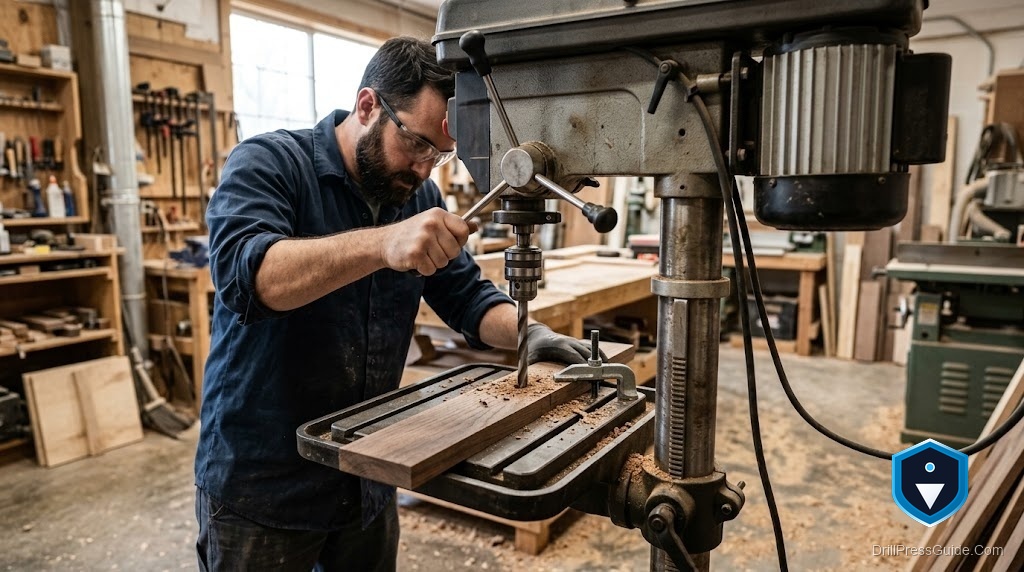
The first time you clamp a four foot board to a benchtop machine and watch the whole thing tip toward you, the appeal of a floor stand drill press stops being theoretical. You want the taller column, the bigger table, and the mass that keeps a bit tracking straight when it bites into hardwood or steel. What most people don’t realize is that buying the machine is the easy part. Getting clean, repeatable holes out of it comes down to a handful of habits and settings that no box ever explains.
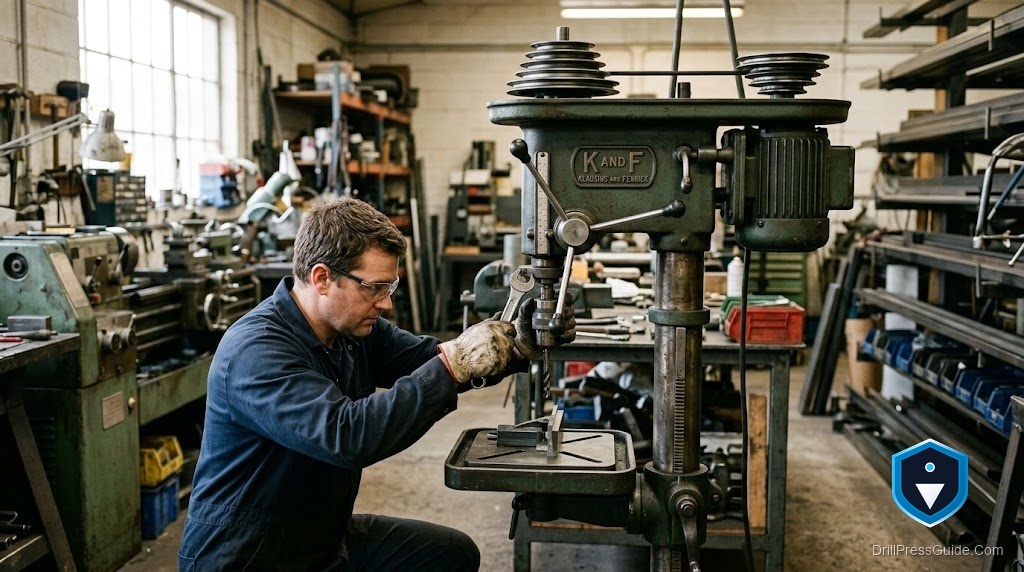
A floor stand drill press is a stationary drilling machine mounted on a full-height column that stands on the shop floor rather than a bench. The extra height gives you more distance between the chuck and the base, so you can stand tall stock upright and drill into the end of it. The added weight and the longer column also cut down on the flex and vibration that make benchtop holes wander.
Here is the short version if you only read one paragraph: most of your accuracy problems come from the wrong spindle speed, a table that isn’t square to the bit, and stock that isn’t held down. Fix those three and a mid-priced floor machine will outperform a careless setup on an expensive one.
Speed is the setting people get wrong most
Every drill press has a speed range, and the number you pick matters more than horsepower. Large bits and hard or metal stock want low RPM. Small bits and soft wood want high RPM. Run a big Forstner bit at high speed and you scorch the wood and cook the cutting edge. Run a tiny twist bit too slow and it wanders instead of cutting.
Most floor machines change speed one of two ways. Belt-and-pulley presses ask you to open a cover and move a belt between steps, which is slower to change but dead simple and reliable. Variable-speed presses let you dial the RPM with a lever, often with a digital speed readout so you can see the exact number. If you switch bit sizes constantly, variable speed saves real time. If you tend to settle into one operation for an hour, belt changes are no hardship.
Square the table before you trust a single hole
A drill press is only as accurate as the relationship between the spindle and the work table. Chuck a short length of steel rod, or a purpose-made square-up gauge, and check it against the table with a small square. Most tables tilt on purpose for angled work, and most of them drift out of true during shipping. Reset it to a true 90 degrees, confirm it, then drill a test hole through scrap and look at the exit. If the hole blows out crooked, your table is lying to you, not your technique.
While you are down there, look at the table surface itself. Cast iron tables on value-focused machines sometimes ship with slightly rough milling or sharp edges around the center hole. A few minutes with a file and some fine sandpaper flattens the high spots so your work sits without rocking.
Hold the work down, always
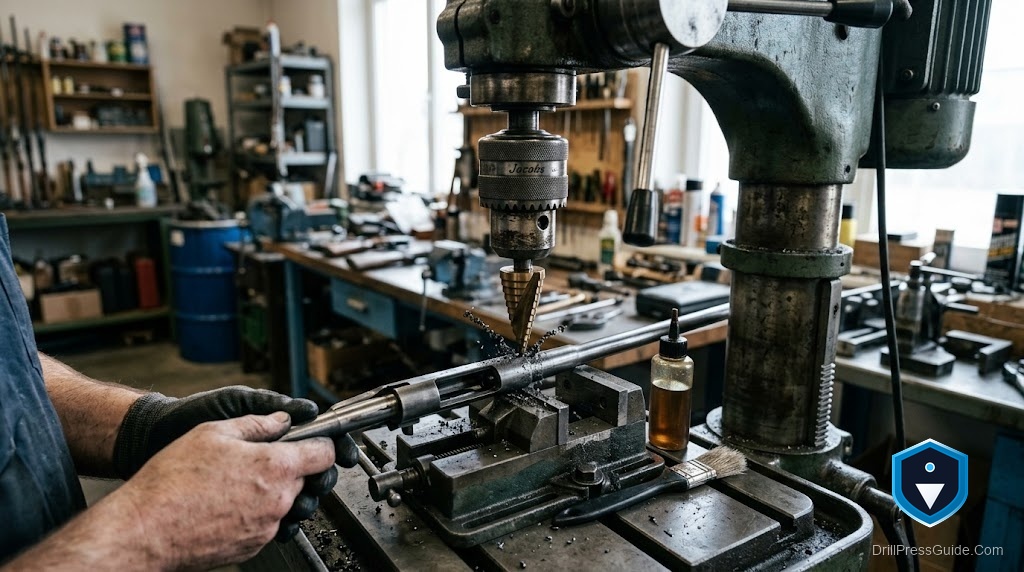
The single most dangerous mistake at a drill press is trusting your hands to hold metal or small parts. When the bit breaks through the bottom, it can grab the piece and spin it into a blade of hot, flying steel. That is the point of operation the safety literature keeps warning about, and it is not a hypothetical. Clamp the stock to the table, or hold it in a drill press vise, every time you drill anything you would not want thrown across the room.
A depth stop is the other quiet hero here. Set it so the quill bottoms out just past your intended depth, and you get identical holes all day without eyeballing a mark that keeps sliding out of the work light.
The picks worth your money
Three floor machines cover most home and small-shop needs, and they sit at genuinely different points.
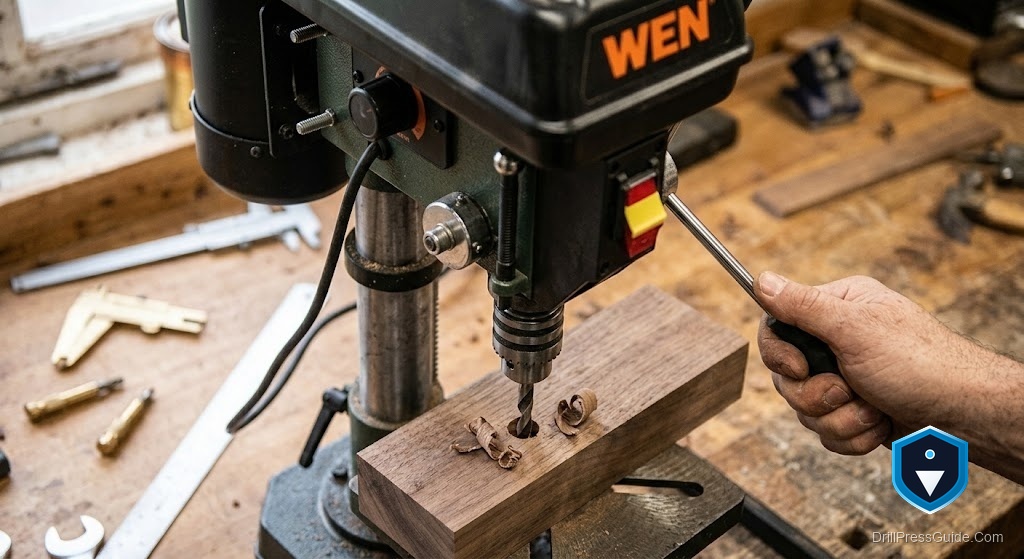
The WEN 4227T 13-Amp 12-Speed Floor Standing Drill Press is the value pick, and it earns it. You get a 17-inch swing, a full 4-3/4 inches of spindle travel, a 5/8-inch keyed chuck, a laser guide, and a built-in work light. The honest drawback is the speed system: twelve speeds, all set by moving a belt, so quick changes mid-project mean opening the cover. The cast table can also arrive with a slightly uneven surface that wants a little flattening. Skip this one if you change bit sizes every few minutes and hate belt swaps.
The JET 17-Inch Floor Drill Press, 16 Speed, 3/4 HP (JDP-17MF) is the machine to buy if you use a drill press hard and often. Owners consistently praise how quiet and smooth it runs across the whole range, the heavy castings, the laser, and the 5-inch spindle travel, which is longer than most. The table tilts a full 90 degrees each way. The catch is that even with sixteen speeds, you are still changing them by moving belts, not turning a dial, so this is not the pick if you specifically wanted variable speed on the fly. It is also more machine than a casual weekend user needs.
The Shop Fox M1039 20-Inch 12-Speed Floor Drill Press is the reach-for-more option. The 20-inch swing and 5/8-inch chuck capacity handle larger workpieces than either 17-inch machine, which matters if you drill wide panels or center holes far from an edge. That size is also its flaw: it is heavy, it eats floor space, and for anyone drilling small parts on a crowded bench-lined shop wall, it is simply overkill. Buy it because your work is genuinely big, not because bigger sounds better.
| Machine | Swing | Speed changes | Best for |
|---|---|---|---|
| WEN 4227T | 17 in | 12, belt | Value, long spindle travel |
| JET JDP-17MF | 17 in | 16, belt | Heavy, frequent use, quiet running |
| Shop Fox M1039 | 20 in | 12, belt | Large workpieces, more reach |
Notice none of these is a true variable-speed floor machine. If a lever-and-readout speed dial is your must-have, that is a real feature to shop for specifically, and you will be trading some of the mass and reach these three offer.
A few upgrades that punch above their size
A keyed chuck and its chuck key hold small bits more securely than a keyless chuck under heavy load, so keep the key on a magnet nearby, never in the chuck when you power on. A shop-built wooden auxiliary table with a replaceable sacrificial insert protects your bits on breakthrough and gives you something to clamp to. And a simple work light aimed across the cutting area, if your machine’s built-in one is weak, does more for hole placement than any laser.
The machines above will all drill a straight hole. Whether yours do depends on the speed you dial, the square you trust, and the clamp you actually reach for instead of your thumb.
FAQ
What is the difference between a floor stand and a benchtop drill press? A floor stand drill press mounts on a tall column that reaches the floor, giving you more chuck-to-base distance, a larger table, and more mass. A benchtop sits on a workbench and is lighter and shorter. The floor model handles tall stock and heavy drilling with less vibration.
What spindle speed should I use? Match speed to bit size and material. Large bits and metal want low RPM, small bits and softwood want high RPM. As a rule, the bigger the hole and the harder the material, the slower you go.
Do I really need to clamp small metal parts? Yes. When a bit breaks through, it can catch the part and spin it violently. Use a drill press vise or a hold-down clamp for anything you would not want flung off the table, especially metal and small pieces.
How do I keep holes from wandering? Square the table to the bit, use a center punch or the laser to mark the start, set the correct speed, and hold the work firmly. A short, sharp bit and a pilot mark do more than raw power.
Is a 20-inch swing worth it over a 17-inch? Only if you regularly drill wide panels or need to place holes far from an edge. For most furniture and general shop work, a 17-inch machine has the reach, and it takes up less room.
References
- WEN 4227T Floor Standing Drill Press: Check on Amazon
- JET JDP-17MF Floor Drill Press: Check on Amazon
- Shop Fox M1039 Floor Drill Press: Check on Amazon