Shop Fox W1848 Oscillating Floor Drill Press: Specs, Capacity, Parts, and Owner Notes
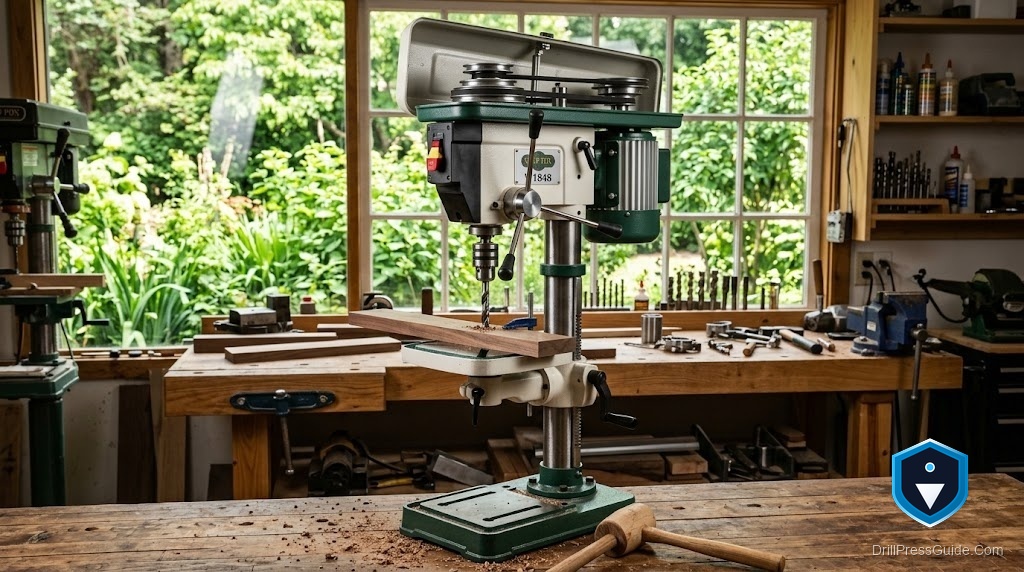
Most floor drill presses do one thing. The Shop Fox W1848 does two, and that is the whole reason it exists. It drills like a proper 13-1/4-inch floor machine, and then, in a few tool-free steps, the spindle starts moving up and down so you can sand curved edges with a drum. For a woodworker who is tired of choosing between a drill press and a dedicated oscillating spindle sander, that combination is genuinely useful, and it is worth understanding exactly what the W1848 gives you before you clear the floor space.
The Shop Fox W1848 is a floor-standing oscillating drill press with a 3/4 HP, 110V motor, a 13-1/4-inch swing, a JT33 chuck taper holding bits from 3/64 to 5/8 inch, 3-1/8 inches of spindle travel, and 12 speeds spanning 250 to 3,050 RPM. Its defining feature is a 3/4-inch oscillating stroke that turns it into a spindle sander, complete with a 12-3/8-inch cast table, a 2-inch dust port, and included sanding drums. It stands about 63 inches tall. It has a benchtop sibling, the W1668, for shops without floor space.
Here is the direct take: if you do curved woodworking and want one machine that drills and contour-sands, the Shop Fox W1848 earns its footprint. If you only ever drill, a plain floor press gives you the same drilling for less complexity, and you should skip the oscillating feature.
What the specs mean in the shop
The 3/4 HP motor and 12-speed range are the meat of the drilling side. That speed spread, from a slow 250 RPM up to 3,050, covers large Forstner bits and hole saws at the low end and small twist bits in wood at the high end, and 12 steps means you can usually land close to the ideal speed rather than settling. The 5/8-inch drilling capacity in mild steel and the 3-1/8-inch spindle travel are solid for a machine in this class, and the tall floor column lets you swing the head and table for long or awkward workpieces a benchtop cannot manage.
The oscillating side is what sets it apart. Unlatch the spindle, fit a sanding drum, switch on the 3/4-inch stroke, and the drum sands while it spins, which spreads wear across the abrasive and leaves a smoother curved edge than a fixed drum ever will. The 2-inch dust port and the cast table with its dust channel keep the mess manageable.
Parts, accessories, and setup
The W1848 uses a JT33 chuck, which is the common benchtop-and-floor taper, so a worn chuck is easy to replace with a JT33 keyed chuck, and a lost key is covered by a universal ratcheting chuck key. For drilling accuracy on the round table, a drill press vise holds parts square. Sanding drums and sleeves are consumables you will replace regularly once you use the oscillating feature.
Assembly is the usual floor-press routine: column to base, head to column, table onto the column, then chuck. Give the machine a solid, level floor, because at roughly 180 pounds shipping weight it is stable but not something you want to reposition often.
The honest flaws
Two things deserve plain talk. First, the round 12-3/8-inch cast table is designed around the sanding function, and for large flat drilling layouts it is smaller and less accommodating than a big square table on some drilling-only floor presses. Many owners add an auxiliary wooden table for sheet work. Second, the oscillating mechanism adds parts and complexity you are paying for whether or not you use it. If contour sanding is not in your work, that money and that mechanism are wasted, and a straightforward floor press will drill just as well with fewer things to maintain.
Who should buy it, and who should skip it
Buy the W1848 if you build anything with curves, chair makers, instrument builders, sign carvers, and cabinet shops with shaped parts, and want to stop swapping between two machines. The dual function is a real time-saver and the drilling is capable.
Skip it if you only drill, if your work is mostly large flat panels that want a big rectangular table, or if bench space rather than floor space is your constraint (in which case the benchtop W1668 is the closer fit). Do not pay for the oscillating spindle you will never switch on.
Conclusion: two machines in one, for the right shop
The Shop Fox W1848 is a well-judged combination tool, capable at drilling and genuinely handy at contour sanding.
- 3/4 HP, 13-1/4-inch swing, 12 speeds (250 to 3,050 RPM), JT33 chuck, 3-1/8-inch travel.
- The 3/4-inch oscillating stroke turns it into a spindle sander in seconds.
- JT33 taper makes chuck and key replacement simple; add a vise for drilling accuracy.
- Best for curved woodworking; skip it if you only drill or need a large flat table.
FAQ
What makes the Shop Fox W1848 different from a normal drill press? Its spindle oscillates up and down with a 3/4-inch stroke, so with a sanding drum fitted it works as an oscillating spindle sander in addition to drilling.
What are the W1848 speed range and count? Twelve speeds from 250 to 3,050 RPM, set by moving the belt across stepped pulleys.
What chuck and taper does it use? A JT33 keyed chuck holding bits from 3/64 to 5/8 inch, which makes replacements easy to find.
How tall is the W1848 and how heavy? About 63 inches tall with a shipping weight near 180 pounds, so it needs a dedicated, level floor spot.
Is there a benchtop version? Yes. The Shop Fox W1668 is the benchtop oscillating drill press with the same core idea for shops without floor space.
Does it come with sanding drums? Yes, it includes sanding drums, and the drums and sleeves are consumables you will replace with use.
Is the table good for large flat work? The round 12-3/8-inch cast table suits sanding and general drilling; for large panels many owners add an auxiliary table.
References
- Grizzly/Woodstock W1848 Specifications Sheet (PDF): https://cdn0.grizzly.com/specsheets/w1848_ds.pdf
- The Home Depot, Shop Fox 13-1/4 in. Oscillating Floor Drill Press W1848: https://www.homedepot.com/p/Shop-Fox-13-1-4-in-Oscillating-Floor-Drill-Press-W1848/309625973
- Shop Fox W1668 Benchtop Oscillating Drill Press (benchtop sibling): Check on Amazon