Choosing and Using a Standing Drill Press
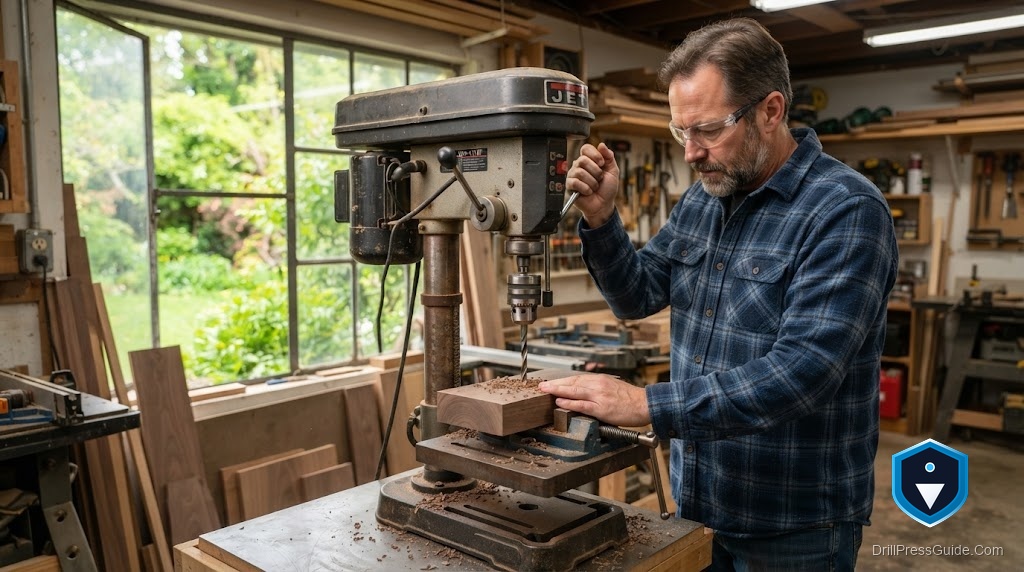
There comes a point in most shops when the benchtop drill press stops being enough. The work gets taller, the holes get deeper, or you simply run out of bench, and the answer is a standing drill press, the floor-mounted machine that trades benchtop convenience for capacity, reach, and stability. It is a bigger commitment in space and often in money, so it is worth understanding what a standing drill press gives you over a benchtop, how to choose one, and how to set it up to earn that floor space. This guide covers all three.
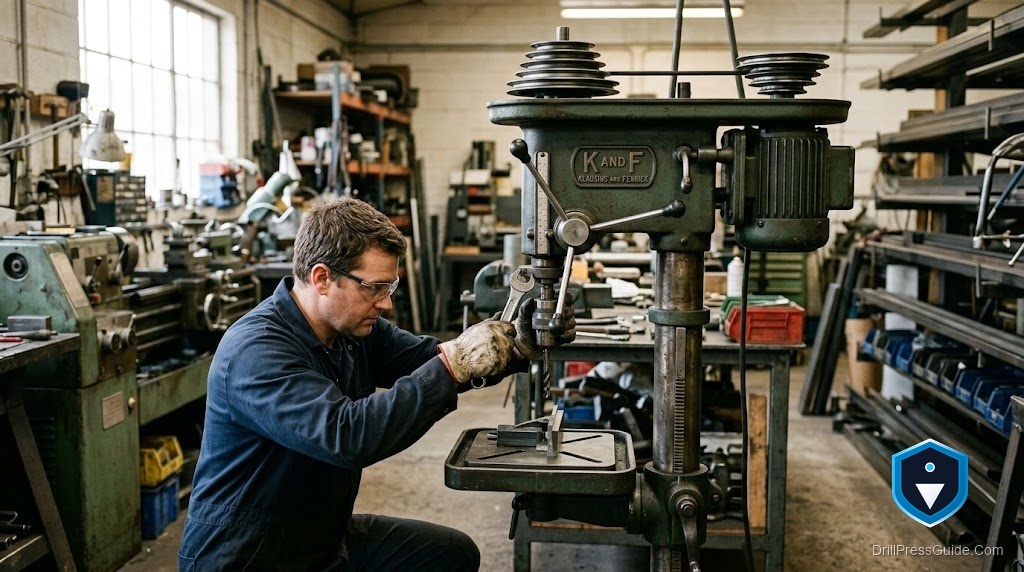
A standing drill press, also called a floor drill press, is a drill press mounted on a full-height column that stands on the floor rather than sitting on a bench. The tall column gives it a large distance between the chuck and the base, so it can handle tall workpieces and offers more quill travel and often more power than a benchtop machine. It is the choice when the work outgrows a benchtop press, and its stability and capacity are exactly what larger and heavier drilling demand.
What a standing press gives you over a benchtop
The floor design brings concrete advantages. It handles tall work, because the long column and the adjustable table create room for pieces a benchtop press cannot fit under the spindle. It offers more travel and capacity, typically a longer quill stroke for deeper holes and a larger, more powerful machine overall. And it is more stable, since a heavy floor machine bolted down resists the vibration and tipping that a benchtop press is prone to under a big cut. For drilling large or tall work, deep holes, or heavier materials, the standing press is simply the more capable machine.
The tradeoffs are honest: it takes floor space, costs more, and is heavy to move and set up. If your work is small and your bench has room, a benchtop press may still be the better fit. The standing press is for when capacity and stability matter.
Choosing a standing drill press
Choose by capacity and by the checks that apply to any press. Match the throat depth (spindle to column distance) to how far from an edge you need to drill, and the quill travel to your deepest holes. Consider the swing, twice the throat, which tells you the largest disc you can center a hole in. Weigh the motor and speed range: a wide range or variable speed lets you run the right speed across materials, which matters more than raw power. Check the table size, its adjustment and tilt, and the spindle taper for the tooling you will use. And favor a heavy, rigid machine, since the mass that makes a floor press stable is much of its value.
Setting up a standing press
A floor press needs proper installation to be safe and accurate. Level it and bolt it to the floor, since a tall machine can be top-heavy and a solid anchor prevents both tipping and the vibration that spoils accuracy. Square the table to the spindle. Set up good lighting on the drilling point, which is more important on a tall machine where the spindle is farther from any bench light. And confirm the belt tension and pulley alignment so the machine’s power reaches the spindle cleanly.
Using it well
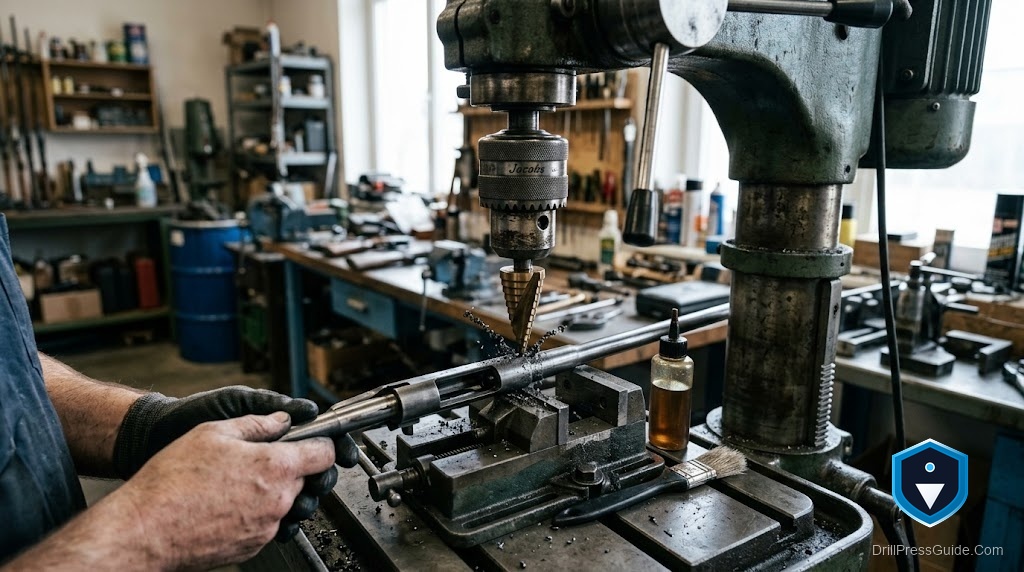
Get the capacity you paid for by using the machine correctly. Clamp the work, always, since a standing press turns large bits with real torque and an unclamped piece will spin dangerously; a heavy cast-iron drill press vise bolted to the table holds stock securely, and for tall work, support long pieces so they do not lever the machine. Run the correct speed for the bit and material from the machine’s range, slower for large bits and steel. Use the depth stop for repeatable holes, use cutting fluid on metal, and keep bits sharp. If the chuck is worn and drilling off center, confirm the arbor taper, often JT33 on mid-size machines, and fit a JT33 keyed chuck once the old one is driven off.
Conclusion
A standing drill press is the machine you graduate to when the work outgrows a benchtop: it handles tall pieces, drills deeper, and stands more stable, at the cost of floor space, expense, and weight. Choose one by throat depth, quill travel, swing, speed range, and rigidity, matching the capacity to your work rather than buying the biggest machine. Bolt it down, square the table, light the work, and then use it with clamped stock, correct speeds, and sharp bits. Set up and used this way, a standing press earns its floor space with capacity and stability a benchtop machine cannot match.
Three takeaways: a standing press handles tall work, deeper holes, and heavier drilling with more stability than a benchtop, at the cost of space and weight; choose it by throat depth, travel, swing, speed range, and rigidity; and bolt it down, clamp the work, and run correct speeds to get its capacity safely.
Frequently Asked Questions
What is a standing drill press? A floor-mounted drill press on a full-height column, as opposed to a benchtop machine. The tall column gives a large chuck-to-base distance for tall work, more quill travel, and usually more power and stability.
When should I choose a standing over a benchtop press? When your work is tall, your holes are deep, or you need the stability and capacity for heavier drilling, and you have the floor space. For small work on a roomy bench, a benchtop press may still fit better.
What specifications matter when choosing one? Throat depth (how far from an edge you can drill), quill travel (deepest hole), swing, motor and speed range, table size and tilt, and spindle taper. Favor a heavy, rigid machine, since its mass provides much of its value.
How do I install a standing drill press safely? Level it and bolt it to the floor, since a tall machine can be top-heavy and a solid anchor prevents tipping and vibration. Then square the table to the spindle and set up good lighting on the drilling point.
Do I still need to clamp work on a big floor press? More than ever. A standing press turns large bits with real torque, and an unclamped piece will spin dangerously. Clamp stock in a heavy vise bolted to the table, and support long or tall work.
What speed should I run on a standing drill press? The correct speed for the bit and material from the machine’s range, slower for large bits and steel, faster for small bits and wood. A wide or variable speed range is a key reason to value the machine.
References
- VintageMachinery.org, machine tool references and literature. http://vintagemachinery.org
- Jacobs Chuck Manufacturing, Mounting and Removing Chucks. http://www.jacobschuck.com/uploads/ueditor/file/20200604/1591240204146153.pdf