Choosing and Using a Production Drill Press
There is a world of difference between drilling a few holes and drilling the same hole a thousand times. The second is production work, and it exposes every weakness in a machine and a setup that occasional drilling never touches. A production drill press is built and set up to make repeated, identical holes quickly, accurately, and without wearing out the machine or the operator. Choosing the right one and setting it up properly is what separates a shop that hits its numbers from one that fights its equipment all shift. This guide covers both.
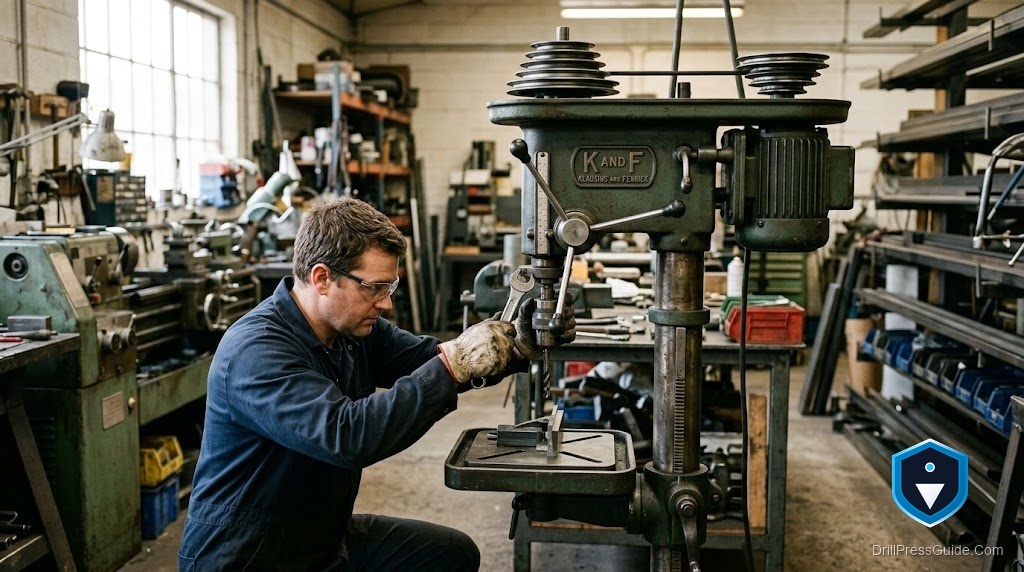
A production drill press is a machine configured for high-volume, repetitive drilling, typically a heavy floor press with a continuous-duty motor, a wide and quickly changed speed range, and features aimed at repeatability: a positive depth stop, a rigid slotted table for fixtures, and often power feed and coolant. Some production settings use multi-spindle heads or gang setups, but at its core the production drill press is about doing the same operation reliably, over and over.
Choosing a production drill press
Choose by the demands of the job, weighing a handful of traits.
Duty rating and motor. Production means the machine runs for hours, so a continuous-duty motor sized for the work is essential. An intermittent-duty home-grade motor overheats and fails under a production load.
Rigidity and mass. Repeated heavy cuts demand a rigid column and heavy castings to hold accuracy and resist vibration. A flexible machine drills oversized, out-of-round holes as it wears.
Speed range and change. Running the correct speed for each material and bit protects tooling and finish, and in production you want to change speed quickly, through a gearbox or variable-speed head rather than moving a belt.
Depth control and feed. A positive, repeatable depth stop is the heart of production drilling, since every hole must reach the same depth. Power feed, where available, keeps the feed rate consistent and spares the operator.
Table and fixturing. A rigid slotted table that accepts vises and fixtures lets you set up once and repeat, which is where production efficiency comes from.
Match these to the actual work. Buying more machine than the run requires wastes money; buying less means a machine that cannot keep up or hold tolerance.
Setting up for repeatability
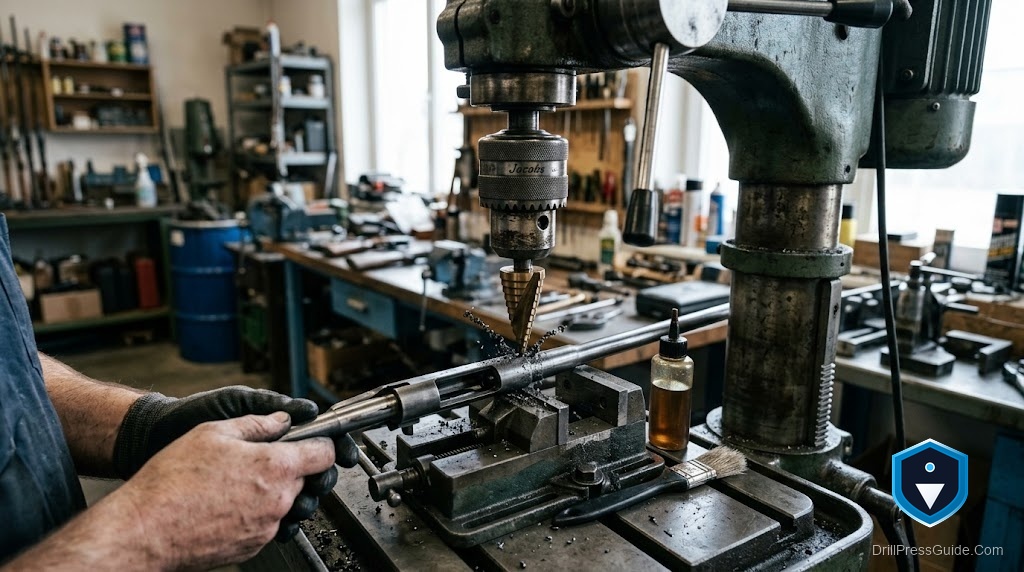
Production efficiency lives in the setup. Fixture the work so every piece sits in the same place, using a vise or a purpose-made fixture bolted to the slotted table. A heavy cast-iron drill press vise holds stock securely and repeatably against the drilling torque, and for parts that must be positioned precisely under the spindle, a cross-slide drill press vise lets you set coordinates and return to them, at the cost of some rigidity. Set the depth stop once for the run so every hole matches. Choose the correct speed for the material and bit, and set up coolant for metal to protect the bits across a long run.
The goal is a setup where the operator loads a part, drills, and unloads, with the machine enforcing the depth and position rather than relying on the operator’s judgment each time. That is what makes production drilling fast and consistent.
Using it well over a long run
Running production well means protecting the tooling and the machine. Keep bits sharp and swap them before they dull enough to oversize holes or overheat, since a dull bit in a long run ruins parts and works the machine hard. Keep coolant flowing on metal. Clear chips regularly so they do not pack and mar the work. And keep the chuck running true; a worn chuck drilling off center scraps parts, so if runout climbs, confirm the arbor taper and fit a fresh chuck matched to it. Check the depth stop periodically to confirm it has not drifted.
Conclusion
A production drill press is chosen for duty rating, rigidity, quick speed change, positive depth control, and a fixturable table, and it is set up so the machine enforces depth and position while the operator simply loads and drills. Choose the machine to match the run, fixture the work for repeatability, set the depth stop and speed once, and protect the tooling with coolant and timely bit changes. Done right, production drilling turns a thousand identical holes into a smooth, consistent shift rather than a fight with the equipment.
Three takeaways: a continuous-duty motor and rigid mass are the foundation of a production press, repeatability comes from fixturing and a positive depth stop, and sharp bits with coolant protect a long run.
Frequently Asked Questions
What is a production drill press? A machine configured for high-volume, repetitive drilling, typically a heavy floor press with a continuous-duty motor, quick speed changes, a positive depth stop, a fixturable slotted table, and often power feed and coolant.
How do I choose a production drill press? Match the duty rating, rigidity, speed range, depth control, and table to the run. A continuous-duty motor and rigid castings are essential; buying more or less machine than the work needs is costly either way.
How do I make repeated holes identical? Fixture the work so every piece sits in the same place, set the depth stop once for the run, and choose the correct speed, so the machine enforces depth and position rather than relying on operator judgment each time.
Do I need power feed for production drilling? It helps by keeping the feed rate consistent and sparing the operator over a long run, but a well-set depth stop and good fixturing deliver most of the repeatability on many jobs.
How do I protect tooling over a long run? Keep bits sharp and swap them before they dull, keep coolant flowing on metal, clear chips regularly, and keep the chuck running true, replacing a worn one that drills off center.
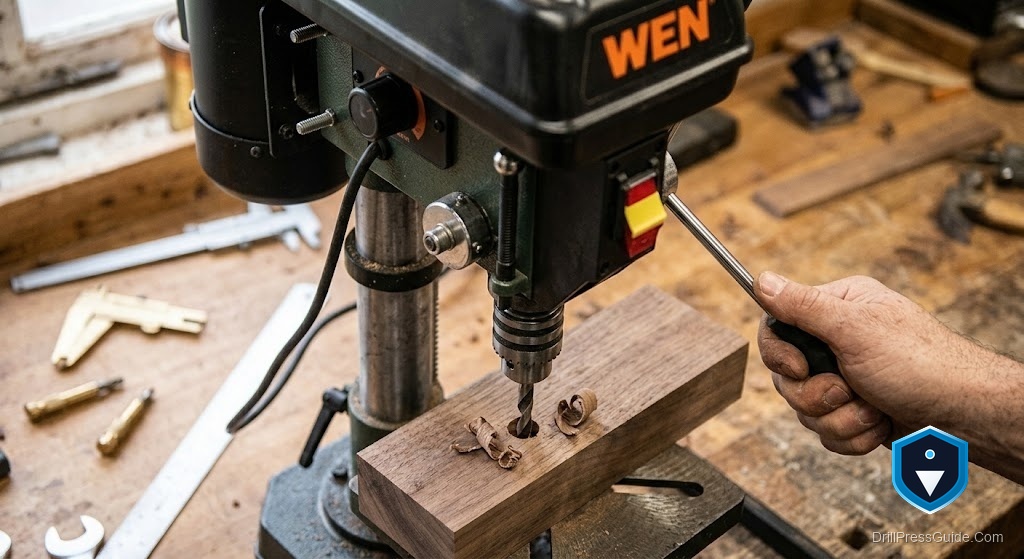
Can a benchtop drill press do production work? Only light, low-volume runs. Sustained production needs the continuous-duty motor, mass, and depth control of a heavier machine, since a benchtop press overheats and loses accuracy under a production load.
References
- VintageMachinery.org, industrial machine tool references and literature. http://vintagemachinery.org
- Jacobs Chuck Manufacturing, Mounting and Removing Chucks. http://www.jacobschuck.com/uploads/ueditor/file/20200604/1591240204146153.pdf