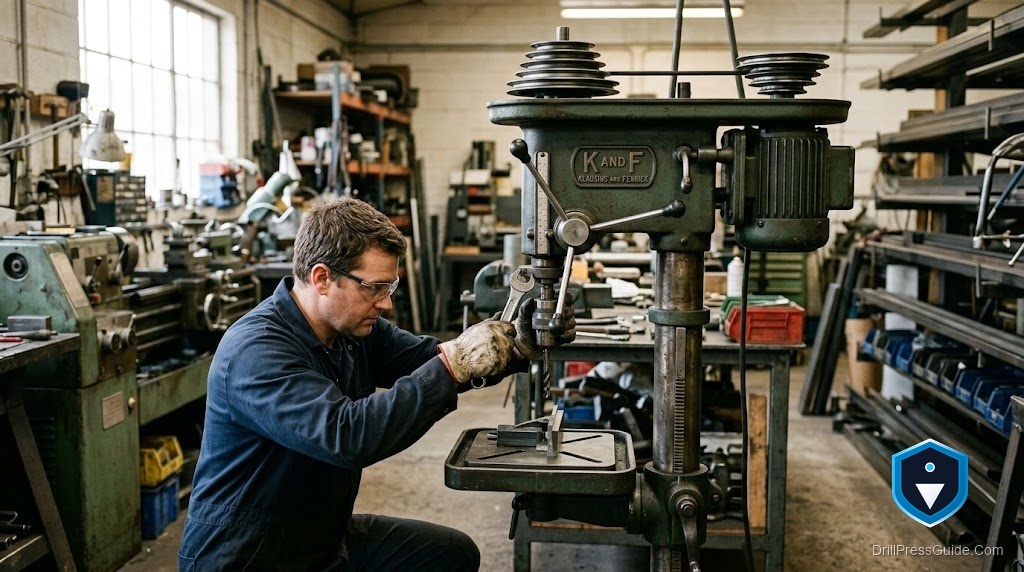
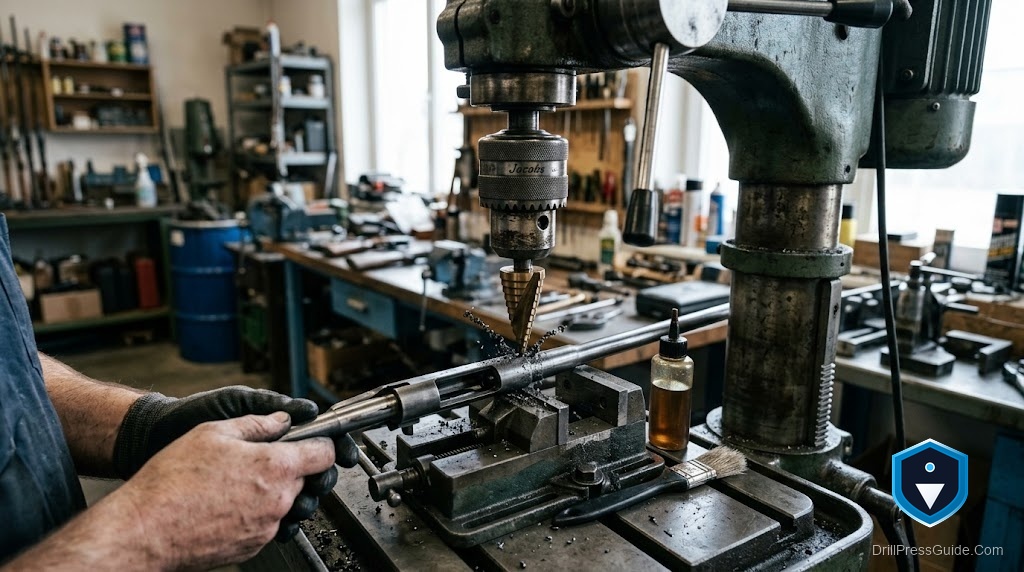
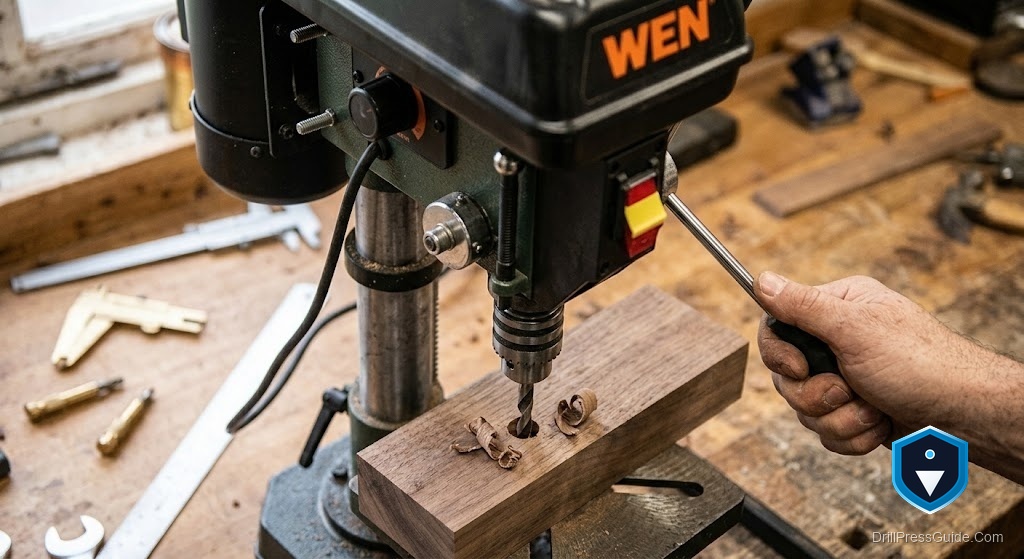
Floor Mounted Drill Press: What It Is and Who Actually Needs One
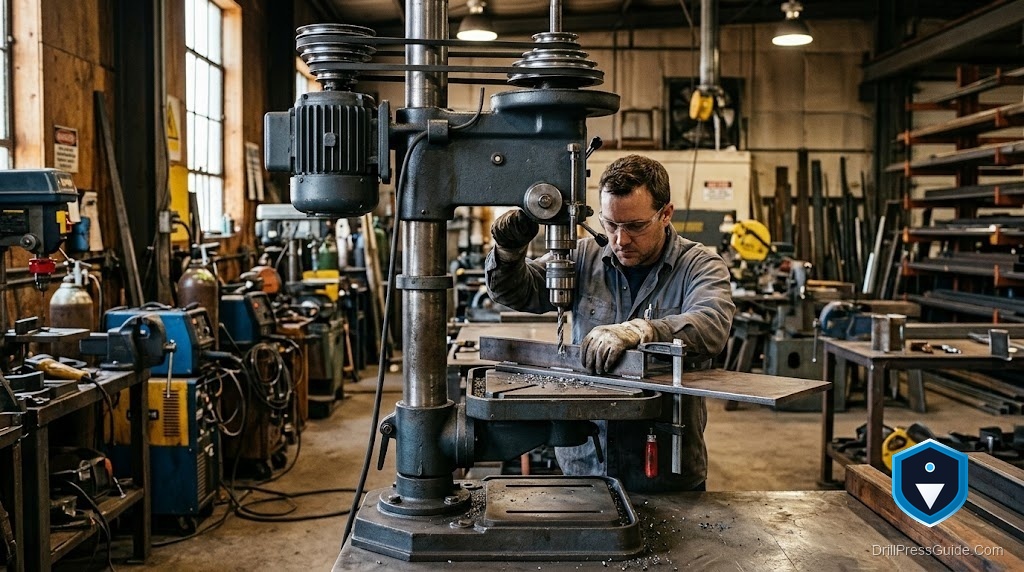
Stand in front of a floor drill press and it announces itself: a tall column bolted to the ground, a big table you can raise waist high, and enough reach to swallow a door or a long piece of steel. It is the machine you graduate to when a benchtop model keeps running out of room. But floor presses are a real commitment in space and setup, so the honest question is not whether they are better, they usually are, but whether you actually need one.
A floor mounted drill press is a stationary drilling machine whose column stands on the floor rather than sitting on a bench, giving it greater height, larger capacity, more power, and a bigger work table than a benchtop model. That floor-standing design is what lets it handle tall and long workpieces and heavier, more repetitive drilling.
Short answer: you need a floor mounted drill press when your work is too tall, too heavy, or too demanding for a benchtop machine, or when you drill often enough that capacity and power pay off daily. If your work is small and occasional, a benchtop model saves space and money; the floor machine earns its footprint only when you regularly push past what a benchtop can do.
What the floor-standing design buys you
The long column is the whole point. It gives far more distance between the chuck and the table, so tall workpieces fit, and it lets you slide the table down and drill big items on the base itself. Floor presses generally pair that with stronger motors, more speed steps, greater spindle travel, and a heavier, more rigid build. The payoff is capacity and steadiness: bigger holes in thicker stock, longer workpieces held securely, and less vibration on demanding cuts. If your projects keep bumping against a benchtop machine’s height and power ceiling, that headroom is exactly what a floor model adds.
The costs: space, mobility, and money
That capability comes with real tradeoffs. A floor press claims a permanent piece of floor and stands too tall and heavy to tuck away, so a cramped shop feels its footprint immediately. It should be leveled and, in many cases, secured so a top-heavy machine cannot tip. It costs more than a comparable benchtop model. And it is not something you carry to a job; it stays put. None of these are dealbreakers for a busy shop, but for someone drilling a few holes a month they are a lot of commitment for capacity that mostly sits idle.
Matching the machine to your work
Decide by looking honestly at what you drill. If you regularly work with long boards, tall assemblies, or thick metal, or you drill often and want speed and rigidity, the floor press is the right tool and will feel like a relief after a cramped benchtop. If your work is small parts, thin stock, and occasional holes, a benchtop machine gives you most of the function for a fraction of the space and cost. Also weigh what you can host: enough floor, a solid level surface, and the ability to secure the machine. Buying more capacity than your work and your shop can use is a common and expensive mistake.
Setting one up right
Put a floor press on a solid, level floor and level the machine so the table sits true to the spindle, shimming the base as needed. Secure it against tipping where appropriate, especially in a busy shop, since the machine is tall and top-heavy. Set it where long stock has clearance to hang past the table and where you can reach the work and the controls comfortably. Square the table to the chuck and confirm with a test hole. Guard the spindle, and keep the surrounding floor clear so you are never handling long workpieces in a cramped space. A well-sited floor press feels effortless; a poorly placed one fights you on every large piece.
Conclusion
A floor mounted drill press trades bench space and money for capacity, power, and rigidity, and that trade is worth it precisely when your work is tall, heavy, or frequent enough to use what it offers. Its long floor-standing column is what handles big workpieces and demanding drilling that a benchtop machine cannot. But it claims permanent floor space, needs leveling and securing, and never leaves the shop, so a smaller or occasional user is better served by a benchtop model. Match the machine to the work you actually do, site it well, and a floor press becomes the steady workhorse a serious shop is built around.
Frequently asked questions
What is a floor mounted drill press? A stationary drilling machine whose column stands on the floor, giving greater height, capacity, power, and a larger table than a benchtop model, so it handles tall and heavy work.
How is it different from a benchtop drill press? Mainly the floor-standing column, which adds height between chuck and table for tall workpieces, along with generally stronger motors, more spindle travel, and a heavier, more rigid build.
Do I need a floor press or a benchtop one? Choose floor if you regularly drill tall, heavy, or frequent work. Choose benchtop if your work is small and occasional, since it saves space and money while covering most light tasks.
Does a floor drill press need to be secured? Often yes. It is tall and top-heavy, so leveling it and securing it against tipping is wise, especially in a busy shop where it could be bumped.
Can it drill large items on the base? Yes. You can lower or swing the table and drill tall or large workpieces on the base itself, which is one of the main advantages of the floor-standing design.
Is a floor press portable? No. It is heavy and stays in one place, so it is not something you carry to a job. If portability matters, a benchtop machine or a portable drill guide fits better.
References
- OSHA, Machine Guarding eTool: Drill Presses, osha.gov
- Vintage Machinery, drilling machine references, vintagemachinery.org