Can You Convert a Bench Drill Press to a Floor Model? An Honest Look
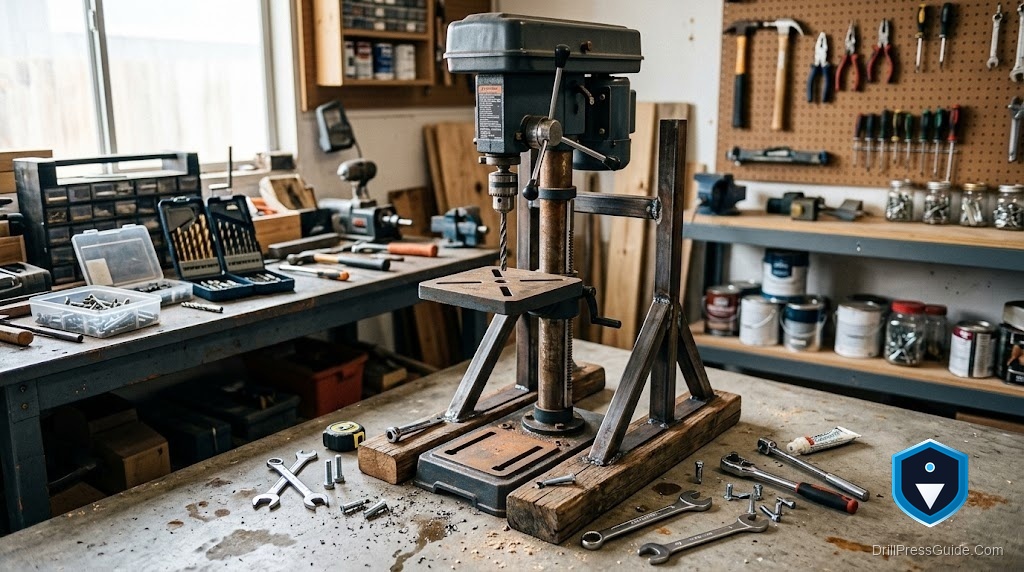
It is a tempting idea. You have a solid benchtop drill press, you wish it stood on the floor with more room under the chuck, and somewhere online someone swears they just bolted theirs to a taller pipe and called it a floor model. Before you buy a length of steel and start drilling mounting holes, it is worth understanding what actually separates a bench machine from a floor machine, because the difference is not just the length of the column, and getting it wrong turns a precise tool into a wobbly one.
Converting a bench drill press to a floor model means replacing or extending the short column of a benchtop machine so the head sits at standing height over a floor-mounted base, giving more distance between the chuck and the work below. The head, motor, and spindle stay the same; what changes is how far off the ground the machine stands and how it is supported.
Short answer: it is sometimes possible, but it is usually not worth it. A longer column adds leverage and vibration that a benchtop head and base were never designed to handle, so a home conversion often trades away the rigidity that made the machine accurate. In most cases you are better off using the bench machine as it is, or buying a purpose-built floor model. There are a few situations where a careful conversion makes sense, and this covers both sides honestly.
What actually separates a bench machine from a floor machine
The obvious difference is column length, but the real difference is how the whole machine is engineered around that length. A floor drill press has a thicker, longer column, a heavier base bolted to the floor, and often a beefier head casting to stay rigid over that span. A benchtop machine has a short, thinner column and a light base meant to be clamped to a bench, which itself adds stiffness. Lengthen the column without upgrading the base and head, and you have created a tall lever with a heavy weight at the top and not enough support at the bottom. That is a recipe for flex and vibration, which show up as holes that wander and a chuck that chatters.
Why a longer column changes the physics
A drill press works because the spindle stays rigidly square to the table under downward force. The taller the column, the more any tiny flex at the base gets multiplied at the head, the same way a long ruler waves more at the tip than a short one. Cutting forces and motor vibration that a short column shrugs off can set a tall one humming. So a conversion is not just a mechanical fit problem, it is a stiffness problem, and stiffness is exactly what you are paying for in a good drill press.
When a conversion can actually work
There are honest exceptions. If your benchtop machine was designed with a modular column and the manufacturer sells a longer column or a floor-standing base kit for that exact model, that is a real, supported path, because the parts are engineered to keep the machine rigid. Some machine lines share a head across bench and floor versions precisely so the column can be extended. In that case, buy the manufacturer’s kit for your model and follow its instructions. That is a very different thing from welding your own pipe and hoping.
When to skip it
Skip a homemade conversion when you would be fabricating your own column, mixing in a base that was not made for the machine, or extending a light benchtop head far beyond its design. The money and hours you would sink into steel, machining, and trial and error usually approach the cost of a proper floor machine that is rigid by design and carries a warranty. And the failure mode is not just wasted effort; a top-heavy converted machine can be genuinely unsafe if it flexes or tips under load. If your real need is more height under the chuck for occasional tall work, a taller sturdy stand for the bench machine, or simply drilling the tall piece on its side, often solves the problem without touching the column.
Conclusion
Converting a bench drill press to a floor model is one of those projects that sounds clever and usually is not. The column length is only the visible part; the hidden part is the rigidity engineered into a floor machine’s base, column, and head, and that is exactly what a homemade extension gives away. The one path worth taking is a manufacturer’s floor-conversion kit made for your specific model, where the parts are designed to keep the machine square and stable. Short of that, use the bench machine as intended, raise it on a solid stand if you need height, or buy a floor model built for the job. A drill press only earns its keep when it drills straight, and straight comes from stiffness, not from a taller pipe.
Frequently asked questions
Can any benchtop drill press be converted to a floor model? No. Only machines with a manufacturer-supported longer column or floor-base kit convert cleanly. A homemade extension usually sacrifices the rigidity that keeps the machine accurate.
What is the real difference between a bench and floor drill press? More than column length. Floor machines have thicker, longer columns, heavier floor-mounted bases, and often stouter heads, all engineered to stay rigid over a longer span.
Why does a longer column cause problems? A taller column multiplies any flex at the base and amplifies vibration, so a head and base designed for a short column can flex and chatter, producing holes that wander.
Is a homemade floor conversion safe? Often not. A top-heavy machine on an unsupported extension can flex or tip under load. Only use engineered parts made for your specific model.
What if I just need more height under the chuck? Raise the bench machine on a sturdy stand, drill tall work on its side, or move to a purpose-built floor model. These solve the height problem without compromising rigidity.
Is it cheaper to convert or buy a floor drill press? By the time you buy or fabricate a column and base and machine everything to fit, a homemade conversion often approaches the cost of a proper floor machine that is rigid by design.
References
- OSHA, Machine Guarding eTool: Drill Presses, osha.gov
- WEN Products, drill press specifications and manuals, wenproducts.com