Floor Mount Drill Press: A Practical Guide for the Workshop
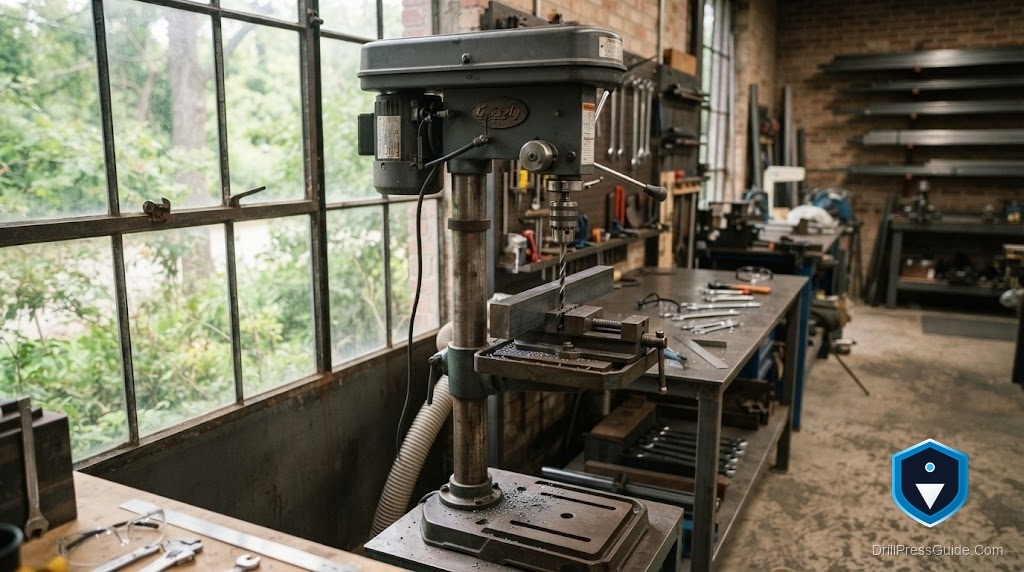
A floor mount drill press is not just a taller version of a benchtop machine. It is a different class of tool with a different purpose, different setup requirements, and a different place in the workflow of a busy shop. The name refers to the fact that the press stands on its own base rather than sitting on a workbench. That simple change in mounting opens up capacity, stability, and workpiece handling that a benchtop press simply cannot match.
I have used floor mount presses in woodworking shops, metal fabrication garages, and shared workspaces where the machine is the anchor of the drilling station. The good ones feel like industrial equipment. The bad ones feel like a benchtop press on a stand, with the same vibrations and the same limitations, just higher off the ground. Here is what a floor mount press actually is, how to set it up, and how to use it without fighting the machine.
What Floor Mount Means in Real Terms
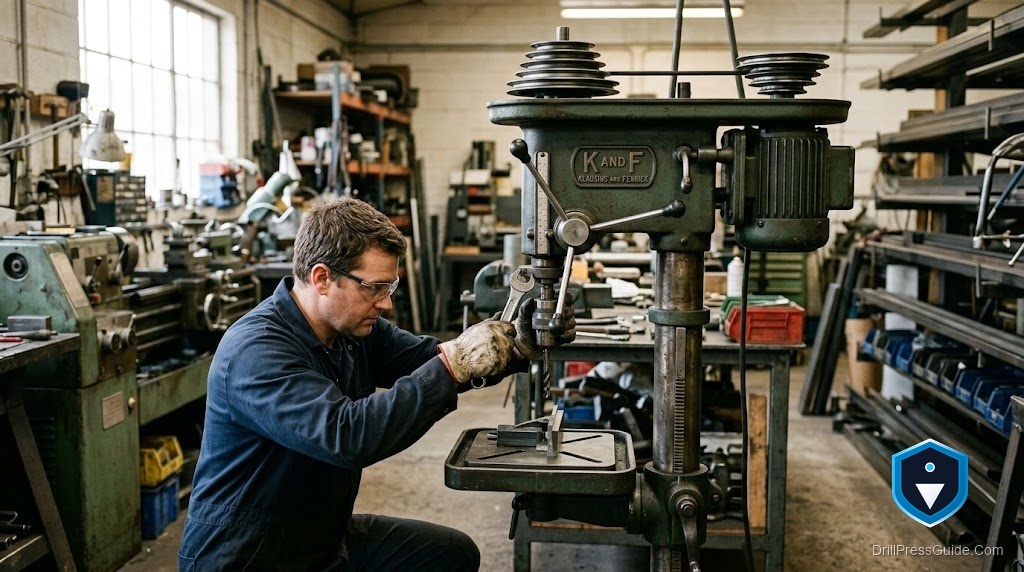
A floor mount drill press is a self-standing machine with a base that sits directly on the floor. The column is typically four to five feet tall, which gives you enough height to drill into large workpieces, tall assemblies, and thick stock without the bench getting in the way. The swing is usually twelve to seventeen inches, which means you can drill the center of a workpiece up to twenty-four to thirty-four inches wide. The motor is larger, often three-quarters to one horsepower, and the base is heavy enough to absorb vibration and resist walking under load.
The trade-offs are space and mobility. A floor mount press needs a dedicated spot. It is not moving once you stand it up and bolt it down. It also weighs enough that moving it requires help, a dolly, and a plan. You need a level floor, enough ceiling height for the column, and clearance around the machine for the handles and the workpiece.
Setup and Placement
Before you unbox the press, plan the location. You need a flat, level floor. A concrete floor is ideal. A wood floor is fine if it is level and the joists can handle the weight. A sloped or uneven floor will make the press lean, and a leaning press drills holes that are not square to the face.
Measure the height. A floor mount press is typically five to six feet tall. You need ceiling height for the full column, plus clearance for lighting and ventilation. A six-foot press in a seven-foot ceiling is tight but workable. In a standard eight-foot ceiling, it is comfortable.
Leave clearance around the machine. You need space for the feed handles, which stick out on both sides. You need space in front for the workpiece. And you need space behind for the column and any material that extends past the table. A minimum footprint of three feet by four feet is practical, and more is better.
Assembly is straightforward but requires help. The headstock, column, table, and base come in separate pieces. The headstock is heavy, and lifting it onto the column is a two-person job. The table slides onto the column and is secured with a clamp. The base bolts to the floor or sits on pads to prevent scratching. Once assembled, the press is checked for square, the table is aligned, and the belt tension is set.
Using the Press for Large Work
The main advantage of a floor mount press is capacity. You can drill the center of a door panel, a tall cabinet side, or a stack of steel plate. The table is larger, typically ten to twelve inches square or more, and it rotates and tilts for angled work. The rack-and-pinion height adjustment lets you raise and lower the table quickly to accommodate different workpiece sizes.
For large panels, use the table as a reference surface and clamp the panel with hold-downs or clamps. Do not rely on hand pressure to keep the panel in place. A large bit can grab the panel and spin it, which is dangerous and ruins the work. The table slots or T-tracks are there for this purpose. Use them.
For tall assemblies, you may need to remove the table entirely and drill into the base. Some presses have a base with a flat center section that accepts a workpiece directly. This is useful for drilling into the end of a long post or the center of a tall assembly that does not fit under the table. Check the manual for the maximum height without the table.
Maintenance and Longevity
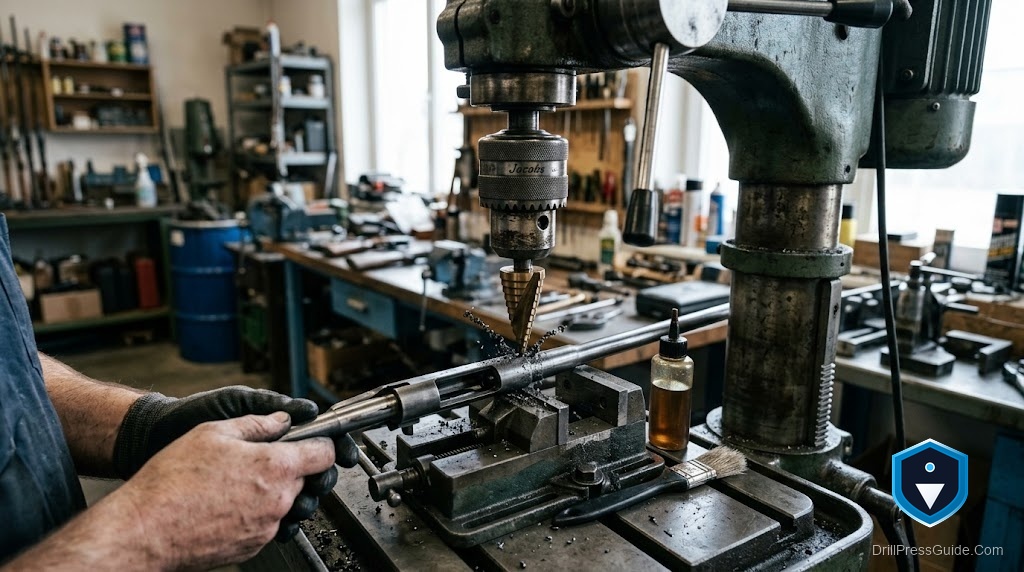
A floor mount press is built for daily use. The bearings are larger, the castings are thicker, and the motor is heavier. With proper care, it lasts ten to fifteen years or more. The maintenance is simple: keep the column clean and lightly greased, check the belt tension every few months, and replace the chuck when it develops excessive runout.
The table rack-and-pinion mechanism should stay smooth. If it binds, clean the rack and apply a light machine oil. The pinion gear is usually a softer metal, and aggressive cranking can wear the teeth. Raise and lower the table with steady pressure, not force.
The motor bearings are typically sealed and maintenance-free. If the motor starts to hum or vibrate, the bearings may be failing. Replacement is possible but requires disassembling the motor housing. For most home shops, a motor replacement is easier than a bearing repair.
Who Needs a Floor Mount Press
A floor mount press is for the shop that has outgrown the benchtop. It is for the woodworker who builds large furniture and needs to drill accurate holes in panels and assemblies. It is for the metal fabricator who drills thick plate and needs the torque and stability that a benchtop press cannot provide. It is for the production shop where the drill press is in constant use and the machine needs to keep up.
It is not for the beginner who is just learning to drill straight holes. It is not for the small shop where floor space is limited. And it is not for the hobbyist who drills a few holes a month. A benchtop press is the right tool for that shop. A floor mount press is the upgrade you make when the benchtop becomes the limiting factor.
The Verdict
A floor mount drill press is a serious machine for a serious shop. It gives you the height, the power, and the stability to handle large workpieces and demanding materials. The setup is more involved than a benchtop press, and the space requirement is real. But for the shop that needs the capacity, it is the only choice that makes sense. Buy it for the work you do, place it where it will live, and maintain it with the same care you give your table saw or lathe. It will outlast the benchtop press by a wide margin and handle work that the smaller machine cannot touch.
FAQ
How much floor space does a floor mount press need? Plan for a footprint of about two feet by two feet, plus clearance for the handles and the workpiece. A three-foot by four-foot area is practical. You also need ceiling height for the full column.
Can I move a floor mount press if I rearrange my shop? Technically yes, but practically no. They weigh hundreds of pounds. Move them with help, a dolly, and a plan. Once in place, they stay put.
Do I need to bolt it to the floor? Not always, but it helps. Bolting prevents tipping and reduces vibration. If the floor is concrete, use expansion bolts. If it is wood, use lag bolts into the joists. If you cannot bolt it, place it on a heavy rubber mat to prevent walking.
What is the minimum ceiling height? A five-foot press needs at least six feet of clearance. A six-foot press needs at least seven feet. Add extra clearance for lighting and ventilation. An eight-foot ceiling is comfortable for most floor presses.
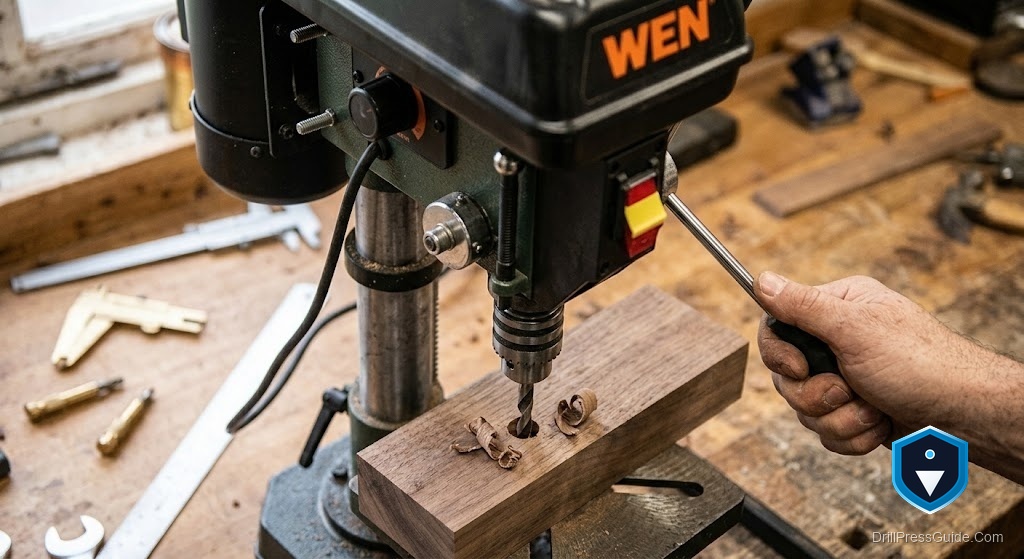
Can I use a floor mount press for woodworking? Yes, and it excels at it. The larger table, longer column, and more powerful motor make it ideal for large panels, thick stock, and deep mortising. Many floor presses live in woodworking shops.
How heavy is a typical floor mount press? Two hundred to three hundred pounds is common for a mid-range model. Larger industrial models can weigh five hundred pounds or more. The weight is part of the stability. A light floor press is a contradiction.
What motor size should I look for? Three-quarter horsepower is the minimum. One horsepower is better for heavy work. Less than three-quarter horsepower, and you are paying for height without getting the power that justifies the size.
Can I use the same bits as my benchtop press? Yes. The chuck size and spindle taper are standard. Any bit that fits a benchtop press will fit a floor press. The difference is the capacity and the power, not the tooling.
How long does a floor mount press last? With proper care, ten to fifteen years or more. The bearings are larger, the castings are thicker, and the motors are heavier. In a busy shop, they outlast benchtop presses by a wide margin.
Should I buy a used floor mount press? Yes, if you can inspect it. Check the bearings for play, the table crank for smoothness, and the column for rust or damage. A used quality press is often a better value than a new cheap one.