Industrial Metal Drill Press: The Setup Details That Change the Result
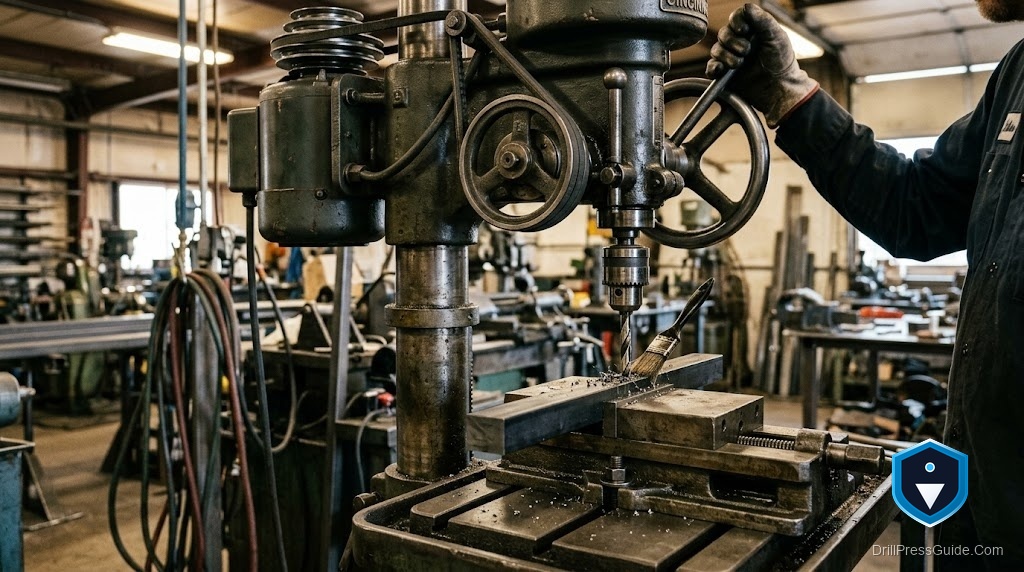
Stand next to a real industrial drill press and the first thing you notice is that it barely moves. You lean into the feed handle and the column does not flex, the table does not shudder, and the hole comes out round. That stillness is the whole point. An industrial metal drill press is bought for rigidity and repeatability, and the difference it makes shows up long before you ever touch the speed dial.
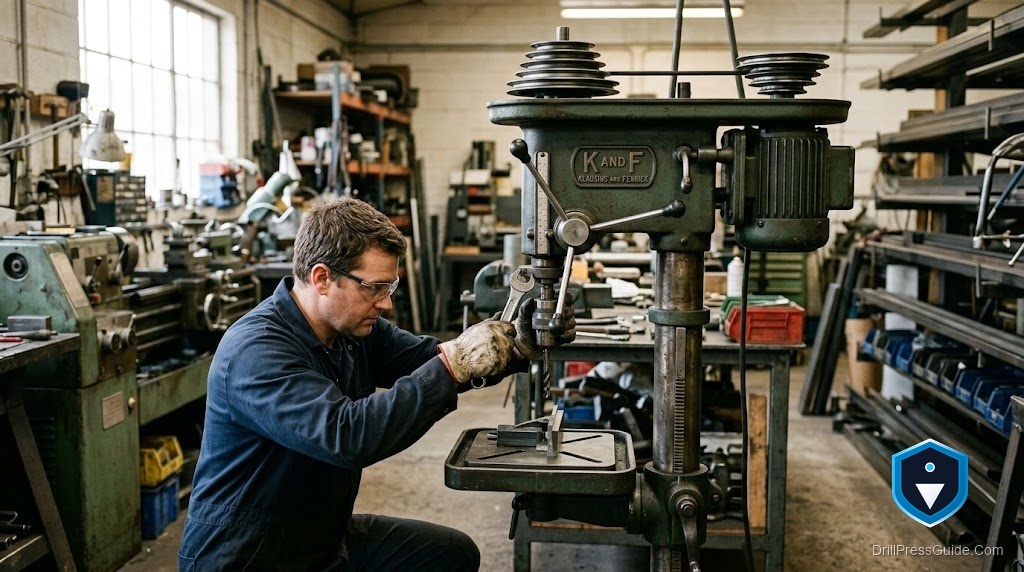
An industrial metal drill press is a heavy, floor-standing machine built to drill ferrous metal accurately and often, with a stiff cast iron column, a large flat table with T-slots, a powerful induction motor, and a wide speed range reaching down into the low hundreds of RPM. The word that separates it from a hobby press is mass.
If you are drilling steel all day, the setup details matter more than the badge: get the machine bolted down, the table trammed, the work clamped in a proper vise, and the speed set to the metal, and even a value machine will outperform an expensive one used carelessly. Here is what actually changes the result.
What makes a press count as industrial
Three things, mostly. Mass, because a heavy head and column resist the deflection that turns a round hole oval. Motor type, because a true induction motor holds RPM under load instead of bogging like a universal motor. And travel, because drilling thick stock in a single pass needs 4 inches or more of spindle stroke.
Many home shops do not need a genuine industrial machine, and that is worth saying plainly. A stout benchtop or a value floor model, set up well, drills clean steel. The industrial class earns its keep when the work is constant, the holes are large, or tolerances are tight enough that a flexing column shows up in the part.
The setup details that change everything
Bolt it down. A floor press that can rock will chatter, and chatter is the enemy of a clean hole. Lag the base to the floor or to a heavy stand. This single step fixes more accuracy complaints than any upgrade.
Tram the table. The table has to sit square to the spindle. Check it with a rod and a square, or a dial indicator swept across the surface. A table that is off by a degree drills holes that are not perpendicular, and no bit fixes that.
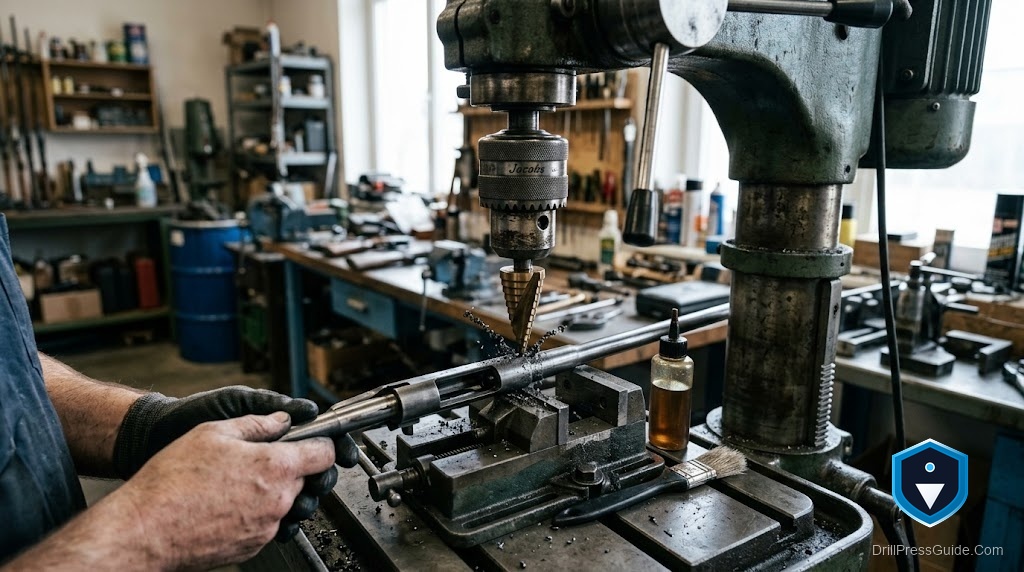
Clamp the work in a vise. A drill press vise like a hardened-jaw model keeps the part from spinning when the bit breaks through. Hand-holding steel is how people get hurt: the part becomes a spinning blade the instant the drill grabs.
Set speed to the metal. Mild steel wants roughly 80 to 100 SFM, stainless drops to 20 to 40 SFM. Convert with RPM = (SFM x 3.82) / diameter. A machine that reaches down near 150 RPM lets you run large bits in steel without cooking them.
A floor machine that gets the fundamentals right
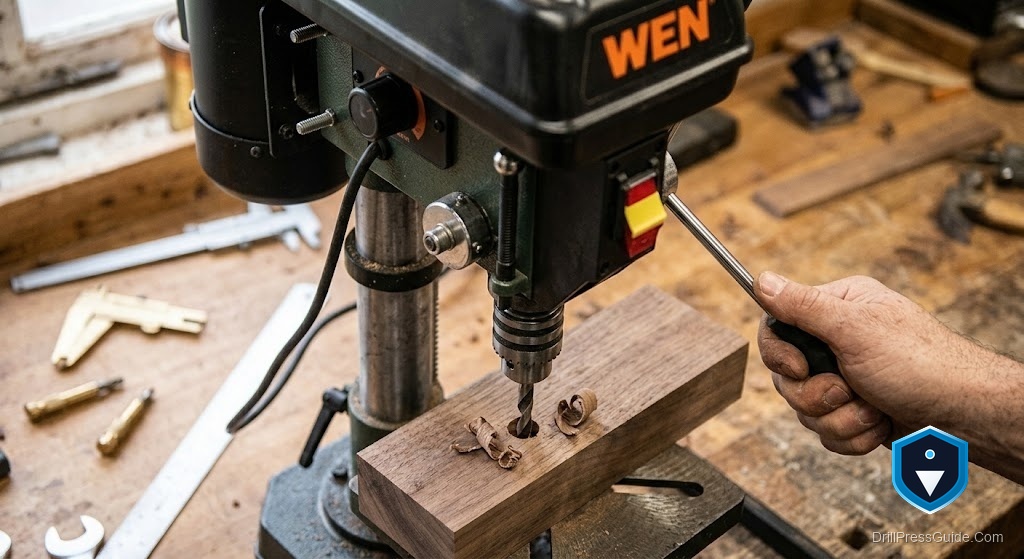
For a small shop that wants industrial-style behavior without an industrial footprint, the WEN 4227T 17-inch, 12-speed floor drill press checks the important boxes: a 13-amp motor, 4-3/4 inches of spindle travel, a 14-by-14 cast iron table, a 5/8-inch chuck, and twelve speeds from 150 to 3150 RPM. That low end is what makes it usable on large-diameter holes in steel.
The honest drawbacks are real. At 214 pounds it is a two-person move, and changing speed means repositioning belts across three pulleys rather than turning a lever, which is slow if you switch materials often. It is also not a true production machine; run it hard all day on 1/2-inch holes in plate and you will feel its limits. A shop drilling steel continuously should look at heavier gear-head machines and treat this as the ceiling of the value class, not the start of the industrial one.
Tooling that suits ferrous work
An industrial setup deserves bits that hold up. A cobalt M35 twist drill set survives stainless and hardened steel where plain HSS glazes over. For repeat holes in the same spot, a drill press vise with hardened jaws and a solid stationary base keeps parts registered and hands clear. Keep cutting fluid on the bench; it is the difference between a bit that lasts a month and one that lasts an afternoon.
The verdict
A true industrial metal drill press is about rigidity and repeatability, and for most home and small-shop users the smarter move is a stout floor machine set up with care rather than a name on a casting. Bolt it down, tram the table, clamp the work, and match speed to the metal, and you will get industrial-grade holes out of value-grade money.
Worth remembering:
- Mass and a stiff column matter more than horsepower for hole quality.
- A trammed table and a bolted base fix most accuracy problems for free.
- Reach for a genuine industrial machine only when the work is constant or the tolerances are tight.
- Cobalt bits and cutting fluid protect the investment on every ferrous hole.
Frequently asked questions
What makes a drill press industrial rather than hobby grade? Mass, a true induction motor that holds speed under load, a large T-slotted table, generous spindle travel, and a speed range that reaches low enough for large bits in steel.
Do I need an industrial press to drill steel well? No. A rigid benchtop or value floor press, bolted down and set up correctly, drills clean steel. Industrial machines pay off with constant use, big holes, or tight tolerances.
What speed should an industrial press run for mild steel? Around 80 to 100 SFM, which is roughly 700 RPM for a 1/2-inch bit and 1400 RPM for a 1/4-inch bit.
How do I stop holes from coming out at an angle? Tram the table square to the spindle and confirm the base is not rocking. An out-of-square table is the usual cause.
Is a benchtop metal drill press ever enough? For light and occasional steel work, yes, if it is heavy and rigid. For heavy or frequent drilling, a floor machine with a low speed range serves better.
What accessories make the biggest difference on a metal press? A hardened-jaw drill press vise, cobalt bits, and cutting fluid. Together they improve safety, accuracy, and tool life at once.
References
- Carbide Depot, HSS Twist Drill Recommended Speeds and Feeds: https://www.carbidedepot.com/formulas-drills-speeds.htm
- Viking Drill and Tool, Drill Feeds and Speeds: http://www.vikingdrill.com/viking-Drill-FeedandSpeed.php
- University of Florida Design and Manufacturing Lab, Speeds and Feeds: https://web.mae.ufl.edu/designlab/Advanced%20Manufacturing/Speeds%20and%20Feeds/Speeds%20and%20Feeds.htm