Floor Drill Press for Metal: The Setup Details That Change the Result
A floor drill press is what people picture when they think of serious metal work: a tall column, a heavy cast base, and enough mass to drive a large bit through steel without flinching. The format earns that reputation, but the machine alone does not guarantee clean holes. The setup details around it, speed, workholding, fluid, and how you approach large holes, are what turn a heavy press into accurate steel work.
Quick answer: a floor press gives you the rigidity and speed range metal needs, and it pays off when you set the correct low speed, clamp the work solidly, use cutting fluid, and pilot large holes. The mass handles the force; your setup handles the accuracy.
What the floor format actually buys you
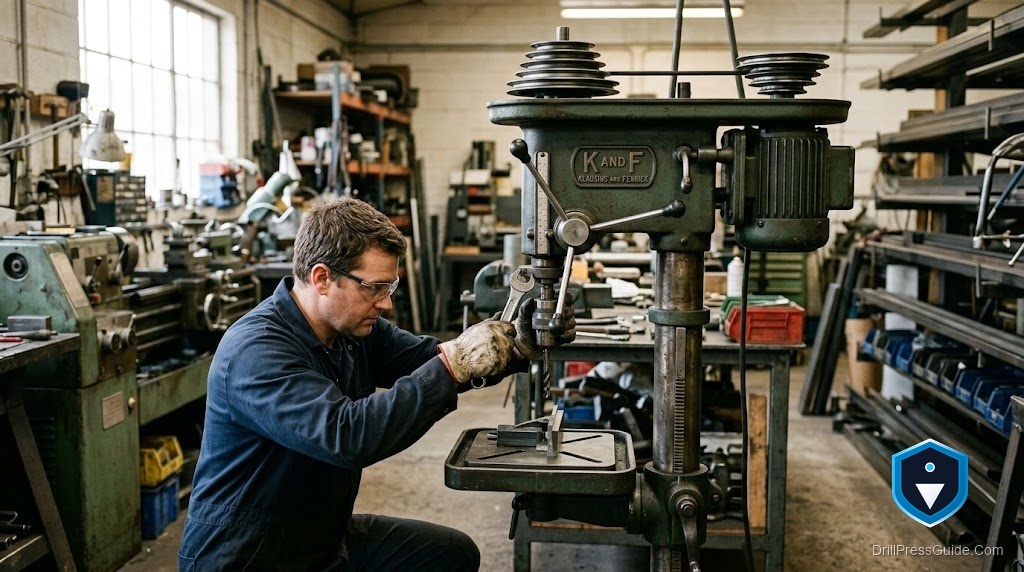
The advantage of a floor press for metal is rigidity and range. The heavy column and base resist the deflection that makes a lighter machine wander on big holes, and floor models usually offer lower speeds and more of them, which steel needs as bits grow. There is also table height and travel for taller work and fixtures. Those are real benefits for metal, but they only show up if the rest of the setup is right.
Set the speed low and deliberate
The most common mistake on a capable machine is running too fast because it can. Steel wants low RPM as diameter climbs: a half-inch hole in mild steel near 750, larger holes slower, stainless at roughly half those numbers. A floor press gives you those low speeds, so use them. The whole point of the machine’s speed range is lost if you leave it on a fast step and cook the bit.
Clamp to the heavy table
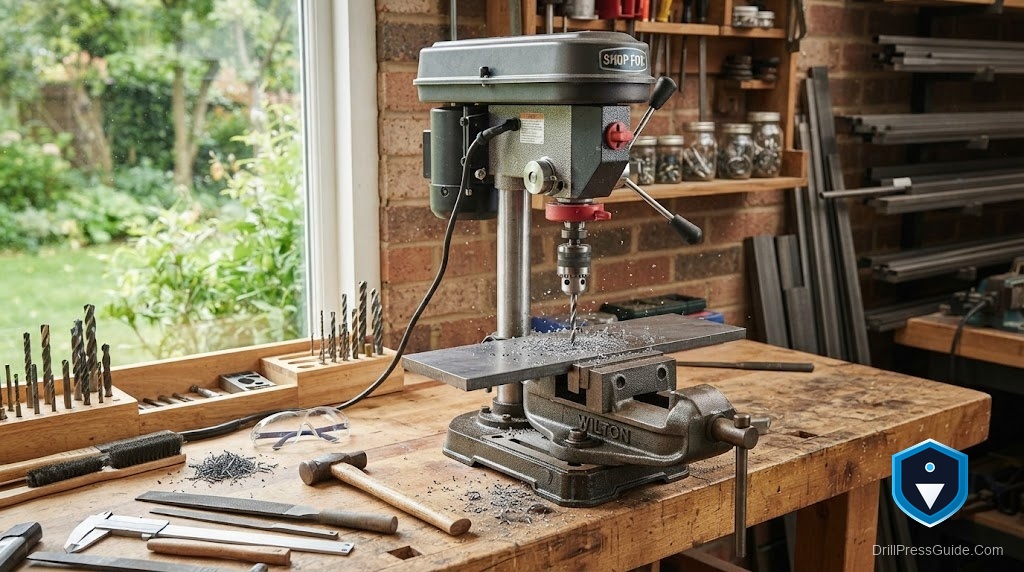
A floor press has a solid table, and that table is there to hold work, not just support it. Use a drill press vise bolted or clamped down, or clamp the workpiece directly. Steel grabs hard at breakthrough, and while the machine has the mass to stay put, the part does not. A spinning part on a powerful machine is more dangerous, not less, so clamping is non-negotiable.
Fluid and pilot holes for the large stuff
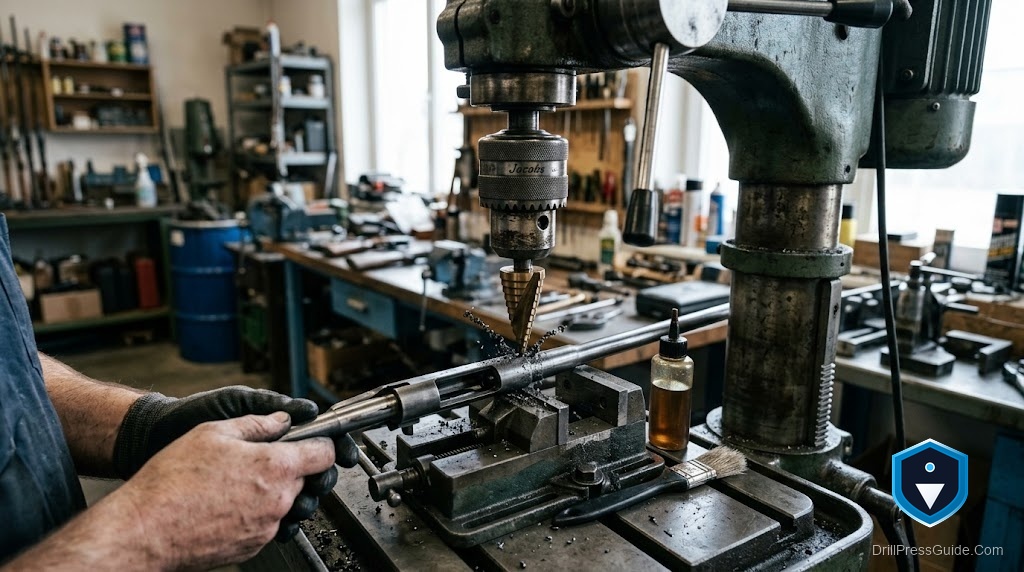
Large holes are where a floor press shines and where setup matters most. Pilot the hole with a smaller bit so the large bit’s center is not just pushing metal; this keeps it tracking true and eases the load. Apply cutting fluid generously and peck to clear chips from deep holes. The machine supplies the power and rigidity; fluid and piloting supply the clean, accurate result.
A capable floor machine
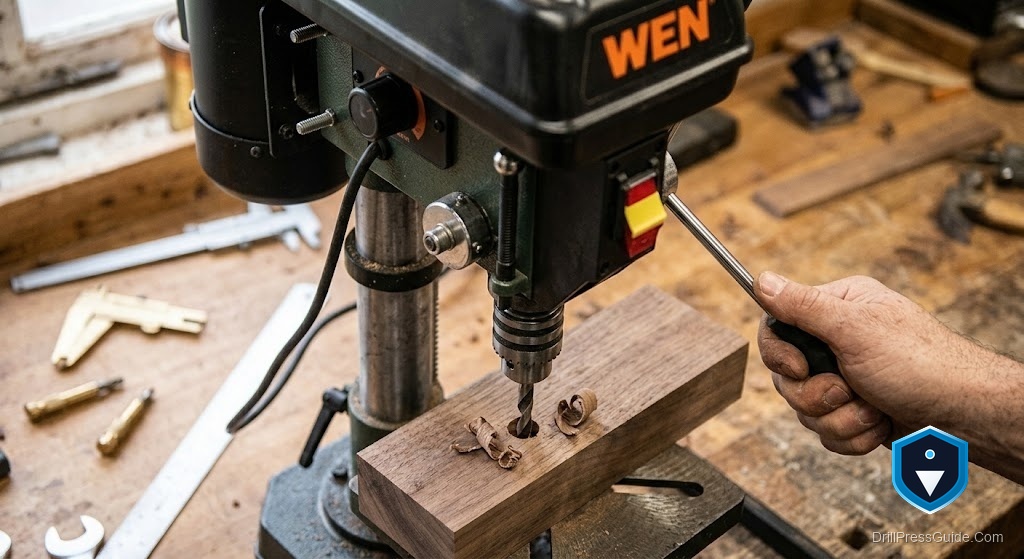
A solid floor press with a wide, low speed range suits sustained metal work. A machine like the WEN 4227T 12-speed floor-standing drill press provides twelve speeds down into the low range and the cast-iron mass to keep large bits steady in steel. That combination of low speed and rigidity is exactly what separates a metal-capable floor press from a machine built mainly for wood.
The verdict
A floor press is a strong foundation for metal, but the setup finishes the job:
- Use the low speed range the machine gives you instead of running fast.
- Clamp the work to the heavy table on every hole.
- Pilot large holes, use cutting fluid, and peck to clear chips.
Who does not need a floor press? Someone drilling small holes in thin metal occasionally. For regular large holes in steel, the rigidity and low-speed range change the result.
Frequently asked questions
Is a floor press always better than benchtop for metal? For large holes and heavy work, yes, because of rigidity and lower speeds. For small holes in thin metal, a good benchtop machine is enough.
Why does speed matter so much on a powerful machine? Power does not cancel heat. Steel still needs low RPM as bits grow, and running fast because the machine can is what burns bits.
Do I still need cutting fluid on a floor press? Yes. Fluid cools the edge and flushes chips no matter how heavy the machine. Rigidity does not replace cooling.
How do I drill a large hole cleanly? Pilot with a smaller bit first, set a low speed, apply fluid, and peck to clear chips. That sequence keeps the big bit tracking true.
What table setup works best for metal? A drill press vise clamped or bolted to the table, so the work cannot spin at breakthrough. Direct clamping works for larger pieces.
Can a floor press handle stainless? Yes, at roughly half the mild-steel speed for the diameter, with fluid and steady feed. The low speed range is what makes stainless workable.
References
- CCOHS, Metalworking Machines - Drill Presses: https://www.ccohs.ca/oshanswers/safety_haz/metalworking/drillpresses.html
- Dynabrade HSS Drill Speed Recommendation Chart: https://www.dynabrade.com/pdf/lit/D1201_Singles/D12.01_pg134.pdf
- Delta 17-900 Instruction Manual: https://powertool.manualsonline.com/manuals/mfg/delta/17900.html