Heavy Duty Drill Press for Metal: Match the Bit, Speed, and Support to the Job
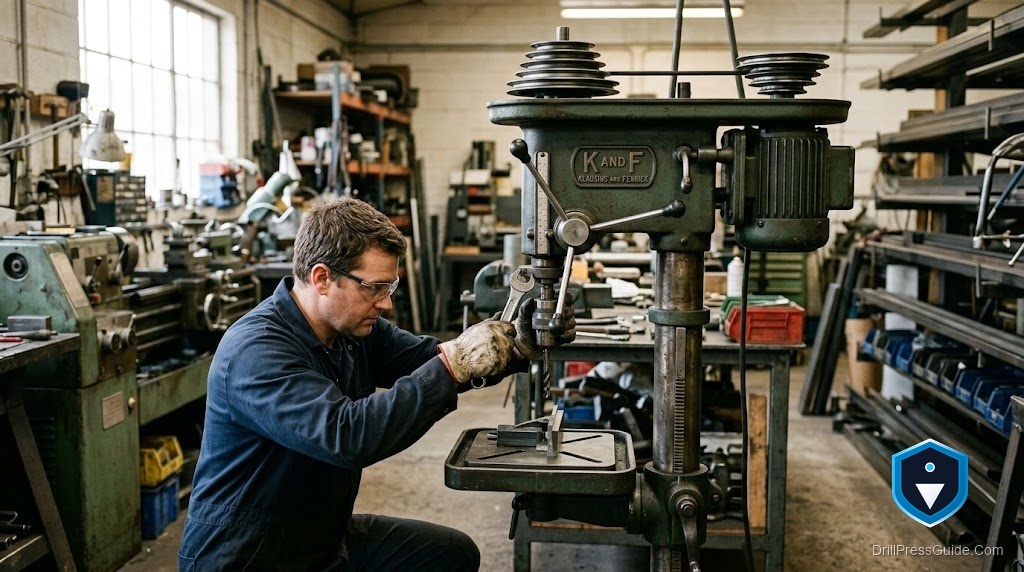
When people say they want a heavy-duty drill press for metal, they usually mean they are tired of a light machine that bogs down, chatters, and drifts the moment a large bit meets steel. The fix is not just a bigger motor. A metal-capable press combines power with the slow speeds steel needs, the rigidity to resist deflection, and a table solid enough to clamp real work. Get those together and large holes in steel stop being a fight.
Quick answer: for metal you want a press that reaches genuinely low speeds, has the mass and column strength to stay steady, and provides a stable table for clamping. Pair that machine with the right bit and cutting fluid, and it will drill steel cleanly and repeatedly.
Power is only useful with low speed
A strong motor drives a large bit through steel, but only if the spindle can turn slowly enough. Steel needs low RPM as diameter climbs, so a half-inch hole in mild steel wants around 750 RPM and larger holes want less. A machine with plenty of power but a high minimum speed will cook bits on big holes. Look at the low end of the speed range as carefully as the motor rating; both have to be right for metal.
Rigidity keeps the hole true
The force of a large bit in steel tries to deflect a light column and flex the quill, and that flex becomes an oversized, wandering hole. A heavy press with a large-diameter column and a substantial casting resists that force and keeps the spindle where you set it. This is why metalworkers reach for heavier machines: not for show, but because rigidity is what turns motor power into an accurate hole.
A machine built for steel
A sturdy floor-standing press with a wide speed range suits sustained metal work. A machine like the Klutch 13-inch 16-speed floor drill press pairs a cast-iron build with a speed range that reaches down for steel, so it can drive large bits without bogging or forcing you into a too-fast setting. The floor format adds the mass and table height that heavy metal work benefits from.
Match the bit to the metal
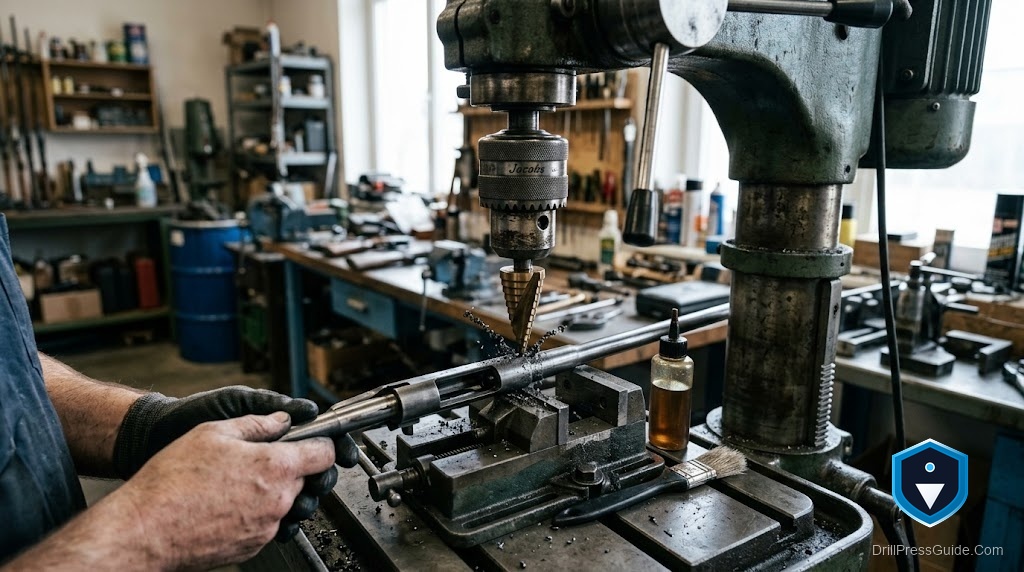
A heavy press still needs the right cutting tool. Cobalt bits handle steel and stainless because they hold an edge at the heat those metals generate. For large holes, pilot first with a smaller bit so the big bit tracks true and the machine works less. Keep bits sharp; a rigid machine driving a dull bit just generates more heat and a rougher hole. The machine and the bit are a pair, not substitutes for each other.
Support and fluid finish the job
Even the heaviest press needs the work clamped, because steel grabs hard at breakthrough. Use a solid drill press vise or clamp directly to the table. Apply cutting fluid to carry heat off the edge and flush chips, and peck deeper holes to keep the flutes clear. Rigidity, the right bit, fluid, and clamping together are what a heavy-duty setup really means.
The verdict
A heavy-duty metal press is a balance of power, slow speed, and rigidity:
- Check that the machine reaches genuinely low speeds, not just that it has a big motor.
- Favor a rigid, heavy build so large bits do not deflect the spindle.
- Pair it with cobalt bits, cutting fluid, pilot holes, and a solid clamp.
Who does not need this? Someone drilling only small, occasional holes in thin metal. Anyone driving large bits through steel regularly will feel every bit of the rigidity and low-speed range.
Frequently asked questions
Is a bigger motor enough for metal? No. Without a low speed range and a rigid build, power alone cooks bits and drifts holes. All three qualities have to be present.
Benchtop or floor for heavy metal work? Floor models tend to be heavier and more rigid, which suits large holes in steel. A stout benchtop can handle lighter metal work.
What is the lowest speed I should look for? Low enough to reach the mid-hundreds of RPM, since large holes in steel need slow, controlled cutting to avoid heat damage.
Do I still need cutting fluid on a heavy press? Yes. Fluid carries heat off the edge and flushes chips regardless of how strong the machine is. Rigidity does not replace cooling.
Why pilot large holes even with plenty of power? The center of a large bit pushes rather than cuts. A pilot hole lets the big bit track true and reduces the load on both the bit and the machine.
What bits should I use for steel? Cobalt for steel and stainless because they hold an edge under heat. Standard high-speed steel works on mild steel with fluid and correct speed.
References
- CCOHS, Metalworking Machines - Drill Presses: https://www.ccohs.ca/oshanswers/safety_haz/metalworking/drillpresses.html
- Dynabrade HSS Drill Speed Recommendation Chart: https://www.dynabrade.com/pdf/lit/D1201_Singles/D12.01_pg134.pdf
- Delta 17-900 Instruction Manual: https://powertool.manualsonline.com/manuals/mfg/delta/17900.html