Understanding K and F 16-Speed Floor Drill Press Before You Buy or Set One Up
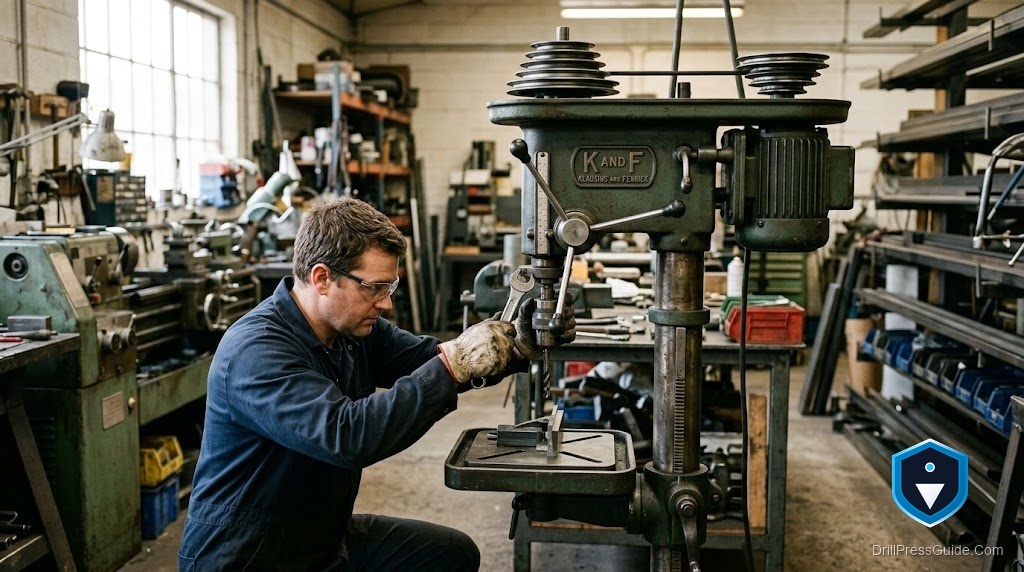
Browse used-tool listings and you will run into machines badged K&F, Cummins, Duracraft, and other names that no longer sell new. Many are 16-speed floor drill presses, and people find them cheap and wonder whether they are worth it. The honest answer starts by separating the badge from the spec, because what matters is not the brand on the head casting but what a 16-speed floor press actually is, what those sixteen speeds buy you, and what to check before you hand over any money.
A 16-speed floor drill press is a floor-standing machine with a belt-and-pulley drive arranged to offer sixteen fixed speed settings, giving a wide spread from low to high RPM for different bits and materials. Brand names like K&F are often older or store-brand machines, so judge them by condition and specs, not the label, and confirm parts and belts are still findable before buying.
What the 16 speeds actually mean
Sixteen speeds come from a belt running across stepped pulleys, often three pulleys with multiple steps, that combine into sixteen ratios. The point is range: a wide span from a low speed for large bits and metal up to a high speed for small bits in wood. It is the same belt-change principle as any pulley press, just with more combinations, so you can get closer to the ideal speed for each job than a five-speed machine allows. Matching speed to the bit and material is the core habit good setup guides such as Pro Tool Reviews stress, and more steps make that easier.
What sixteen speeds do not give you is the smooth, dial-a-number adjustment of a variable-speed machine. You still open the cover and move the belt to change speed, just with more stops to choose from.
Why the brand matters less than you think
Names like K&F, Cummins, and Duracraft were often importers or store brands, and many similar floor presses came from shared factories. So two machines with different badges can be nearly identical inside. That cuts both ways: a no-name 16-speed press can be perfectly good, but you cannot lean on brand reputation or a manufacturer’s support line. Judge the actual machine, its condition, rigidity, and runout, rather than the label.
The floor-standing advantage
The floor format is the other half of the description. A floor press has a tall column and stands on the ground, giving more spindle-to-table distance and headroom for long or tall workpieces than a benchtop model, plus more mass for stability. If you drill tall stock or want capacity, this is the reason to choose a floor machine. When buying new instead of used, a current floor press like the WEN 4227T floor-standing drill press shows the format’s strengths, a tall column, generous spindle travel, and a cast-iron table, with parts and support you can actually get.
Speeds and format compared
| Feature | 16-speed floor press | 5-speed benchtop | Variable-speed press |
|---|---|---|---|
| Speed choices | Sixteen belt settings | Five belt settings | Smooth, dialed |
| Speed change | Move the belt | Move the belt | Turn a dial |
| Capacity for tall work | High, floor column | Limited, benchtop | Varies by model |
| Best for | Range plus big-work capacity | Small shops, budget | Frequent material switching |
What to check before buying a used one
Because these are often older machines, inspect before you buy. Spin the chuck and look for runout or wobble, check the quill for side-to-side play, confirm the belt and pulleys are intact and that replacement belts are still available, and test that the speed-change mechanism and motor run smoothly. Look for rust, cracks in the casting, and a table that locks solidly. And remember the safety basics from OSHA and CCOHS apply the moment you power it up: bolt it down, clamp the work, keep the guard closed. A cheap floor press with worn bearings and no available belt is not a bargain.
The verdict
A 16-speed floor drill press is simply a floor-standing, belt-driven machine with sixteen speed settings, giving a wide RPM range plus the capacity of a tall column, and badges like K&F are often older or store brands to judge on condition rather than name. Three takeaways: sixteen speeds mean more belt steps and better speed matching, not smooth variable adjustment; the floor format buys capacity for tall work and stability; and with used machines, inspect runout, quill play, and belt availability before you buy. Who should consider one? Anyone wanting range and big-work capacity on a budget, provided the specific machine checks out.
Frequently asked questions
What is a 16-speed floor drill press? A floor-standing drill press whose belt-and-pulley drive offers sixteen fixed speed settings, giving a wide range from low to high RPM for different bits and materials, along with the capacity of a tall column.
Is a K&F drill press a good brand? K&F is often an older or store-brand machine, and many similar presses shared factories. Judge the specific machine by its condition, rigidity, and runout rather than the badge, and confirm parts are available.
Are 16 speeds better than fewer speeds? More speeds let you get closer to the ideal RPM for each bit and material, which helps finish and bit life. They do not give the smooth, dialed adjustment of a variable-speed machine, though.
How do I change speed on a 16-speed drill press? Unplug it, open the belt cover, and move the belt across the stepped pulleys to the combination shown on the speed chart. Sixteen speeds simply means more combinations to choose from.
What is the advantage of a floor drill press over benchtop? A taller column and more spindle-to-table distance for long or tall workpieces, plus more mass for stability. It is the format to choose when capacity matters.
What should I check when buying a used 16-speed floor press? Runout at the chuck, side play in the quill, intact pulleys and an available replacement belt, a smooth-running motor, no cracks or heavy rust, and a table that locks solidly.
Is a 16-speed press the same as variable speed? No. Sixteen speeds are still fixed belt settings you change by hand. Variable speed changes smoothly by dial without moving a belt.
References
- Pro Tool Reviews, How to Use and Set Up a Drill Press. https://www.protoolreviews.com/how-to-use-drill-press/
- OSHA, Woodworking eTool: Drill Press. https://www.osha.gov/etools/woodworking/production/machines-tools/drill-press
- CCOHS, Metalworking Machines: Drill Presses. https://www.ccohs.ca/oshanswers/safety_haz/metalworking/drillpresses.html