Can You Use Mortise Bit in a Drill Press? Capability, Limits, and the Safer Setup
It is one of the most reasonable questions a woodworker asks: you own a drill press, you need square holes for mortises, and a mortising chisel-and-bit looks like it might just chuck right in. The honest answer is more interesting than a flat yes or no, because a drill press can cut mortises, but only with the right attachment, and never by simply jamming a mortise bit into the chuck. Here is exactly what works, what does not, and how to set it up so you get clean square holes instead of a jammed, dangerous mess.
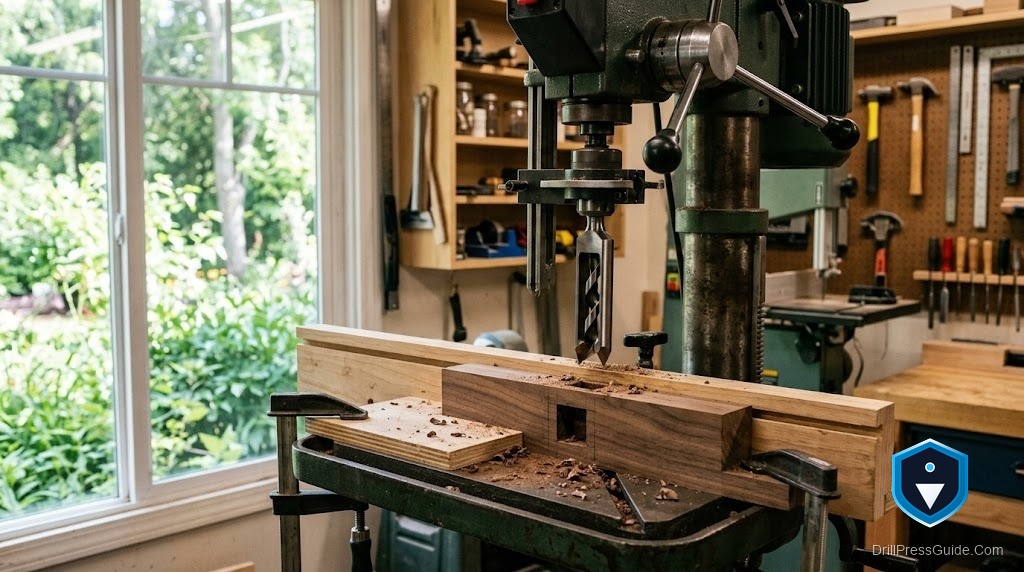
A mortising bit is really a two-part tool: a drill bit that spins inside a hollow square chisel that pares the corners. A drill press can drive that setup only through a proper mortising attachment that holds the square chisel while the bit spins inside it. You cannot use the chisel-and-bit without that attachment, so the attachment is the whole answer.
Short answer: yes, you can cut mortises on many drill presses, but only with a mortising attachment that holds the hollow chisel, not by chucking a mortise bit alone. You need an attachment that fits your press, such as the Grizzly H7789 kit, and a compatible model.
Why you cannot just chuck a mortise bit
The mortising system works because the hollow square chisel stays fixed while the auger bit spins inside it, clearing the waste while the chisel squares the corners. If you put the bit in the chuck alone, there is nothing to hold the chisel, and the square corners never get cut. Worse, without the attachment clamping and aligning the chisel, the setup is unsafe. The chisel must be held rigidly by an attachment, not by hand and not by the chuck.
So the real question is not “can the bit go in the chuck” but “does a mortising attachment fit my press.”
What actually works: a mortising attachment
A mortising attachment clamps to the drill press quill and column, holds the hollow chisel square to the table, and lets the bit spin inside it while you feed down. The Grizzly H7789 mortising attachment kit is a representative example: it ships with a column collar and a G9716 adapter and is specified to fit a defined list of presses, including the Grizzly G0485, G0491, G7943, G7944, G7947, and G7948, the Shop Fox W1680 and M1039, the Delta 11-990 and 17-900, and the JET JDP-17M.
That model list is the point. Mortising attachments are not universal, so the capability depends on whether an attachment matches your specific press.
Check before you try
- Attachment fit. Confirm a mortising attachment lists your press, as the H7789 lists the models above.
- Chisel and bit set. Match the hollow chisel and auger bit sizes to the attachment.
- Quill and column. The attachment clamps to these, so confirm the collar and adapter fit.
- Work holding. Clamp the stock so it cannot lift with the chisel on the up-stroke.
Drill press with attachment versus a dedicated mortiser
Against a dedicated mortising machine, a drill press with a mortising attachment wins on using a tool you own and loses on speed, leverage, and ease over many mortises. A dedicated mortiser has a long feed lever and a fixed geometry built for the job; the attachment adapts a press for occasional mortising. For a few mortises, the attachment is fine; for production, the dedicated machine is better. You can compare a drill press mortising attachment with a set of mortising chisels and bits.
Setting it up
- Confirm a mortising attachment fits your press model, and fit its collar and adapter.
- Install the hollow chisel and auger bit with the specified small gap between them.
- Square the chisel to the fence so the mortise walls come out true.
- Clamp the stock firmly against the fence so it cannot lift on the up-stroke.
- Feed down steadily, clear chips, wear eye protection, and keep clear of the chuck, per CCOHS.
Who should read this
If you cut occasional mortises and own a compatible press, a mortising attachment lets your drill press do the job, confirm the fit first. If you cut mortises constantly, a dedicated mortiser is faster and less fiddly, and worth having instead.
Bottom line
You can use a mortise bit in a drill press, but only through a mortising attachment that holds the hollow chisel; chucking the bit alone does not cut square holes and is unsafe. Confirm an attachment like the Grizzly H7789 fits your specific model, set the chisel square, and clamp the stock. Within those limits, a drill press makes clean mortises.
- A mortise bit needs the hollow chisel held by an attachment, not the chuck alone.
- Attachments are model-specific; confirm one fits your press, as the H7789 lists set models.
- Clamp the stock so it cannot lift on the up-stroke, and square the chisel to the fence.
FAQ
Can I put a mortise bit straight in the drill press chuck? No. The hollow square chisel must be held by a mortising attachment. The bit alone cannot cut the square corners and is unsafe.
What do I need to cut mortises on a drill press? A mortising attachment that fits your press model, plus a matching hollow chisel and auger bit set. The attachment holds and squares the chisel.
Will any attachment fit my press? No. Attachments are model-specific. The Grizzly H7789, for example, lists set models like the G0485, Delta 17-900, and JET JDP-17M.
Why does the stock lift? The chisel can grab on the up-stroke. Clamp the stock firmly against the fence so it cannot lift with the chisel.
Is a drill press or a dedicated mortiser better? An attachment suits occasional mortises on a press you own. A dedicated mortiser is faster and easier for frequent or production work.
How do I get square, clean walls? Square the chisel to the fence, keep the specified gap between chisel and bit, feed steadily, and clear chips as you go.
References
- Grizzly H7789 Mortising Attachment Kit: https://www.grizzly.com/products/grizzly-mortising-attachment-kit-for-drill-presses/h7789
- TEKTON 4-Inch Drill Press Vise Manual: https://media.tekton.com/manuals/manual_53994.pdf
- CCOHS, Metalworking Machines - Drill Presses: https://www.ccohs.ca/oshanswers/safety_haz/metalworking/drillpresses.html