Can You Use a Mortising Bit in a Drill Press? Capability, Limits, and the Safer Setup
Ask this question in any woodworking forum and you get a pile-up of contradictory replies: “works great,” “ruined my quill,” “just buy a mortiser.” They are all describing the same tool used in different ways. The capability is real, the limits are real, and the difference between a good result and a wrecked machine comes down to setup. Here is the straight version, capability first, then the limits, then the setup that keeps you on the safe side of both.
A mortising bit is a hollow square chisel with a drill bit turning inside it, mounted through an attachment so a drill press can chop square joinery holes. The bit clears the round waste and the chisel shears the corners square. The capability is genuine; the arguments online are really about whether people respected the limits.
Short answer: yes, you can use a mortising bit in a drill press with a compatible mortising attachment, and it cuts real mortises. The limits are that the quill takes downward force, not sideways racking, and the results depend on a sharp chisel, a correct bit-to-chisel gap, and firm clamping. Set it up right and it works; ignore the limits and you get the horror stories.
The capability
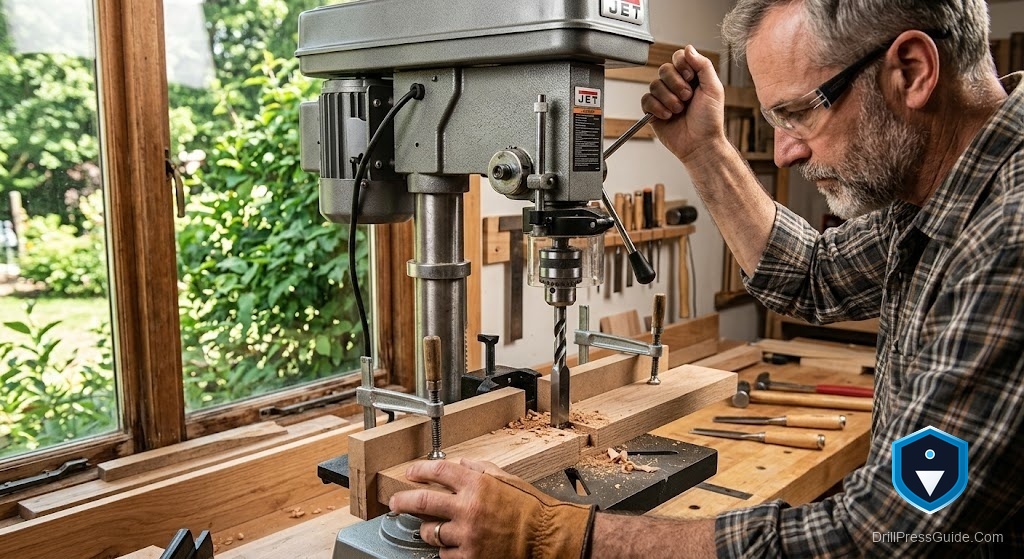
With the right attachment, a drill press does cut real mortise-and-tenon joinery. The attachment clamps the hollow chisel to the quill and adds a fence; the bit goes in the chuck inside the chisel. You plunge, the bit hogs the middle, the chisel squares the corners, and you get a clean square hole. Move along in overlapping cuts and you have a mortise.
Kits publish which presses they fit. The Grizzly H7789, for example, lists compatible machines including the Grizzly G0485, G0491, G7943, G7944, G7947, and G7948, the Shop Fox W1680 and M1039, the Delta 11-990 and 17-900, and the JET JDP-17M, and it ships with a column collar and a G9716 adapter. Confirm your press is covered.
The limits
Three honest limits shape everything.
Quill design. A drill press quill is built for straight-down thrust, not the sideways force a chisel imposes. Push too hard, especially in hardwood, and the quill flexes and the mortise drifts out of square. The fix is a moderate pace, not muscle.
Chisel sharpness and gap. A dull chisel or too little clearance between bit and chisel causes burning and heavy pushing. Set the bit slightly ahead of a sharp chisel, about a business-card gap.
Clamping. A mortising chisel throws chips and demands firm holding. Clamp the work to a fence with a hold-down or a 4-inch drill press vise, and wear eye protection, exactly as CCOHS advises.
The safer setup
- Confirm your press is on the attachment’s compatibility list, or measure to match.
- Clamp the chisel holder to the quill and anchor the fence.
- Set the bit slightly ahead of a sharp chisel and square the chisel to the fence.
- Clamp the work firmly and chop overlapping plunges, leaving thin walls, then clean them.
- Keep the pace moderate, let the chisel cool if it smokes, and stay clear of the chuck.
Drill press attachment versus a dedicated mortiser
Against a dedicated mortiser, the drill press method wins on shelf space and using a tool you own, and loses on rigidity and speed. The standalone machine’s stout quill and long lever chop faster and stay square under heavier load. For occasional joinery, the attachment is the sensible pick; for volume or hardwood mortising, the dedicated tool is worth it. You can compare a drill press mortising attachment and a hollow mortising chisel set.
Who should skip it
If you mortise daily or in tough hardwood, the drill press attachment will frustrate you; buy a dedicated mortiser. If you cut the occasional joint and own a compatible press, the attachment gives you real joinery without another machine, as long as you respect the limits.
Bottom line
Yes, you can use a mortising bit in a drill press, and it cuts genuine joinery, with a compatible attachment and respect for the limits. The quill dislikes side load, the chisel must be sharp with the right gap, and the work must be clamped. Set it up that way and it works cleanly. The online horror stories come from ignoring exactly those points.
- Yes, with a compatible attachment; confirm your press is on the fit list.
- The quill takes downward force, not sideways racking, so cut at a moderate pace.
- A sharp chisel, correct gap, and firm clamping separate clean results from ruined ones.
FAQ
Can you use a mortising bit in a drill press? Yes, with a compatible mortising attachment that clamps the chisel to the quill. The bit alone will not work; the attachment is required.
Will it damage my drill press? Not if you respect the quill. It takes downward thrust, not sideways force, so cut at a moderate pace and keep the chisel sharp to avoid flexing it.
How do I know my press is compatible? Check the attachment kit’s list. The Grizzly H7789, for example, names the presses it fits. Match yours or measure the quill and column.
Why does my chisel burn? Too little bit-to-chisel clearance or a dull chisel. Increase the gap slightly, sharpen the chisel, and let it cool between cuts.
Do I have to clamp the work? Yes. A mortising chisel throws chips and pushes hard, so clamp the work to a fence and wear eye protection, per CCOHS.
Drill press or dedicated mortiser? Drill press with an attachment for occasional joinery; dedicated mortiser for frequent or hardwood work where speed and rigidity matter.
References
- Grizzly H7789 Mortising Attachment Kit: https://www.grizzly.com/products/grizzly-mortising-attachment-kit-for-drill-presses/h7789
- TEKTON 4-Inch Drill Press Vise Manual: https://media.tekton.com/manuals/manual_53994.pdf
- CCOHS, Metalworking Machines - Drill Presses: https://www.ccohs.ca/oshanswers/safety_haz/metalworking/drillpresses.html