Getting Clean Holes with Forstner Bits on a Drill Press
The first time I ran a large Forstner bit in a handheld drill, it grabbed, twisted my wrist, and left a hole that looked like a beaver had been at it. The same bit in a drill press, a week later, cut a flat-bottomed hole so clean it looked machined. That contrast taught me something worth passing on: Forstner bits and drill presses are made for each other, and using them any other way is fighting the tool. If you want those crisp, flat-bottomed holes for hinges, dowels, or decorative work, the drill press is where they come alive.
Why Forstner bits demand a drill press
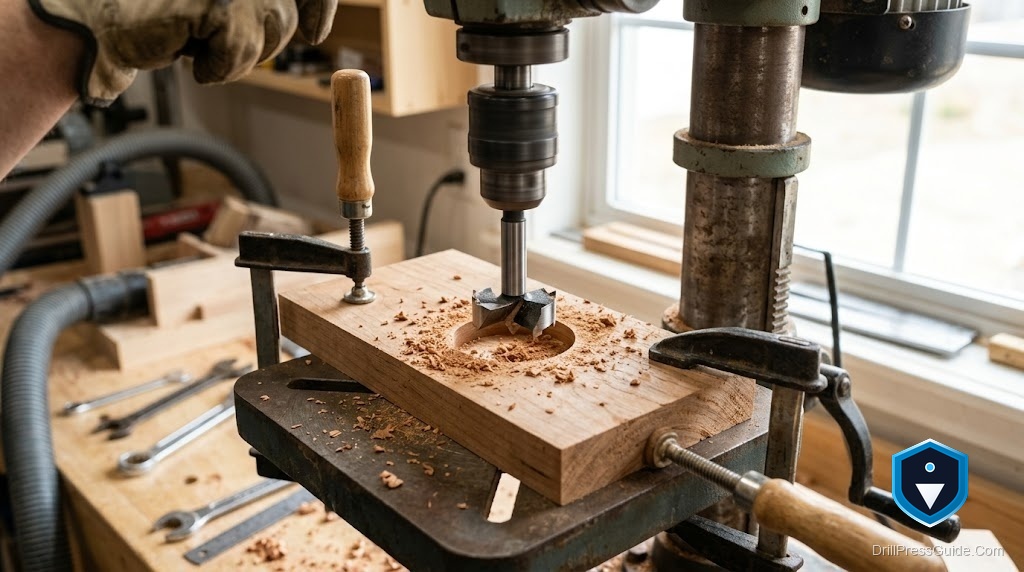
A Forstner bit does not have a lead screw pulling it into the wood like an auger. It cuts with a sharp rim and shears the fibers, which is what leaves that clean wall and flat bottom. But that rim also needs steady downward force and perfect alignment to cut without chattering. A handheld drill wobbles, so the bit skips and grabs. A drill press holds the bit perfectly perpendicular and lets you feed steady pressure through the quill, which is exactly what a Forstner bit wants. This is why a drill press for Forstner bits is not a luxury but close to a necessity for larger sizes.
Matching the machine to the bit
Here is where honest buying advice matters. Large Forstner bits, the two-inch and larger sizes, demand torque and low speed. Run a big bit too fast and it burns the wood and dulls fast. So the machine’s low speed range matters more than its top speed. A benchtop machine with a good low-end RPM, like the WEN benchtop drill press, handles mid-size bits well and suits most hobby work. For bigger bits and constant use, a floor machine such as the WEN floor standing drill press gives the torque, the slow speeds, and the quill travel that large Forstner work needs.
The honest limit: a small underpowered press will bog down and stall on a large bit in hardwood. If you plan to run big bits regularly, buy for torque and low speed, not for a high number of speeds you will never use.
The bits themselves
A clean hole starts with a sharp, well-made bit. Cheap Forstner bits come with dull or roughly ground rims that burnish rather than cut, leaving burned, fuzzy walls. A quality set like these Forstner bits with sharp rims cuts cleanly across the common sizes most projects need. For the largest holes, a saw-tooth rim design like this saw-tooth Forstner bit set clears chips better and runs cooler on big diameters, which is why saw-tooth patterns dominate the large sizes.
Technique that makes the difference
Even the best bit needs the right approach. Set your speed slow, slower as the bit grows, because rim speed at the outer edge climbs fast with diameter. Feed steadily but let the bit cut; forcing it packs chips and burns the wall. On deep holes, retract often to clear chips, since a Forstner bit has little room to eject waste on its own. Back the workpiece with a sacrificial board so the bit does not blow out the far side, and clamp the work, because a big bit grabbing an unsecured board is genuinely dangerous. A depth stop gives you consistent, flat-bottomed holes across a batch, which is the whole reason to use these bits.
Where people go wrong
The common mistakes are all avoidable. Running too fast is the biggest, and it shows up as scorched walls and a smoking bit. Not clearing chips is next, which packs the flutes and stalls the cut. Skipping the backing board splinters the exit. And holding the workpiece by hand instead of clamping invites a grab that can spin the board into your hand. None of these are the bit’s fault; they are setup and speed errors that a little patience fixes.
Verdict
Forstner bits on a drill press are one of woodworking’s most satisfying combinations, delivering flat-bottomed, clean-walled holes that no handheld drill can match. The keys are a machine with genuine low-speed torque, sharp quality bits, and disciplined technique: slow speed, steady feed, frequent chip clearing, and a clamped, backed workpiece. Buy for torque over top speed, keep your bits sharp, and these holes will come out looking machined every time.
- A drill press holds a Forstner bit perpendicular and feeds steady pressure, which is what these bits need.
- Large Forstner bits demand low speed and torque, so prioritize the low-end RPM over top speed.
- Sharp, well-ground bits cut clean walls; saw-tooth rims run cooler on the largest diameters.
- Slow speed, steady feed, frequent chip clearing, and a clamped, backed workpiece prevent burning and blowout.
FAQ
Why do Forstner bits work so much better in a drill press? A Forstner bit cuts with a sharp rim and needs perfect alignment and steady downward force. A drill press holds the bit perpendicular and feeds even pressure through the quill, while a handheld drill wobbles and lets the bit grab.
What speed should I use for Forstner bits on a drill press? Use a slow speed, and go slower as the bit diameter grows, because the outer rim speed climbs quickly with size. Too fast burns the wood and dulls the bit; slow and steady leaves clean walls.
Can any drill press handle large Forstner bits? No. Large bits demand torque and low speed. A small underpowered press bogs down and stalls on a two-inch bit in hardwood, so buy for low-end torque if you plan to run big bits regularly.
Why are my Forstner holes burning? Usually the speed is too high, the bit is dull, or you are not clearing chips. Slow the RPM, use a sharp bit, and retract often to eject waste so the rim keeps cutting instead of rubbing.
How do I get clean, flat-bottomed holes every time? Use a sharp bit, a slow speed, a depth stop for consistency, and a sacrificial backing board. Clamp the workpiece and feed steadily, letting the bit cut rather than forcing it.
What is the difference between standard and saw-tooth Forstner bits? Standard rims cut smooth walls and suit smaller and mid sizes. Saw-tooth rims clear chips better and run cooler on large diameters, which is why the biggest bits usually use a saw-tooth pattern.
Do I need to clamp the workpiece for Forstner drilling? Yes. A large Forstner bit can grab and spin an unsecured board into your hand. Clamp the work to the table, and back it with a sacrificial board to prevent blowout on the exit side.
References
- Fine Woodworking, Forstner bit technique and speed guidance, finewoodworking.com
- WEN Products, drill press speed and torque specifications, wenproducts.com
- Wood Magazine, Forstner bit reviews and drilling tips, woodmagazine.com
- Occupational Safety and Health Administration, drill press and workholding safety, osha.gov