Drill Press Bits for Wood Without Sacrificing Finish or Accuracy
The cleanest hole I ever drilled in walnut came off a Forstner bit turning slowly, and the ugliest came from a twist bit run too fast in the same board a minute earlier. Same wood, same machine, wildly different results. Drill press bits for wood are not interchangeable, and picking the right style for the hole you want is the difference between a crisp, flat-bottomed pocket and a torn, fuzzy mess.
Drill press bits for wood are boring tools shaped for clean cutting in end grain and face grain, and the main families are twist bits, brad-point bits, Forstner bits, spade bits, and hole saws, each leaving a different hole and finish. The right one depends on diameter, depth, and how clean the rim needs to be.
The short answer: use brad-point bits for accurate small to medium holes, Forstner bits for flat-bottomed and large clean holes, spade or auger bits for fast rough work, and hole saws for big through-holes. Then set the speed to the bit’s diameter, because even the perfect bit tears out if it spins too fast.
The five families, and what each is for
Twist bits are the general-purpose default, but the standard metal-drilling shape wanders in wood and can splinter the exit. They work in a pinch for small holes.
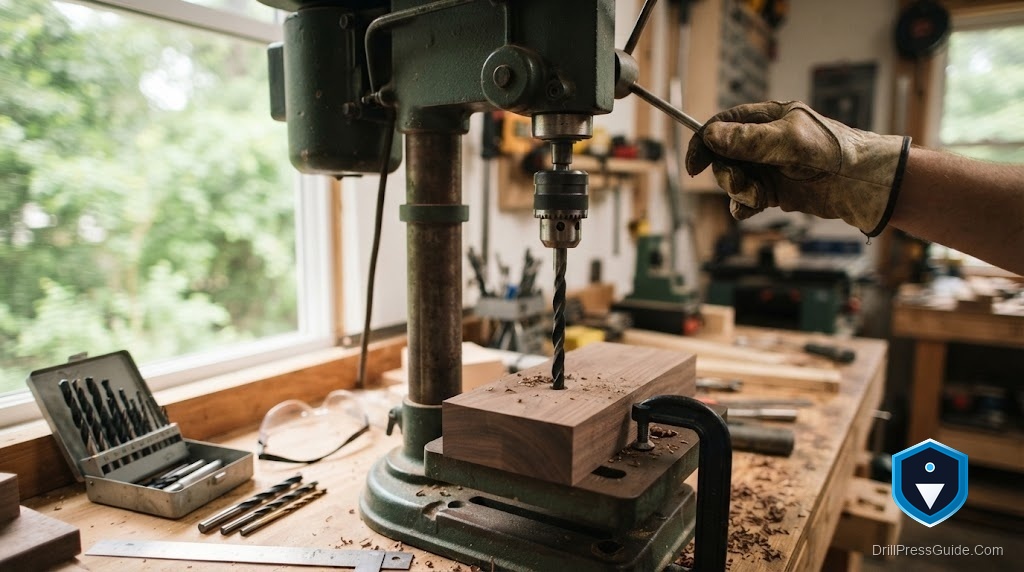
Brad-point bits add a center spur and two cutting lips, so they start exactly on the mark and slice the rim fibers before lifting the waste. For dowels, shelf pins, and any hole where placement matters, this is the bit to reach for.
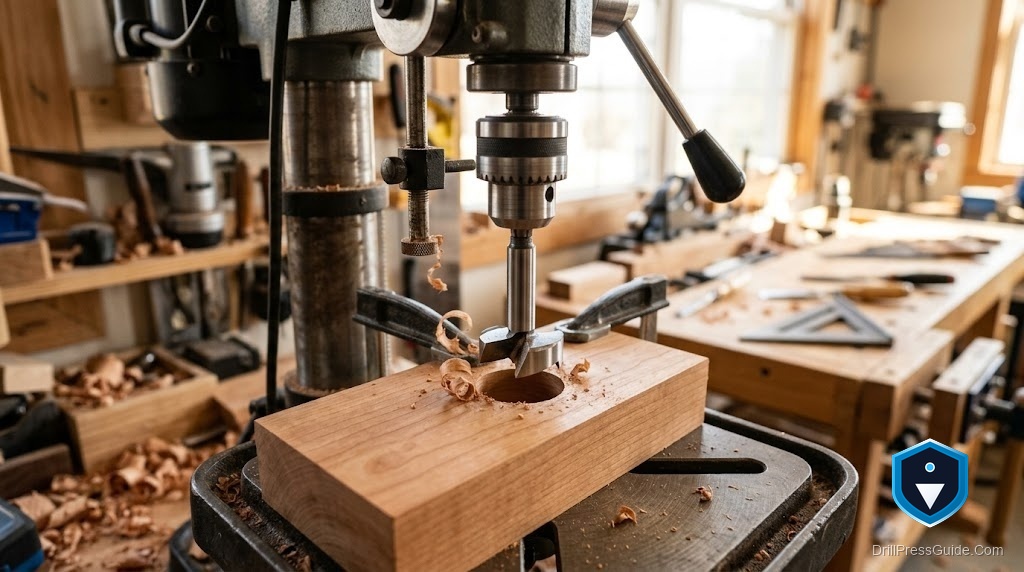
Forstner bits cut a flat-bottomed hole with a clean wall, and they can bore overlapping holes and angled entries a twist bit cannot. They are the choice for hinge cups, plugs, and large clean holes. A Forstner bit set with carbide tips covers the common sizes for cabinet and furniture work. Their honest drawback: big Forstner bits load the motor and scorch if run too fast, so they demand low speed.
Spade and auger bits remove wood quickly for rough carpentry and deep holes, at the cost of a coarse finish. Fine for framing, not for show surfaces.
Hole saws cut large through-holes efficiently but leave a rougher wall and need clearing of the plug.
Speed is half the bit’s job
A great bit run at the wrong speed still tears out. Fine Woodworking’s drill press speed chart puts small twist bits around 3000 RPM and drops the speed steadily as diameter grows, with large Forstner bits running far slower. The rule of thumb is simple: the bigger the bit, the slower it turns.
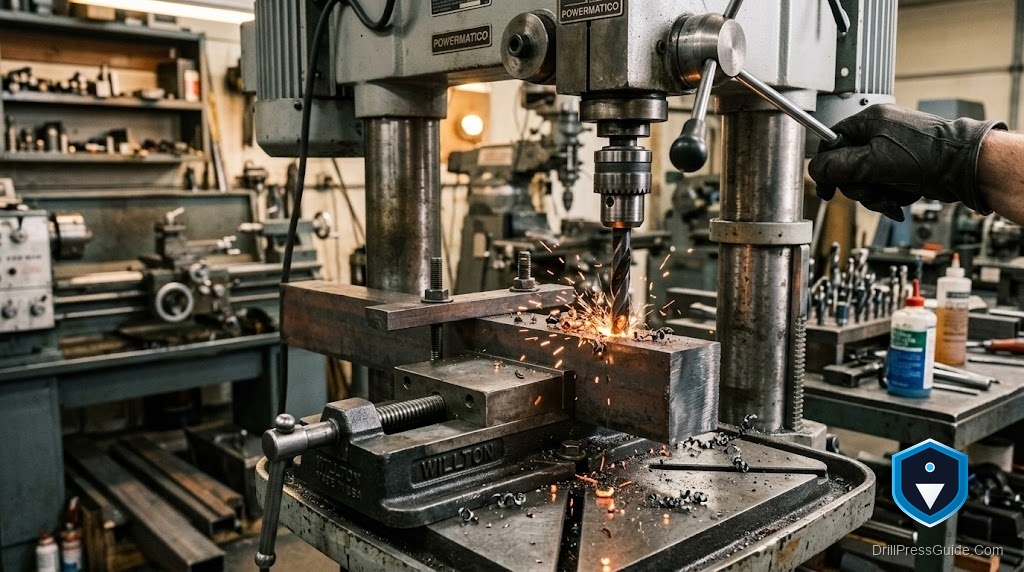
Rough targets that keep wood clean: small twist and brad points near 3000 RPM, mid brad points and 1-inch Forstner bits around 1500 to 2000 RPM, and 2-inch and larger Forstner bits down near 250 to 500 RPM. Run a big Forstner bit at twist-bit speed and it scorches the wall and dulls the rim, which is the single most common wood-drilling error.
Accuracy comes from support, not muscle
Back up the workpiece with a sacrificial board so the bit exits into wood instead of into air, and the underside stays crisp with no blowout. Clamp the piece or use a fence and stop, both so it cannot spin and so repeat holes land in the same spot. A fence turns a drill press into a row-of-holes machine for shelf pins.
Peck deep holes to clear chips, especially with Forstner and auger bits, which pack their flutes and burn if you bury them. Keep hands clear of the point of operation and wear eye protection, because a spinning chip finds an eye faster than you expect.
Matching bit to task
| Hole you want | Best bit | Speed feel |
|---|---|---|
| Accurate dowel or shelf pin | Brad point | Fast for small, slower as size grows |
| Flat-bottom or hinge cup | Forstner | Slow, slower still for large |
| Fast rough hole | Spade or auger | Moderate |
| Large through-hole | Hole saw | Slow |
| Small quick hole | Twist | Fast |
The verdict
For clean, accurate holes in wood, brad-point bits handle everyday work and Forstner bits handle the big and the fussy, and both reward slow, matched speeds. Add a sacrificial backer and a fence and even an inexpensive press drills furniture-grade holes.
Carry these forward:
- Brad points for accuracy, Forstner bits for flat bottoms and large clean holes.
- The bigger the bit, the slower the spindle, without exception.
- A sacrificial backer board kills exit blowout.
- Peck large and deep holes to clear chips and prevent scorching.
Frequently asked questions
What is the best drill bit for clean holes in wood? Brad-point bits for small to medium holes and Forstner bits for flat-bottomed or large holes. Both leave crisp rims when run at the right speed.
Why is my drill press tearing out the wood? Usually too much speed for the bit size, no backer board, or a dull bit. Slow down, back up the exit, and check the edge.
What speed for a large Forstner bit? Slow, around 250 to 500 RPM for 2-inch and larger. High speed scorches the wall and dulls the rim.
Can I use metal twist bits in wood? Yes for small quick holes, but they wander and can splinter the exit. Brad points place and finish better.
Do Forstner bits work on angled holes? Yes, better than most bits, because the rim registers the cut. Start the bit flat to score the circle, then tilt into the angle slowly.
How do I drill repeat holes in the same position? Set a fence and a stop block on the table. The fence sets the distance from the edge and the stop sets the length, so every hole matches.
References
- Fine Woodworking, Drill Press Speed Chart: https://images.finewoodworking.com/app/uploads/2020/01/22111726/drill-bit-speed-chart.pdf
- WOOD Magazine, Wise Buys: Drill-Press Tables: https://www.woodmagazine.com/woodworking-tools/reviews/drill/drill-press-tables