Using a Metal Milling Bits for Drill Press Without Sacrificing Finish or Accuracy
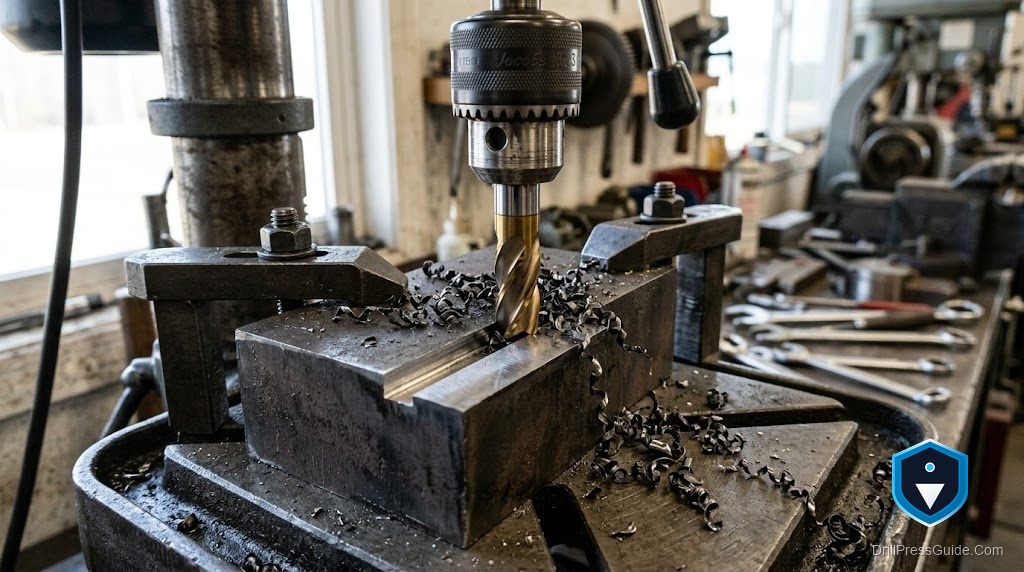
Search for metal milling bits and you will find end mills and rotary cutters that look like they would fit a drill press chuck. They will fit. The question is whether the drill press can use them the way a mill does, and the answer shapes everything about what you can expect. Used within tight limits, a milling bit in a drill press does light work; pushed like a mill, it fails and can be dangerous.
Quick answer: an end mill or milling cutter in a drill press can take very light finishing passes on soft metal if a cross-slide vise controls the movement, but the drill press is not built to take the side loads real milling creates. Keep passes tiny, expect a rough finish compared with a mill, and never side-load a taper-mounted chuck hard.
Why the bit fits but the machine does not
End mills cut on their sides as well as their tips, which is what lets a mill remove material sideways. A drill press is built to push a bit straight down; its quill resists downward thrust, not side force. So the milling bit will spin fine, but the moment you push it sideways into the work, the quill deflects and a taper-mounted chuck can work loose. The bit is capable; the spindle behind it is not built for the job.
The chuck is the weak link
Many drill press chucks seat on a Morse taper held by downward pressure. Side loads from milling try to walk that chuck off its taper, and a chuck that drops a spinning end mill is a serious hazard. Even keyed chucks are not designed to grip an end mill against side load the way a mill’s collet does. This is the core reason milling bits and drill presses are a poor match, and no technique fully removes it.
If you take light passes
Within the limits, some people true a light edge or clean a soft-metal surface. To do it as safely as possible:
- Use a cross-slide vise so movement is controlled by handwheels, never freehand.
- Take passes of only a few thousandths and keep the cutter cutting, not rubbing.
- Favor soft metals like aluminum where the side force is lower.
- Watch the chuck constantly and stop at any sign of it loosening.
Even then, the finish will trail a real mill, and this is finishing, not stock removal.
Finish and accuracy realities
A mill holds the cutter in a rigid collet and moves the work on precise ways, which is why it leaves a clean, accurate surface. A drill press has quill play, a chuck that can shift, and usually a cross-slide vise with more slop than a mill table. Those combine into chatter marks and dimensions that drift. You can improve it with light passes and sharp cutters, but you cannot make a drill press match a mill’s finish, because the rigidity is not there.
The verdict
Milling bits in a drill press are a limited, cautious option, not a real milling setup:
- Understand the quill and chuck resist side loads poorly, which is what milling demands.
- If you try it, use a cross-slide vise, take tiny passes, and favor soft metal.
- Expect a rougher finish than a mill, and stop at any sign of chuck movement.
Who should not attempt this? Anyone needing accurate slots, pockets, or a clean milled finish. A small mill does that safely. A drill press with a milling bit is light finishing at best.
Frequently asked questions
Can I put an end mill in a drill press? It will fit the chuck, but the drill press is not built to take the side loads milling creates, and the chuck can work loose under them.
What is the main danger? The chuck loosening. Taper-mounted chucks rely on downward force to stay seated, and side loads can walk them off, dropping a spinning cutter.
Can I mill aluminum this way more safely than steel? Somewhat, because aluminum cuts with less side force. The machine’s limits still apply, so keep passes very light.
Why is the finish worse than a mill? Quill play, a chuck that can shift, and a cross-slide vise with more slop than a mill table all add chatter and drift a mill avoids.
Do I need a cross-slide vise? For any attempt, yes. It controls movement with handwheels. Freehand side-pushing grabs the cutter and is unsafe.
What should I use for real milling? A milling machine, even a small benchtop model, which holds the cutter in a rigid collet and is built to take side loads safely.
References
- CCOHS, Metalworking Machines - Drill Presses: https://www.ccohs.ca/oshanswers/safety_haz/metalworking/drillpresses.html
- Delta 17-900 Instruction Manual: https://powertool.manualsonline.com/manuals/mfg/delta/17900.html
- Dynabrade HSS Drill Speed Recommendation Chart: https://www.dynabrade.com/pdf/lit/D1201_Singles/D12.01_pg134.pdf