Choosing Between Drill Press Swing vs Spindle Travel: The Differences That Matter

You are comparing two drill presses. One has a 12-inch swing and 2-inch travel. The other has a 10-inch swing and 3-inch travel. The numbers are close, but the difference in real work is larger than the specs suggest. Swing and spindle travel are the two most important size specs on a drill press, and confusing them is the fastest way to buy the wrong machine.
I have used presses with every combination of swing and travel over the years. A large swing with short travel is great for wide panels but terrible for deep holes. A small swing with long travel is perfect for deep mortises but cannot reach the center of wide boards. This guide explains what each spec means, how they interact, and which balance fits your projects.
Swing is the distance from the center of the chuck to the closest edge of the column, multiplied by two. It tells you the maximum width of a board that you can drill in the center. A 10-inch swing means you can drill a hole in the center of a 10-inch board. A 15-inch swing handles a 15-inch board. Swing is about horizontal capacity.
Spindle travel is the distance the quill and chuck can move downward from rest to full extension. It tells you the maximum depth of a hole you can drill in one plunge. A 2-inch travel means you can drill a 2-inch deep hole without repositioning the work or the table. A 3-1/4-inch travel handles deeper holes. Travel is about vertical capacity.
The short answer is that swing matters more for wide work and panel drilling. Spindle travel matters more for deep holes, mortising, and thick stock. Most home woodworkers should prioritize swing first because they drill wide panels and boards more often than they drill deep holes. Metalworkers and mortisers should prioritize travel because depth and precision matter more than width.
How Swing Limits Your Work
A drill press with a 10-inch swing can drill a hole in the center of a 10-inch wide board. If you move the board to the side, you can drill near the edge of a wider board, but you cannot drill the center of anything larger than 10 inches without turning the work around and realigning. That is inconvenient and risks inaccurate placement.
If you build cabinets, shelves, or furniture, you often work with panels that are 12 to 24 inches wide. A 10-inch swing is too small for center drilling in those panels. A 12-inch swing handles 12-inch panels. A 15-inch swing handles most common cabinet sides. A 17-inch or 20-inch swing is the standard for floor presses and handles large panels without repositioning.
The swing is fixed by the column diameter and the head casting. You cannot increase the swing of a drill press without replacing the entire machine. This is why swing is the spec you should get right the first time. If you are unsure, buy one size larger than you think you need. You will grow into it.
How Spindle Travel Limits Your Work
Spindle travel is the depth you can drill in one continuous plunge. A 2-inch travel is standard on 10-inch benchtop presses. It is enough for most through-holes in 1-1/2-inch lumber, for doweling in 3/4-inch boards, and for standard hardware installation. It is not enough for deep mortises, thick timbers, or tall workpieces where the table is set low.
If you plan to use a mortising attachment, you need at least 3 inches of travel. Mortising bits are long, and the chisel needs clearance to enter and exit the work. A 2-inch travel will bottom out before the mortise is complete. You will need to raise the table or lower the work and realign, which defeats the purpose of a mortising attachment.
For metal drilling, travel is less critical than swing for most work. Metal stock is usually thin, and a 2-inch travel is enough for most plates and bars. However, if you use tall fixtures or vise setups, you may need extra travel to clear the fixture and still reach the work. Extra travel is never a problem. Short travel is a constant limitation.
The Trade-Off Between Swing and Travel
Benchtop drill presses are a compromise. A 10-inch benchtop press usually has 2-inch travel. A 12-inch benchtop press may have 2-inch or 3-inch travel. A 15-inch benchtop press usually has 3-inch or 3-1/8-inch travel. The larger the swing, the more room there is in the head casting for longer quill travel, so swing and travel tend to grow together. But not always.
Some radial drill presses have a modest swing on the column but a huge effective reach because the head extends on an arm. The Grizzly G7945 radial drill press has a 34-inch reach with a 3-1/4-inch travel. That is a different way to solve the swing problem. The trade-off is that radial presses are less rigid than fixed-head presses when the head is fully extended.
Floor drill presses generally have both large swing and long travel. A 17-inch floor press may have 4-inch or 5-inch travel. That is the advantage of a full-size machine. The trade-off is floor space, weight, and cost. A floor press is overkill for a shop that only drills small parts.
Which Spec to Prioritize for Your Work
If you build furniture and cabinets, prioritize swing. A 12-inch or 15-inch swing lets you drill shelf pin holes and dowel holes in standard panels without repositioning. Look for at least 2-1/2-inch travel so you can handle 1-1/2-inch stock plus some clearance. A 12-inch benchtop with 3-inch travel is the sweet spot for most furniture makers.
If you do mortising, timber framing, or deep hole drilling, prioritize travel. A 3-inch or 3-1/4-inch travel is the minimum for mortising. A 4-inch or 5-inch travel is better for thick timbers and deep boring. You will usually need a 15-inch or 17-inch floor press to get that much travel, so be prepared for a larger machine.
If you work with metal and small parts, swing is less critical. A 10-inch or 12-inch swing is enough for most metal stock. Prioritize a slow minimum speed and a rigid quill over extra travel. A 10-inch benchtop with 2-inch travel and a solid table is fine for a metal shop that does not use tall fixtures.
If you are a general hobbyist who does a bit of everything, get the largest swing you can fit and afford, with at least 2-inch travel. A 12-inch benchtop press is the best general-purpose size. It handles most wood projects, fits on a standard bench, and leaves room to grow.
Real-World Examples from Our Testing
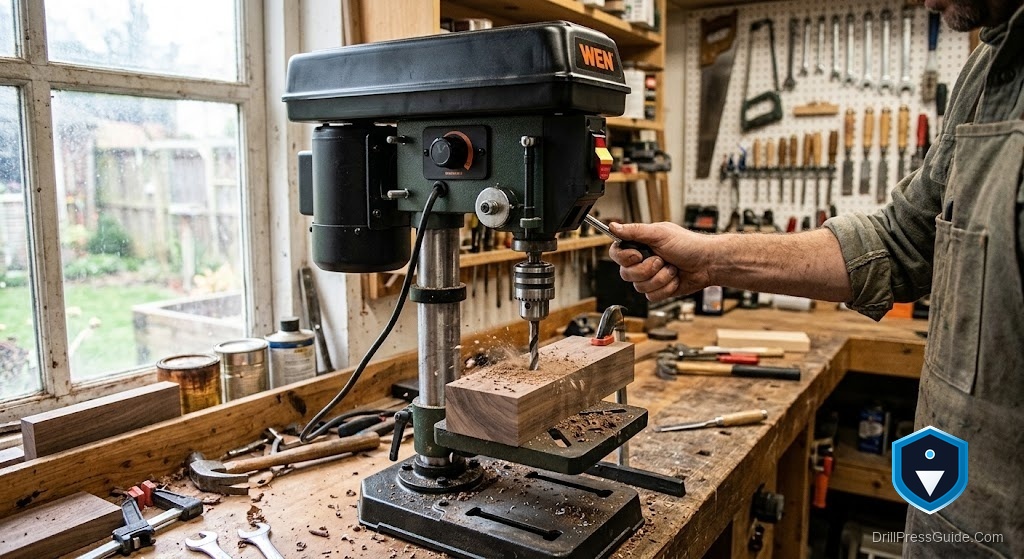
The WEN 4212T has a 10-inch swing and 2-inch travel. It is a good general-purpose press for small to medium projects. The limitation is that you cannot drill the center of a 12-inch panel, and the 2-inch travel is tight for deep mortises. It is the right size for a hobbyist with a small bench.
The WEN 4214T has a 12-inch swing and 3-1/8-inch travel. The extra 2 inches of swing and the extra inch of travel make a noticeable difference. You can drill center holes in standard cabinet sides, and the 3-1/8-inch travel handles mortising in standard lumber. It is the best balance for most home shops.
The JET JDP-15B has a 15-inch swing and 3-1/8-inch travel. The 15-inch swing is enough for large panels and furniture components. The 3-1/8-inch travel is adequate for most woodworking but still limiting for deep mortises in thick timbers. This is the best benchtop press for furniture makers who do not need floor-model capacity.
The Grizzly G7943 has a 14-inch swing and 3-1/4-inch travel. It is a heavy benchtop press with a 3/4-horsepower motor and a large table. The swing and travel are both generous, and the machine is rigid enough to use the full capacity without vibration. The limitation is that it is discontinued, so new units are scarce.
The Klutch 13-inch floor press has a 13-inch swing and a longer travel than most benchtop models. The floor design gives you more height capacity and a larger table. It is a good choice for a shop that needs more than a benchtop but does not want a 17-inch monster. The trade-off is floor space and weight.
Frequently Asked Questions
What is swing on a drill press? Swing is the distance from the chuck center to the column multiplied by two. It is the maximum width of a board you can drill in the center.
What is spindle travel on a drill press? Spindle travel is the distance the chuck can move downward in one plunge. It is the maximum depth of a hole you can drill without repositioning.
Is a 10-inch swing enough for woodworking? A 10-inch swing is enough for small projects and narrow boards. For furniture, cabinets, and panels, a 12-inch or 15-inch swing is better.
How much spindle travel do I need for mortising? You need at least 3 inches of travel for effective mortising. A 2-inch travel is too short and will require repositioning.
Can I increase the swing of a drill press? No. Swing is fixed by the machine’s design. You must buy a larger press to get more swing.
Can I increase the spindle travel of a drill press? No. Travel is limited by the quill and head casting. You can work around it by raising the table or lowering the work, but that is inconvenient.
What is the best swing size for a home shop? A 12-inch swing is the best general-purpose size for most home shops. It handles most projects without taking up too much space.
What is the best spindle travel for a home shop? Two to three inches is enough for most home projects. Three inches is better if you do mortising or work with thick stock.
Does a larger swing mean a larger motor? Not necessarily, but larger swings usually come with larger machines that have more powerful motors. A 15-inch press usually has a stronger motor than a 10-inch press.
Should I buy a drill press with more swing or more travel? Buy more swing if you work with wide panels. Buy more travel if you do deep holes or mortising. If you do both, get a 12-inch or 15-inch press with at least 3-inch travel.
References
- Fine Woodworking: Drill press specifications and workshop layout guides.
- WEN Products: 4212T and 4214T specification sheets showing swing and travel differences.
- JET Tools: JDP-15B specifications and capacity tables.
- Grizzly Industrial: G7943 and G7945 specifications and application notes.
SEO Metadata