
Mill vs Drill Press: Where Each Option Wins in a Home Shop
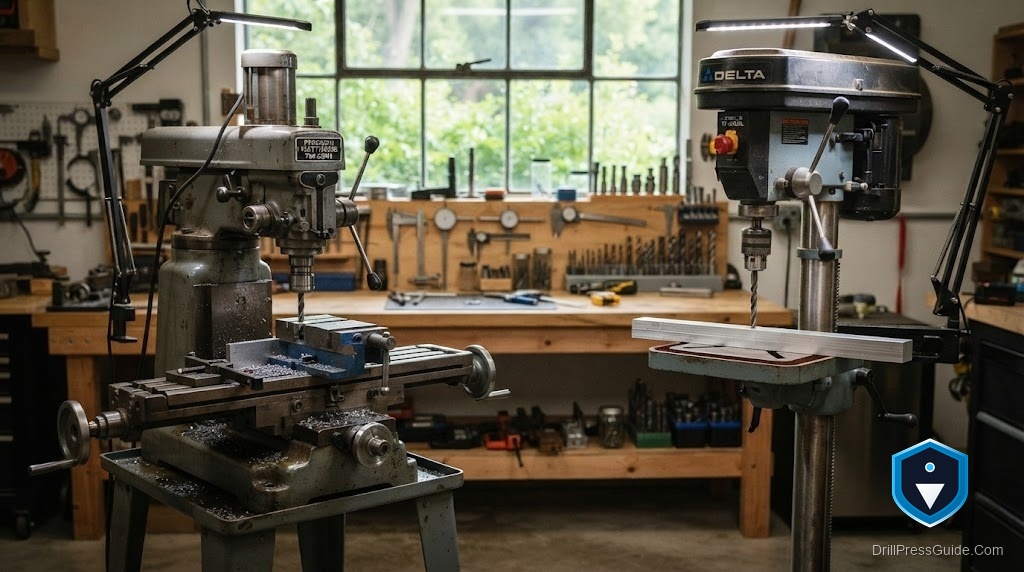
Every home-shop owner eventually faces this fork: the bench is getting crowded, the budget allows one more machine, and the choice is between a mill and a drill press. The forums will tell you a mill “does everything a drill press does and more,” which is technically true and practically misleading. The right answer depends on what you actually make, how much space and money you have, and whether you value doing one thing cheaply and well or many things at a steep cost. Mill vs drill press, for a real home shop, comes down to where each option genuinely wins.
Mill versus drill press is the practical home-shop choice between a milling machine, which shapes metal by moving a cutter sideways and can also drill, and a drill press, which makes holes cheaply and simply but cannot shape metal. A mill does more but costs and weighs far more; a drill press does one job affordably.
The short answer: for most home shops, a drill press is the smarter first buy because it does the common job, making holes, cheaply, compactly, and well. A mill wins only when you genuinely need to shape metal, and its cost, weight, and learning curve are worth it. Choose by what you actually make.
The “a mill does everything” trap
The most repeated advice, that a mill can drill so it replaces a drill press, is where people go wrong. It is true a mill drills well, since its rigid spindle handles drilling as a subset of milling. But that argument ignores everything the mill costs to do it: several times the price, several times the weight, a much larger footprint, and a real learning curve. Buying a mill just to drill holes is like buying a truck to carry a backpack. The question is not whether a mill can drill, but whether you need what only a mill adds, metal shaping, and if you do not, the drill press does the actual job for a fraction of everything.
Where the drill press wins
The drill press wins on the job most home shops actually do: making holes. It bores accurate, square, repeatable holes in wood, metal, and plastic; it sands, countersinks, and reams with accessories; and it does all of it cheaply, in a small footprint, with almost no learning curve. For woodworking it is essential and a mill is useless. For general metal drilling it is efficient and sufficient. If you tally what a typical home shop does in a year, the overwhelming majority is drilling, and that is the drill press’s home ground. It wins on cost, space, simplicity, and versatility across materials.
Where the mill wins
The mill wins decisively on the one thing a drill press cannot do: shape metal. Cutting slots, pockets, flats, and precise profiles, holding tight tolerances, removing material from the sides of a part, this is milling, and only a mill does it safely and accurately. If you build engine parts, make precise fixtures, or fabricate to dimensions, the mill is not optional and a drill press cannot substitute, because its spindle chatters under side load and a drill chuck can let a cutter pull loose. A mini-mill also drills, so it can serve as a combined machine in a tight shop that does both, at the price of cost, weight, and complexity. Where precise metal shaping is the work, the mill is the only right tool.
Can one replace the other?
Here is the honest two-way answer. A mill can replace a drill press functionally, since it drills, but doing so wastes money, space, and simplicity if drilling is most of your work. A drill press cannot replace a mill, because it cannot shape metal safely or accurately; a light cut in aluminum in a pinch is the most it manages, and forcing more wears it out. So the two machines are not symmetric substitutes. If your work is mostly holes, a drill press is right and a mill is overkill. If your work genuinely includes shaping metal, you need a mill, and a mini-mill can then double as your drill. There is no configuration where a drill press covers a shaper’s needs.
Which to buy first
For a home shop building its tool kit, the sequence is usually clear. Buy the drill press first: it is cheap, compact, essential for woodworking, sufficient for general metal drilling, and covers the job you will do most. Add a mill later, only when a real metal-shaping need appears that the drill press cannot meet, and accept its cost, weight, and learning curve as the price of a genuine new capability. The buyers who regret their choice are almost always those who bought a mill to drill holes and found it big, expensive, and slow for the simple jobs, or those who tried to mill on a drill press and wore it out. Match the machine to the work and the order takes care of itself.
The bottom line
Mill versus drill press, for a home shop, is settled by what you make, not by which machine can technically do more. The drill press wins the common job, making holes, on cost, space, and simplicity, and is the right first buy for almost everyone. The mill wins the specialist job, shaping metal, and is worth its cost, weight, and learning curve only when that job is real. They are complementary tools for different work, so buy the drill press first, add the mill when metal shaping demands it, and let neither pretend to be the other.
- A mill can drill but costs, weighs, and takes far more space than a drill press.
- The drill press wins the common home-shop job, making holes, cheaply and simply.
- The mill wins the specialist job, shaping metal, which a drill press cannot do.
- Buy the drill press first; add a mill only when real metal shaping demands it.
The machine that can do everything rarely does the simple job best. For most home shops, the drill press earns its place first, and the mill joins it when the work truly calls.
Frequently asked questions
Should I buy a mill or a drill press first? A drill press, for most home shops. It does the common job, making holes, cheaply, compactly, and well, and is essential for woodworking. Add a mill later only when you have a genuine need to shape metal that a drill press cannot meet.
Can a mill replace a drill press? Functionally yes, since a mill drills well, but it wastes money, space, and simplicity if drilling is most of your work. A mill costs and weighs several times more and has a learning curve, so buying one just to drill is overkill.
Can a drill press replace a mill? No. A drill press cannot shape metal safely or accurately, because its spindle chatters under side load and a drill chuck can let a cutter pull loose. A light cut in aluminum is the most it manages; real milling needs a mill.
What does a mill do that a drill press cannot? It shapes metal, cutting slots, pockets, flats, and precise profiles, and holds tight tolerances by removing material from the sides of a part. A drill press only makes holes; it cannot do controlled sideways cutting.
Is a mini-mill a good compromise? It can be, for a tight shop that needs both drilling and light metal shaping, since a mini-mill drills as well as mills. The tradeoff is higher cost, more weight, and more complexity than a simple drill press for the drilling job.
Which is better for woodworking, a mill or a drill press? A drill press, without question. It bores clean holes, sands, and takes a fence for repeatable work, all essential for woodworking. A mill is built for shaping metal and offers nothing a woodworker needs.
References
- Carbide Depot, machining speeds and feeds formulas: https://www.carbidedepot.com/formulas-drills-speeds.htm
- Norseman Drill and Tool, drilling feeds and speeds chart: http://www.norsemandrill.com/feeds-speeds-drill.php
- OSHA, machine guarding and point-of-operation safety: https://www.osha.gov/machine-guarding


