Drill Press vs Milling Machine: Which Belongs in Your Shop
The question sounds like it should have a simple answer, and it does, but not the one most people expect. A drill press and a milling machine look related, both spin a cutter in a vertical spindle over a clamped workpiece, and that resemblance fools plenty of buyers into thinking one can stand in for the other. It cannot, and the reason comes down to a single design choice that separates the two tools completely. Understanding drill press vs milling machine is really understanding what each was built to resist, and that tells you which one your work needs.
Drill press versus milling machine is the comparison between a machine built to push a cutter straight down into a workpiece to make holes, and a machine built to move a cutter sideways through a workpiece to shape it. The difference is the direction of load each is engineered to take, and it decides everything about what each can safely do.
The short answer: a drill press is for making holes and is not built for the sideways cutting loads of milling, while a milling machine is built for exactly those side loads and shapes metal in ways a drill press cannot. If your work is holes, buy a drill press; if it is shaping and slotting metal to precise dimensions, you need a mill.
The one difference that explains the rest
Strip away the surface resemblance and the tools diverge on one point: the direction of force each spindle is built to take. A drill press spindle rides in bearings that handle thrust straight down the axis, and its quill slides in a sleeve with a little play so the bit can plunge. That design is perfect for pushing a bit down into a hole and useless at resisting sideways force.
A milling machine spindle and column are built the opposite way, heavy and rigid to resist the lateral loads a cutter generates moving sideways through metal, with a table that feeds the work precisely in multiple axes. That single difference, thrust versus side load, cascades into everything else: what each cuts, how precise it is, and why one cannot safely do the other’s job.
What each tool does best
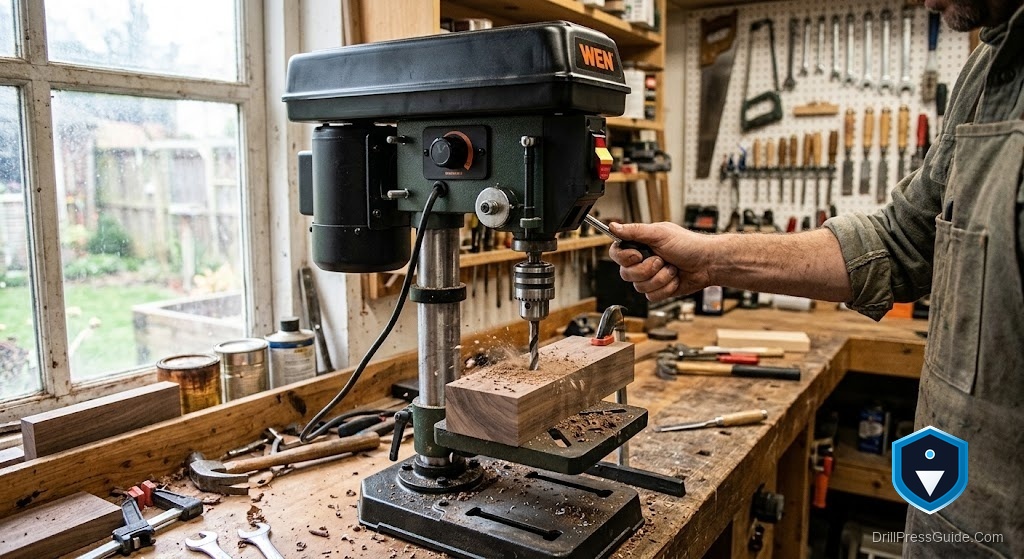
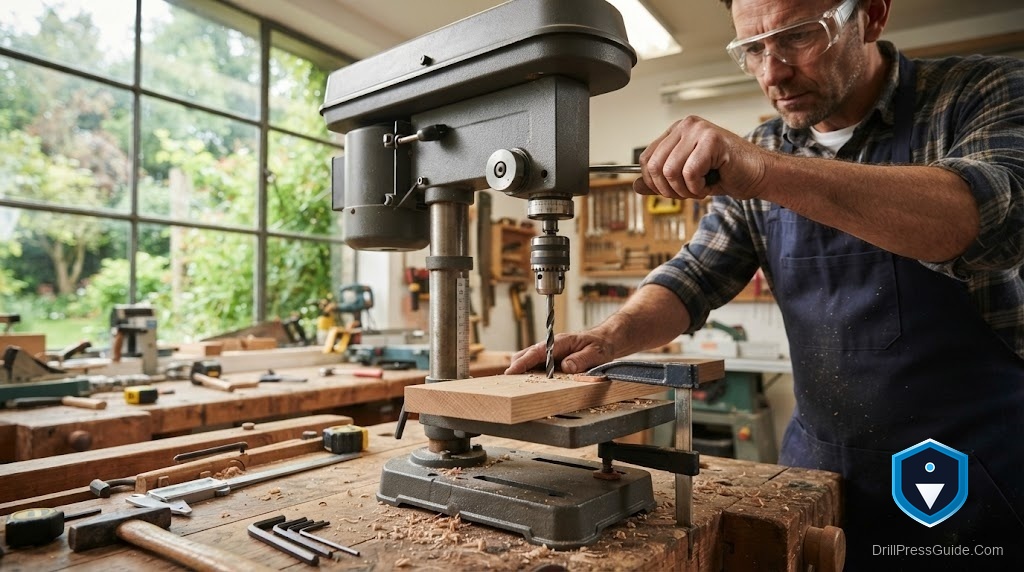
A drill press does one family of jobs superbly: making holes. It bores accurate, square, repeatable holes in wood, metal, and plastic; with accessories it reams, countersinks, and sands; and it does all of it for a fraction of a mill’s cost and footprint. For the vast majority of shop tasks, which are drilling tasks, it is the right and efficient tool.
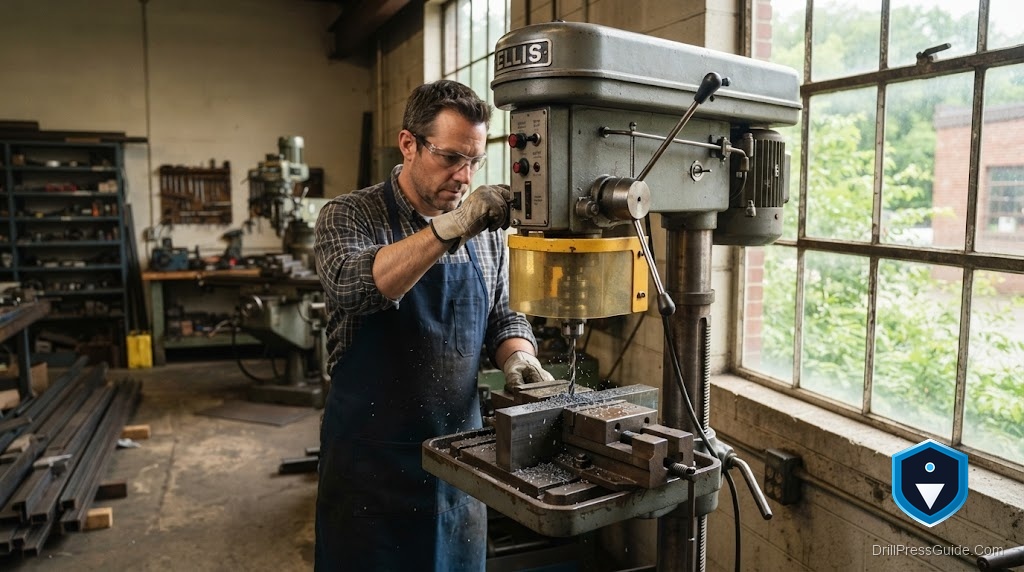
A milling machine shapes metal. It cuts slots, pockets, flats, and precise profiles, removing material from the sides of a workpiece to exact dimensions, work a drill press simply cannot do. It also drills, since drilling is a subset of what its rigid spindle handles, but it costs far more, weighs far more, and takes far more space and skill. It is a specialist for shaping metal precisely, not a general-purpose hole maker.
Why a drill press cannot replace a mill
People still try to mill on a drill press, and it is worth saying plainly why it disappoints. A drill chuck can let a cutter pull loose under side load, the spindle chatters and wears, and the quill’s play makes precise sideways cuts impossible. You can take a whisper-light cut in aluminum in a pinch, but you cannot mill steel to a tolerance, and the attempt wears out the press.
Going the other way, a mill can drill perfectly well, so a shop that owns a mill rarely needs a separate press except for convenience. But a mill costs and weighs several times what a drill press does, so buying one just to drill holes is enormous overkill. The tools are not interchangeable; they are complementary, each covering what the other cannot.
Drill press vs milling machine, side by side
Set the decision out plainly. Choose a drill press if your work is holes, if you want an affordable, compact, easy-to-use machine, and if you do woodworking or general metal drilling; it covers the overwhelming majority of home-shop needs. Choose a milling machine if you need to shape metal, cut slots and pockets, or hold precise dimensions, and if you have the money, space, and skill for it. If you are torn, note that most people who think they want a mill actually need a drill press plus better workholding, while those who genuinely shape metal know they need a mill and are not asking. Buy the drill press first; add a mill only when a real shaping need appears.
The bottom line
A drill press and a milling machine differ on one fundamental point, the direction of cutting load each is built to take, and that difference decides which belongs in your shop. Buy a drill press for holes, which is most of what any shop does, and it will serve for years at a modest cost. Buy a milling machine only when you genuinely need to shape metal to precise dimensions, and accept its cost, weight, and learning curve. They are not rivals or substitutes; they are two tools for two jobs, and the right choice is simply the one that matches the work in front of you.
- A drill press is built for downward thrust to make holes; a mill is built for sideways loads to shape metal.
- A drill press cannot safely mill, and a mill is overkill bought just to drill.
- For holes, woodworking, and general drilling, the drill press is the right, affordable tool.
- Buy a mill only when precise metal shaping, slots, and pockets are a real need.
The resemblance is skin deep. One makes holes, the other shapes metal, and knowing which your work needs is the whole decision.
Frequently asked questions
What is the difference between a drill press and a milling machine? A drill press pushes a cutter straight down to make holes and is built for downward thrust. A milling machine moves a cutter sideways to shape metal and is built for lateral loads. The direction of force each is engineered to take is the core difference.
Can a drill press do milling? Only the lightest cuts in soft metal, and poorly. Its spindle is built for thrust, not side loads, its quill has play, and a drill chuck can let a cutter pull loose. It cannot mill steel to a tolerance, and trying wears the machine.
Can a milling machine drill holes? Yes, well. Drilling is a subset of what a mill’s rigid spindle handles, so a shop with a mill rarely needs a separate press. But a mill costs and weighs far more, so buying one only to drill holes is overkill.
Which should I buy first, a drill press or a mill? A drill press, for almost everyone. It covers holes, which are most shop tasks, affordably and compactly. Add a mill later only when you have a genuine need to shape metal to precise dimensions.
Is a milling machine worth it for a home shop? Only if you truly need to shape metal, cutting slots, pockets, and precise profiles. It is expensive, heavy, and has a learning curve. For holes and general work, a drill press does the job for a fraction of the cost and space.
Why can’t I just mill on my drill press? Because the spindle chatters and wears under side load, the quill’s play prevents precise sideways cuts, and a drill chuck can let the cutter pull out. A light cut in aluminum is possible in a pinch, but real milling needs a mill.
References
- Carbide Depot, machining speeds and feeds formulas: https://www.carbidedepot.com/formulas-drills-speeds.htm
- Norseman Drill and Tool, drilling feeds and speeds chart: http://www.norsemandrill.com/feeds-speeds-drill.php
- OSHA, machine guarding and point-of-operation safety: https://www.osha.gov/machine-guarding