
What Is a Chuck on a Drill Press, and When Is It the Right Tool?
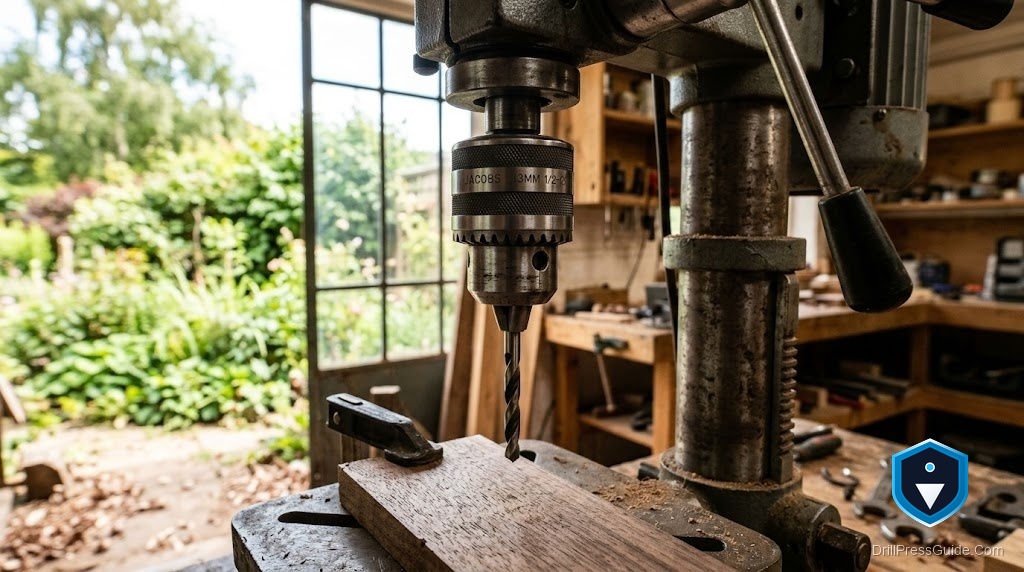
Someone hands you a drill press bit and says “put it in the chuck,” and if you have never used one, you stare at the three-jawed metal cylinder wondering which part is the chuck and how it opens. It is worth demystifying, because the chuck is the one part of the drill press you touch on every single job, and understanding it explains why holes come out true or why a bit keeps slipping.
What a drill press chuck is
The chuck is the clamping device on the end of the spindle that grips the drill bit and holds it centered on the spindle’s axis. Inside are three hardened jaws that move together when you rotate the chuck’s outer sleeve, closing evenly around the bit’s shank so it sits dead center. That centering is the chuck’s real job: not just to hold the bit, but to hold it true, so the hole follows the spindle’s line instead of wobbling.
The chuck mounts on an arbor, and the arbor seats into the spindle with a friction taper (commonly a Morse taper such as MT2). So the chain from motor to bit runs spindle, arbor, chuck, bit, and the chuck is the last link you control.
When the chuck is the right tool, and its limits
Here is the direct answer. The chuck is the right holder for round-shank and hex-shank drill bits, and it covers the overwhelming majority of drill press work: twist bits, brad-point bits, Forstner bits, hole saws, and drum sanders all mount in the chuck. Its limits are worth knowing:
- Bit capacity. A chuck grips shanks up to a stated maximum, commonly 1/2 or 5/8 inch. A shank larger than that will not fit.
- Side loads. A chuck holds well against downward drilling force but can release under sideways load, which is why a drill press should not be used for milling.
- Very small bits. Standard chuck jaws may not close tightly on tiny wire-gauge bits; those want a smaller precision chuck.
Within those limits, the chuck is the default and correct tool. Outside them you change the chuck or the machine, not the technique.
Keyed and keyless: the two kinds you will meet
Drill press chucks come in two flavors. A keyed chuck tightens with a toothed key that meshes with the collar, giving a very firm grip that resists slipping under heavy drilling. A WEN LA164K keyed chuck with an MT2 arbor is a typical replacement of this type, gripping bits up to 5/8 inch. A keyless chuck tightens by hand, so you change bits faster and never misplace a key; a KIPA keyless JT33 chuck with MT2 arbor is a common example that includes the arbor to fit an MT2 spindle. Both center the bit the same way; they differ only in how you clamp them.
Keyed chuck versus keyless chuck
Since the chuck is the part you handle constantly, the keyed-versus-keyless choice shapes your day. A keyed chuck grips harder and holds large bits and heavy cuts without loosening, with the tradeoff of hunting for the key on every bit change. A keyless chuck is quicker and key-free, but it can loosen under big bits or hard drilling. For metal work and large bits, the keyed chuck’s stronger grip is the safer pick. For a wood shop swapping small and medium bits all day, the keyless chuck’s speed usually wins. Neither is better in the abstract; the right one depends on whether your work leans toward grip or toward speed.
My verdict
The chuck is the drill press’s grip: three jaws that clamp the bit and, more importantly, center it on the spindle axis so holes run true. It is the right tool for nearly every bit you will use, within its capacity and away from side loads. Choose keyed for grip and keyless for speed, keep its taper clean so it seats true, and replace it when the jaws no longer close concentrically. Understand the chuck and you understand the one part of the machine your hands never stop using.
Frequently asked questions
What does a chuck do on a drill press? It grips the drill bit with three jaws and centers it on the spindle axis, so the bit turns true and the hole follows the spindle’s line.
What is the difference between a keyed and keyless drill press chuck? A keyed chuck tightens with a toothed key for a firmer grip; a keyless chuck tightens by hand for faster bit changes. Keyed holds big bits better, keyless is quicker.
How big a bit can a drill press chuck hold? Up to its rated capacity, commonly 1/2 or 5/8 inch shank diameter. Bits with larger shanks need a bigger chuck or a reduced-shank bit.
How does the chuck attach to the drill press? The chuck mounts on an arbor, and the arbor seats into the spindle with a friction taper, often a Morse taper such as MT2. No threads are involved.
Why does my bit slip in the chuck? Usually the jaws are worn, the chuck is not tightened enough, or you are putting side load on it. Tighten fully, and replace a chuck whose jaws no longer close evenly.
Can I replace a drill press chuck myself? Yes. Drive out the old chuck and arbor with a taper drift, clean the spindle bore dry, and seat a matching new chuck and arbor with a firm tap. Match the arbor to your spindle taper.
References
- WEN LA164K keyed drill chuck product page: https://wenproducts.com/products/wen-la164k-5-8-inch-keyed-drill-chuck-with-mt2-arbor-taper
- Industrial Monitor Direct, drill press chuck runout: https://industrialmonitordirect.com/blogs/knowledgebase/drill-press-chuck-runout-tolerances-measurement-and-hole-accuracy
- OSHA Woodworking eTool, Drill Presses: https://www.osha.gov/etools/woodworking/production/machines-tools/drill-press


