2 Axis Drill Press Vise: Compatibility and Setup Guide
The first time you need to drill a neat grid of holes, a plain drill press vise shows its weakness. You clamp the part, drill, unclamp, measure, re-clamp, drill again, and by the sixth hole the spacing has wandered. A 2 axis drill press vise solves that in the most satisfying way: clamp the workpiece once, then turn two handwheels to slide it left-right and front-back to each position without ever letting go. It is the difference between chasing pencil marks and dialing in coordinates. This guide covers whether one fits your press and how to set it up so the accuracy it promises actually shows up in your holes.
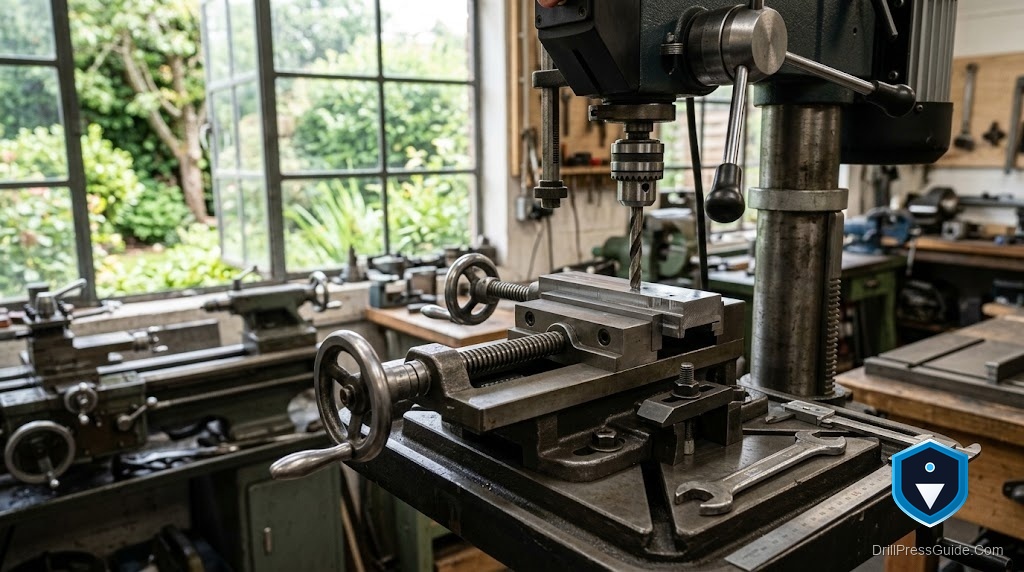
A 2 axis drill press vise, also called a cross slide or compound vise, is a workholding vise mounted on two stacked slides. Handwheels move the clamped workpiece along the X and Y axes, usually in fine graduated increments, so you can position holes precisely relative to one another. On a drill press its job is repeatable hole positioning, not milling.
The direct answer on compatibility: almost any 2 axis vise fits any drill press as long as three things line up. The vise footprint has to sit on your table, the spindle-to-table height has to clear the vise plus your workpiece, and the base slots or lugs have to bolt to your table. Check those three and the vise bolts on.
Compatibility: the three checks
First, footprint. A cross slide vise is wider and taller than a plain vise, so lay out its base on your table and confirm it sits flat with room to reach the mounting holes. Second, headroom. Measure the spindle-to-table height at the lowest table position, then subtract the vise height plus a typical workpiece; if the chuck still reaches, you are fine. A tall two-axis vise can eat several inches of quill clearance. Third, mounting. The base needs bolt lugs or slots that align with your table’s slots, or you clamp it down. On a small benchtop table, a large vise can overhang the edges and lose rigidity, so size the vise to the table.
Choosing the level of vise you need
Basic cross slides and shop-grade ones look similar and behave very differently. A basic 4 inch two-way compound cross-slide vise gives you both axes and a serrated jaw, and for occasional hole positioning it is genuinely useful, as long as you accept rough dials and gibs that need tuning. A step up in fit and finish, the Yost cross-slide drill press vise tightens up the ways and the feel. For the cleanest action and a lifetime warranty, the Wilton CS4 cross-slide drill press vise has hardened V-jaws, fine-grain castings, and dials in 0.1 mm increments. All three do the same job; the step up gives you less slop and better repeatability.
Setup that turns dials into accurate holes
Bolt the vise to the table through its lugs so it cannot shift when the bit loads the work. Tune the gibs on each slide so the ways move smoothly without wobble, then back off just enough to keep the motion free. Take out backlash by always approaching a position from the same direction, since the graduated dials read true only when you stop reversing into a number. Use the dials to get close, then confirm critical spacing with a rule or an edge finder, because even a good cross slide is a positioning aid, not a jig-bore. Lock the idle axis before you drill, put a sacrificial board under the work for clean breakthrough, and clear chips with a brush.
The one rule that keeps it working
A 2 axis vise on a drill press is for positioning and drilling, never milling. A drill press spindle and quill resist downward thrust, not the sideways force of a cutter, and a clamp-on vise cannot take those loads either. Try to mill and you will spin the chuck loose or wreck the ways. Place holes, hold work, spot-face lightly, and stay in that lane.
The verdict
A 2 axis drill press vise is one of the best positioning upgrades you can add, and compatibility is simply a matter of footprint, headroom, and mounting. Buy the basic compound vise if you position holes occasionally and will tolerate rough dials, the Yost for a nicer feel, or the Wilton CS4 if you want shop-grade repeatability and warranty. Then earn the accuracy with setup: bolt it down, tune the gibs, kill the backlash, verify with a rule, and never ask it to mill. Do that and a row of holes becomes a two-minute, dial-and-drill job.
FAQ
Will a 2 axis vise fit my drill press? Most do. Check that the footprint sits on your table, the spindle-to-table height clears the vise plus your workpiece, and the base bolts or clamps to your table.
What is the difference between a basic and a shop-grade cross slide vise? The job is the same; the step up gives tighter ways, less backlash, better dials, and more repeatable positioning. Basic units need gib tuning and have rough dials.
Can I mill with a 2 axis drill press vise? No. It is for positioning and drilling only. Side-cutting loads exceed what a drill press spindle and a clamp-on vise can safely handle.
Why do the dial readings not match my hole spacing? Backlash in the screws. Always approach each position from the same direction, and confirm critical spacing with a rule or edge finder.
Why does the vise feel loose or wobbly? The gibs need adjusting. Tighten each gib until the slide moves smoothly with no play, then lock the axis you are not using.
Does it hold round stock? Models with V-grooved jaws, like the Wilton CS4, cradle round parts so you can drill cross holes in shafts and dowels squarely.
References
- HFS 2-Way 4-Inch Drill Press Compound Cross-Slide Vise, product specifications: Check on Amazon
- Wilton Tools, Cross Slide Drill Press Vise (CS4) specifications: https://wiltontools.com/4-cross-slide-drill-press-vise