
Choosing a Wilton Cross Slide Drill Press Vise That Fits the Work and the Table
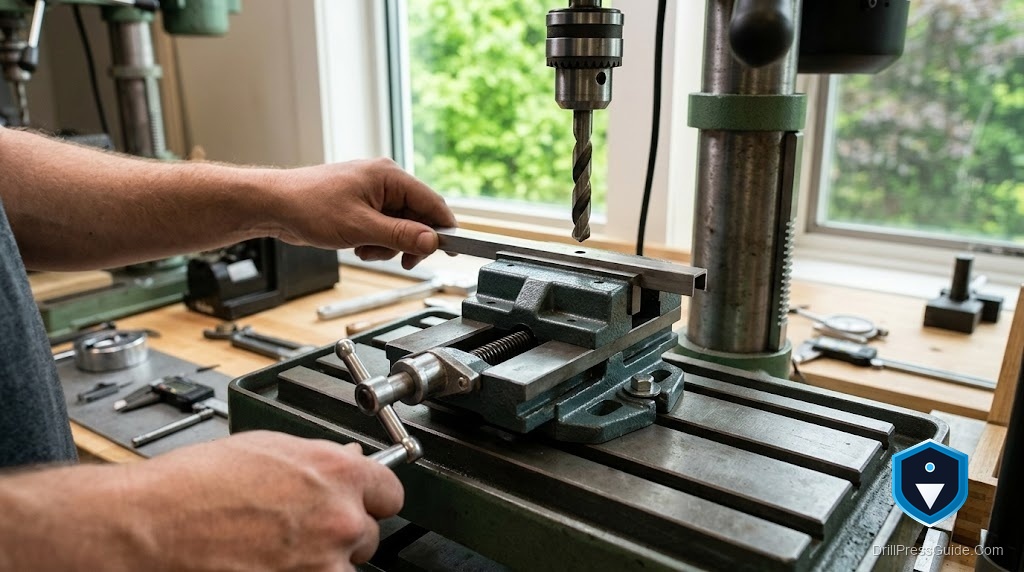
Most drill press vises hold a workpiece in one spot and leave the positioning to you and a pencil line. A Wilton cross slide drill press vise does something better: it grips the part and then lets you move it, sliding on two axes by turning handwheels, so you can place a row of holes on a grid without touching the workpiece between cuts. For anyone drilling repeat patterns or dialing in exact hole centers, that is a genuine upgrade. The trick is choosing the size and understanding what a cross slide vise on a drill press is really for, because buying the wrong size or expecting it to mill will leave you disappointed.
A Wilton cross slide drill press vise is a cast-iron two-axis vise that clamps to your drill press table. Cast side knobs move the jaw and workpiece in X and Y, dialing in roughly 0.1 mm increments, and hardened V-grooved jaws hold round stock both vertically and horizontally. Its purpose on a drill press is precise, repeatable hole positioning, not milling.
The direct answer on choosing one: match the jaw width to your parts and the vise footprint to your table. The Wilton CS4 gives a 4 inch jaw with about 4-9/10 inch of travel on each axis and weighs around 20 pounds, while the CS6 steps up to a 6 inch jaw. Confirm the footprint fits your table, the travel covers your hole spacing, and the spindle-to-table height clears the vise plus your workpiece.
Fit the table first
A cross slide vise is tall and heavy, so it eats both table space and headroom. Before buying, lay out the footprint on your drill press table and make sure it sits flat with room to reach the base’s bolt lugs (the CS4 has five). Then measure the spindle-to-table height at the lowest table setting and subtract the vise height plus a typical workpiece; if the chuck still reaches, it fits. A 6 inch model on a small benchtop table often hangs off the edges and loses rigidity, so size down if your table is small.
Fit the work
The reason to buy a cross slide is positioning, so match the travel to your parts. About 4-9/10 inch of travel per axis on the CS4 covers most small work, letting you index a line or a grid of holes without re-clamping. The hardened V-grooved jaws are the other half of the value: they cradle round stock so you can drill cross holes in a shaft or dowel squarely, which a flat-jaw vise cannot do well. If your parts are larger than the travel, step up to the CS6.
Setup that stays accurate
Bolt the vise to the table through its lugs so it cannot shift under load. Before the first hole, take the backlash out of the handwheels by always approaching a position from the same direction, since the dials read true only when you stop chasing the number back and forth. Use the dials to get close, then confirm critical spacing with a rule or an edge, because even a well-made cross slide is a positioning aid, not a jig-bore. Lock the axis you are not moving before you drill, and clear chips with a brush.
The pick, and its honest limit
For most shops the Wilton cross-slide drill press vise in the 4 inch CS4 size is the sweet spot: fine-grain cast iron, hardened V-jaws, a five-lug base, and dials in 0.1 mm increments, backed by Wilton’s lifetime warranty and reliably available online. It is a clear step up in fit and finish from basic cross slides, with less slop in the ways. The one limit to respect is the same for every cross slide: it is for positioning and drilling, not milling. Side-cutting loads exceed what a drill press spindle and a clamp-on vise can handle safely, so do not try to take a milling cut with it.
The verdict
A Wilton cross slide drill press vise is the right buy when you need repeatable, dialed-in hole positions and want workholding that will outlast basic castings. Choose the CS4 for typical bench work and the CS6 for larger parts, and let your table size and spindle height settle the decision. Bolt it down, work the dials from one direction, verify critical spacing with a rule, and keep it to drilling. Treat it as a precise positioning table and it is excellent; treat it as a milling machine and you will be back reading reviews wondering what went wrong.
FAQ
What does a cross slide vise do that a regular vise does not? It moves the clamped workpiece on two axes by handwheel, so you can position a grid of holes precisely without re-clamping between cuts.
Which Wilton size should I choose? The CS4 (4 inch jaw) suits most bench work, the CS6 (6 inch) handles larger parts. Match jaw width and travel to your parts and your table room.
Can I mill with a Wilton cross slide vise on a drill press? No. It is for positioning and drilling. Side-cutting loads exceed what a drill press spindle and clamp-on vise can safely take.
Why do my hole positions drift from the dial readings? Backlash. Always approach a position from the same direction and verify critical spacing with a rule, since the dials read true only then.
Will it fit my benchtop drill press? Check the footprint and the spindle-to-table height. A 6 inch model can crowd a small table, so size down if space is tight.
Can it hold round stock? Yes. The hardened V-grooved jaws cradle round parts vertically and horizontally, so you can drill cross holes in shafts and dowels squarely.
References
- Wilton Tools, 4-inch Cross Slide Drill Press Vise (CS4, 11694) specifications: https://wiltontools.com/4-cross-slide-drill-press-vise
- Wilton CS4 Cross-Slide Drill Press Vise, product specifications: Check on Amazon


