
Klutch Cross Slide Drill Press Vise: Review and Alternatives
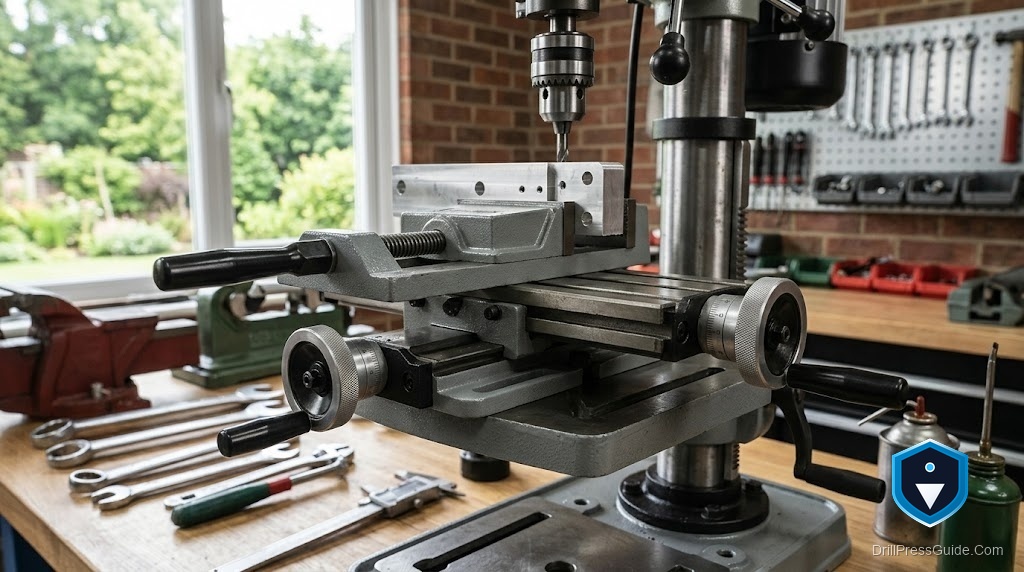
The Klutch cross slide drill press vise has a loyal following among people who drill hole patterns in metal, and for good reason: it is a heavy cast-iron cross slide that lets you position a part in two directions by turning handwheels, then lock it down and drill. The problem is availability. Klutch is Northern Tool’s house brand, so the vise comes and goes from stock, which leaves a lot of people asking whether to wait for one or buy something they can get today. Here is a clear look at what the Klutch does well and the alternatives that do the same job.
A cross slide drill press vise is a vise mounted on two stacked slides. One handwheel moves the work left and right, the other moves it front and back, so you can place a hole precisely and repeat a pattern without unclamping. The Klutch version is known for a solid cast-iron body and usable travel in both axes, aimed at metalworkers who want repeatable hole placement on a drill press.
The direct answer: the Klutch cross slide vise is a good, heavy positioning vise when you can find it in stock, but it is not the only one that does the job. If it is unavailable, a Yost or an HFS cross slide vise gives you the same two-axis control and is easy to get. The features that matter are cast-iron rigidity, smooth gib-adjustable slides, and a base you can bolt down, and several vises deliver those.
What the Klutch does well
The appeal is mass and travel. A cast-iron body resists the flex and chatter that ruin accuracy, and the Klutch offers a few inches of travel in each axis, enough for bolt circles and hole grids on brackets and plates. The handwheels let you creep up on a position by small amounts that are impossible to hit by nudging a part by hand. For a metalworker who drills patterns, that combination is exactly what makes a cross slide worth owning.
The honest drawbacks
Two things hold it back. First is stock: because it is a house brand, the Klutch is frequently out of stock or only available through one retailer, so you may not be able to buy one when you need it. Second, like every affordable cross slide, the handwheel dials are not precise enough to trust blindly, so you verify positions with a rule or a dial indicator, and the gibs need tuning out of the box to remove play. These are not flaws unique to Klutch; they come with the category. But the availability issue is the one that sends people looking elsewhere.
Alternatives you can actually buy
If the Klutch is out of stock, two vises do the same work and are easy to find. The Yost CSV8 cross slide drill press vise is a heavier, wider cast-iron option with smooth two-axis travel, and it comes from a long-standing vise maker, so support and parts are easier. Its tradeoff is size and a bit more outlay, which is fair for the extra mass. For a smaller, more affordable choice, the HFS 2-way compound cross slide vise gives you a 4 inch jaw and both axes for less money, at the cost of rougher dials and gibs that need a careful initial tune. Choose the Yost if you drill larger parts and want the most rigidity, and the HFS if you want the function for the least money and do not mind tuning it in.
How to pick and set up any cross slide
Whichever you buy, the same rules give good results. Bolt the vise to the table through its base slots so it cannot shift. Tune each gib until the slide moves smoothly with no wobble, then lock the axis you are not adjusting before you drill so it cannot drift. Beat backlash by always approaching your final position from the same direction, since the first fraction of a turn back just takes up slack. And remember a cross slide on a drill press is for positioning and drilling, not for milling; the spindle is not built for sideways cutting loads.
The verdict
The Klutch cross slide drill press vise is a solid, heavy positioning vise that is genuinely good when it is in stock, and its main weakness is that it often is not. Do not wait on an empty shelf when a Yost CSV8 gives you more mass and easier support, or an HFS compound vise gives you the same two-axis function for less. Bolt it down, tune the gibs, lock the idle axis, and approach positions from one direction, and any of these three will place holes on a drill press that you could never hit freehand.
FAQ
Is the Klutch cross slide vise worth buying? Yes, when you can find it in stock. It is a heavy cast-iron cross slide with usable travel. Its main drawback is spotty availability.
What can I buy instead of a Klutch cross slide vise? A Yost CSV8 for more mass and easier support, or an HFS compound cross slide vise for the same two-axis function at a lower cost.
Can I mill with a cross slide vise on a drill press? No. It is for positioning and drilling. A drill press spindle is not built for the sideways loads of milling, and the chuck can loosen.
Why are my holes slightly off with a cross slide? Usually loose gibs, an unlocked idle axis, or backlash. Tune the gibs, lock the axis you are not moving, and approach each position from one direction.
Do I need to bolt the vise down? Yes. Anchor it through the base slots so cutting force cannot shift it and ruin your hole placement.
How much travel do I need? A few inches in each axis handles most brackets and plates. Match the travel to the size of the parts you drill.
References
- Northern Tool, Klutch Cross-Slide Drill Press Vise, product specifications: https://www.northerntool.com/products/klutch-cross-slide-drill-press-vise-5in-jaw-length-49463
- Yost Vises, cross-slide and drill press vise line: https://yostvises.com/collections/drill-press-vises


