
9-Inch Drill Press Locking Clamp: Compatibility and Setup Guide
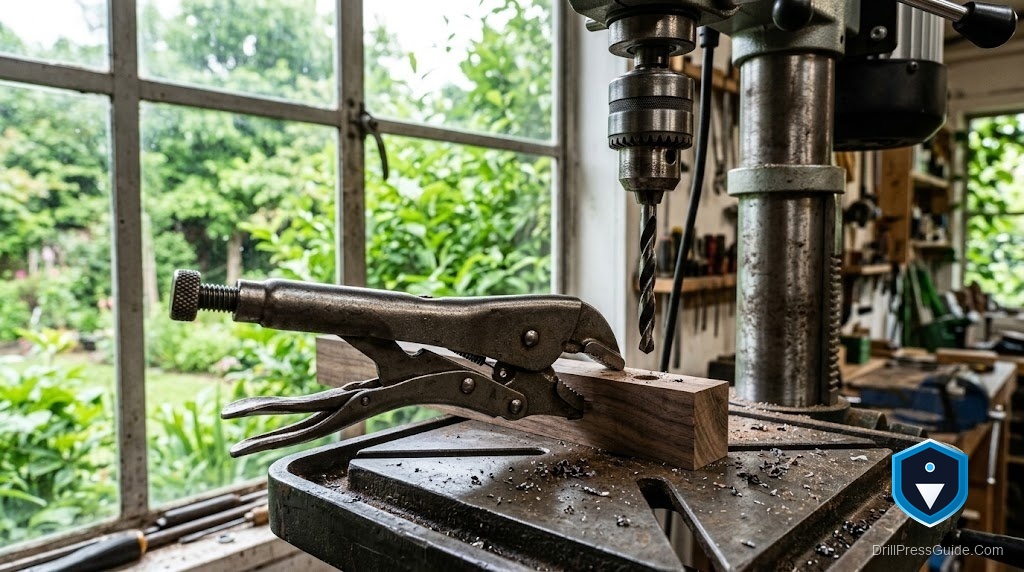
There is a moment every drill press owner knows: the part is too big or too awkward for the vise, and holding it by hand feels like a bad idea because it is one. A 9-inch drill press locking clamp is built for exactly that moment. It reaches across a wide span, presses the work to the table, and locks so it cannot lift or spin. The trick is matching the clamp to your table slots and using it where its long reach actually helps. Here is how to do both.
A 9-inch drill press locking clamp is a hold-down that seats in the table slots and locks the workpiece against the table, with about a 9-inch working span. It suits wider or flatter parts than a vise can grip, and it fixes them so the bit cannot lift or rotate the work. Its fit depends on your table’s slots, and its value is reach.
Short answer: a 9-inch locking clamp fits presses whose table slots accept its base, and it excels at holding wide or flat parts a vise cannot span. Seat it in the slot, press the work near the hole, and lock it so the part cannot lift or spin.
Where the 9-inch reach helps
The long span is the point. A vise grips a part between two jaws; a locking clamp presses down from above and reaches across a wider area, so a broad panel, a long bracket, or an odd shape gets held where a vise cannot grab it. The lock keeps that pressure on, so when the bit breaks through, the work stays put instead of lifting or spinning.
For wide and flat work, that reach and hold is exactly what keeps drilling safe and accurate.
Compatibility comes down to the slots
The clamp anchors in the table’s T-slots or holes, so fit depends on your table. Confirm the clamp’s base or bolt matches your slot size and that the slot layout lets the clamp reach where you need to press. On a table with no slots, this style of clamp has nothing to anchor to, so you would need a different holding method.
The honest limitation: reach is only useful if the clamp presses near the hole. A 9-inch clamp anchored far from the drilling point still leaves the work able to flex where the bit is. Position the pad close to the hole, on solid material.
Check before buying
- Slot fit. The clamp base or bolt must match your table’s slot size.
- Slot layout. The slots must let the clamp reach your drilling area.
- Work type. Best for wide, flat, or awkward parts a vise cannot span.
- Pad placement. Plan to press near the hole on solid material.
Locking clamp versus a vise
Against a drill press vise, a 9-inch locking clamp wins on holding wide, flat, and awkward parts and on reach, and loses on gripping small parts and on repeatable positioning. A vise excels at small, regular work; the clamp excels at big or odd shapes. Many shops keep both and reach for whichever suits the part. You can compare a 9 inch drill press locking clamp with a drill press table clamp kit.
Setting it up
- Confirm the clamp base fits your table’s slots and reaches your drilling area.
- Mark the hole and set the work on the table.
- Seat the clamp in a slot and position the pad near the hole on solid material.
- Lock it so the work is pressed firmly to the table and cannot lift or rotate.
- Confirm the bit path is clear of the clamp, then drill with eye protection, per OSHA and CCOHS.
Who should read this
If you drill wide panels, long brackets, or odd shapes, a 9-inch locking clamp holds what a vise cannot, just confirm it fits your slots. If your parts are small and regular, a vise gives better grip and repeatable positioning; keep the clamp for the big awkward pieces.
Bottom line
A 9-inch drill press locking clamp is about reach: it holds wide and flat work a vise cannot span, and locks it so the bit cannot lift or spin the part. Confirm the clamp fits your table slots, press near the hole on solid material, and lock it firmly. For big and awkward parts, it is the tool that keeps drilling safe and square.
- The 9-inch span holds wide, flat, and awkward parts a vise cannot grip.
- Fit depends on your table slots; confirm the base matches before buying.
- Press near the hole on solid material and lock so the work cannot lift.
FAQ
When should I use a 9-inch locking clamp instead of a vise? For wide, flat, or awkward parts a vise cannot span. Its long reach presses the work to the table where jaws cannot grip.
Will it fit my drill press? If your table has T-slots or holes that match the clamp’s base or bolt, and the layout lets it reach your drilling area.
Where should the clamp pad go? Near the hole, on solid material. Clamping force drops with distance, so a far-off pad lets the work flex where the bit is.
Can I use it on a slotless table? No. This style anchors in the slots. A table without slots needs a different holding method.
How firmly should I lock it? Until the work is pressed hard to the table and cannot lift or rotate when the bit grabs. Confirm it does not move.
Does it replace a vise? For wide, flat work, often yes. For small parts and repeatable positioning, a vise is better. Many shops use both.
References
- TEKTON 4-Inch Drill Press Vise Manual: https://media.tekton.com/manuals/manual_53994.pdf
- CCOHS, Metalworking Machines - Drill Presses: https://www.ccohs.ca/oshanswers/safety_haz/metalworking/drillpresses.html
- OSHA Woodworking eTool, Drill Press: https://www.osha.gov/etools/woodworking/production/machines-tools/drill-press


