
3 Cross Slide Drill Press Vise: Fit, Capacity, and Setup Explained
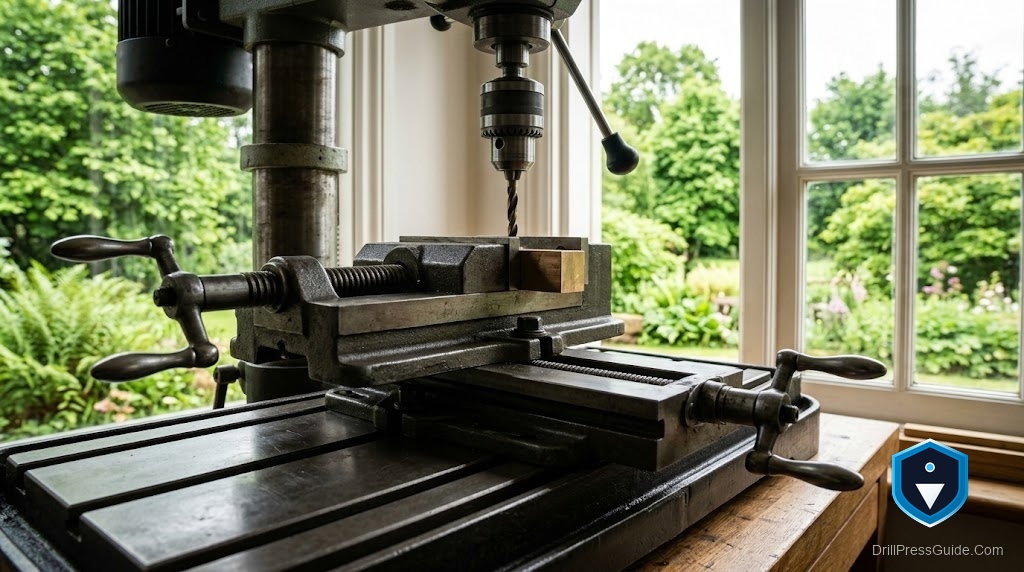
A 3-inch cross slide vise is the compact member of the cross-slide family, and its small size is both its charm and its constraint. It gives you dial-in positioning on two axes in a footprint that suits a small table, which is genuinely handy. It also grips a narrower range of parts than its bigger siblings, so buying one is about matching the tool to small, precise work. Here is what the 3-inch size does well, where it runs out of room, and how to set it up so the positioning stays accurate.
A 3-inch cross slide drill press vise is a compact two-axis vise with lead screws that move the clamped work left-right and front-back for precise hole placement. The 3-inch figure refers to the jaw width, which sets how much it can grip. It bolts to the table like any vise, and its value is small-scale, dialed-in positioning.
Short answer: a 3-inch cross slide vise suits small parts and tight tables, giving two-axis positioning in a compact size, and its limit is jaw capacity, so larger work needs a bigger cross slide. Bolt it down, position between holes, and drill straight down; never feed sideways into the bit.
What the 3-inch size does well
The two lead screws let you set a hole location by turning dials rather than nudging the part, so a small grid of holes lands on layout. In the 3-inch size, that capability comes in a footprint that fits a small or crowded table, and it handles small parts, hobby and light metal work, precisely. The screws also hold position under the bit, so a hand-fed part cannot creep.
For small, precise placement on a modest press, the compact cross slide is a tidy, capable tool.
The capacity limit
The honest constraint is the jaw width. A 3-inch vise grips a narrower range than a 4-inch or 6-inch cross slide, so larger parts simply will not fit or will overhang unsupported. Match the vise to your typical part size. If your work regularly exceeds what 3-inch jaws hold, size up rather than fight the capacity.
The rule that protects the press
Like any cross slide on a drill press, this is a positioning tool, not a milling table. A drill press quill carries downward thrust, not side load. Position the work with the bit clear, lock the axes, and drill straight down. Do not turn the dials to feed the work sideways into a spinning bit; that flexes the quill, and the bit can grab and break.
Check before buying
- Jaw capacity. The 3-inch jaws must hold your typical parts.
- Table mounting. Slots or holes to bolt the vise down securely.
- Spindle travel. The vise adds height; confirm the quill still reaches your work.
- Screw feel. Smooth, backlash-limited screws position more accurately.
3-inch versus a larger cross slide
Against a 4-inch or 6-inch cross slide vise, the 3-inch wins on compactness and fitting a small table, and loses on capacity and grip on larger parts. If your parts are consistently small, the 3-inch is the right fit; if they vary or run large, a bigger cross slide is more versatile. You can compare a 3 inch cross slide drill press vise with a larger cross slide drill press vise.
Setting it up
- Confirm the 3-inch jaws hold your parts and the table can mount the vise.
- Bolt the vise to the table so it cannot move, and check spindle travel.
- Clamp the work in the jaws.
- Position with the dials while the bit is clear, lock both axes, then drill straight down.
- Wear eye protection and keep clear of the chuck, per OSHA and CCOHS.
Who should skip it
If your parts often run larger than 3-inch jaws hold, buy a bigger cross slide instead. If your work is consistently small and precise and your table is tight on space, the 3-inch cross slide is the right, compact choice.
Bottom line
A 3-inch cross slide drill press vise gives compact, two-axis hole positioning for small work, and its only real limit is jaw capacity. Match it to your part size, bolt it down, and follow the cross-slide rule: position with the bit clear, lock, and drill straight down. Within its size, it is a precise and space-friendly tool.
- The 3-inch cross slide positions small parts on two axes in a compact size.
- Its limit is jaw capacity; size up if your parts run larger.
- Position and lock with the bit clear, then drill straight down.
FAQ
What does the 3-inch measurement mean? The jaw width, which sets how large a part the vise can grip. A 3-inch vise suits small parts on a compact table.
Can I mill with a 3-inch cross slide vise? No. It positions on two axes; the drill press quill cannot take side load. Position with the bit clear, then drill straight down.
Will it hold my parts? Only parts within the 3-inch jaw capacity. If your work runs larger, choose a 4-inch or 6-inch cross slide.
Does it reduce drilling depth? Yes. The vise raises the work, so confirm your spindle travel still reaches your tallest parts.
Why choose 3-inch over a bigger size? Compactness. It fits a small or crowded table and suits consistently small parts better than a larger, heavier vise.
How do I keep the positioning accurate? Bolt the vise down, clamp the work, and lock both axes before drilling each hole so nothing creeps.
References
- TEKTON 4-Inch Drill Press Vise Manual: https://media.tekton.com/manuals/manual_53994.pdf
- CCOHS, Metalworking Machines - Drill Presses: https://www.ccohs.ca/oshanswers/safety_haz/metalworking/drillpresses.html
- OSHA Woodworking eTool, Drill Press: https://www.osha.gov/etools/woodworking/production/machines-tools/drill-press


