Wilton Cradle Style Angle Drill Press Vise: Compatibility and Setup Guide
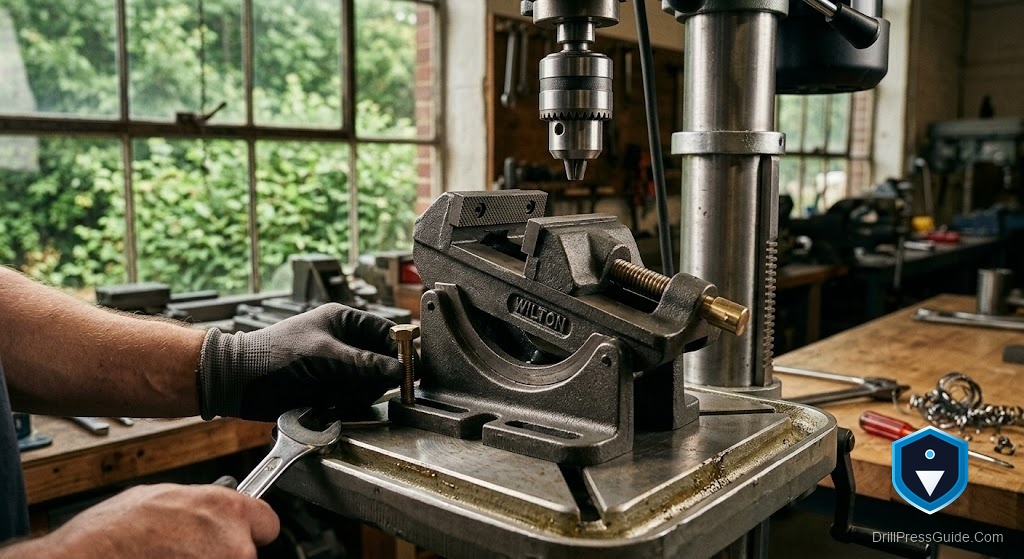
Most vises hold work flat and square, which is exactly what you want until the job needs a hole at an angle. That is the niche the Wilton cradle style angle vise fills: it cradles the work and tilts it, so you drill an angled hole without shimming and swearing. It is a specialist tool, and like any specialist, it is worth it when the work calls for it and overkill when it does not. Here is how to tell which side of that line you are on, and how to set the vise up so the angle stays put.
A cradle style angle drill press vise holds the workpiece in a tilting cradle that pivots to a set angle, so the drill enters at that angle while the bit still travels straight down. It bolts to the table like a standard vise. Its value is repeatable angled holes; its trade is more height, weight, and complexity than a plain 4-inch drill press vise.
Short answer: a cradle style angle vise fits a press with a table that can carry its size and bolt it down, and it earns its place when you drill angled holes often. For straight-down work, a plain vise is simpler, lower, and easier to keep accurate.
What the cradle does
The cradle tilts the work to a chosen angle and locks there, so the vertical bit meets the piece at that angle. Instead of propping a part on wedges and hoping, you set the cradle, lock it, and drill a repeatable angled hole. For angled dowel holes, chamfered entries, or parts that must be drilled off-square, that is a real convenience and a real gain in accuracy.
The flip side is that a tilting cradle adds joints, and joints add height and the chance of flex if they are not locked firmly.
Compatibility and the honest limit
The vise bolts to the table through its base, so the checks are the familiar ones: the table needs slots or holes, the surface must carry the vise’s size and weight, and the tilted work plus the vise height must leave you working spindle travel. A tall cradle on a short-travel press can run the quill out before the bit reaches the work.
The honest limitation: any tilting fixture flexes more than a solid vise if the pivots are not locked hard. Lock every adjustment firmly, take lighter cuts at steep angles, and clamp the work in the cradle so nothing shifts. Respect that and the angle holds; ignore it and the hole wanders.
Check before buying
- Table mounting. Slots or holes to bolt the vise down securely.
- Spindle travel. Enough travel for the cradle height plus the tilted work.
- Angle range. The cradle’s tilt covers the angles you actually need.
- Lock quality. Pivots that lock firmly so the angle does not creep.
Angle vise versus a plain vise and wedges
Against a plain vise with shims or a tilting table, the cradle angle vise wins on repeatable, dialed-in angles and loses on height, weight, and simplicity. Shimming works for a one-off; the cradle is better when angled holes are routine and must match. For straight-down drilling, the plain vise is the better daily tool. You can compare a cradle angle drill press vise with a plain 4 inch drill press vise.
Setting it up
- Bolt the vise to the table through its base so it cannot move.
- Confirm you have spindle travel for the cradle height and tilted work.
- Set and lock the cradle angle firmly.
- Clamp the work in the cradle and confirm the bit meets it where you want.
- Take lighter cuts at steep angles, wear eye protection, and keep clear of the chuck, per OSHA and CCOHS.
Who should read this
If angled holes are a regular part of your work, a cradle style angle vise makes them repeatable and accurate. If nearly all your drilling is straight down, skip it, a plain vise is lower, simpler, and easier to keep dead accurate.
Bottom line
A Wilton cradle style angle drill press vise is a specialist that shines on repeatable angled holes and asks for more height, weight, and careful locking in return. Confirm your table can mount it and your spindle travel covers the cradle, lock every pivot hard, and clamp the work. For angled work it is a genuine upgrade; for straight-down drilling, a plain vise wins.
- The cradle tilts and locks the work for repeatable angled holes.
- Confirm table mounting, spindle travel, angle range, and firm locks.
- Lock every pivot and take lighter cuts at steep angles.
FAQ
What is a cradle style angle drill press vise for? Drilling repeatable angled holes. The cradle tilts and locks the work to a set angle while the bit travels straight down.
Will it fit my drill press? If the table has slots or holes to bolt it down, can carry its weight, and your spindle travel covers the cradle height plus the tilted work.
Why does the angle sometimes creep? Unlocked or under-tightened pivots. Lock every adjustment firmly and clamp the work so nothing shifts during the cut.
Can I just use shims instead? For a one-off angled hole, yes. For routine angled holes that must match, the cradle vise is more accurate and repeatable.
Does it reduce drilling depth? Effectively yes, because the cradle raises the work. Confirm your spindle travel covers the cradle and tilted part.
How do I drill cleanly at steep angles? Lock the cradle hard, clamp the work, and take lighter cuts so the bit does not deflect on the angled surface.
References
- TEKTON 4-Inch Drill Press Vise Manual: https://media.tekton.com/manuals/manual_53994.pdf
- CCOHS, Metalworking Machines - Drill Presses: https://www.ccohs.ca/oshanswers/safety_haz/metalworking/drillpresses.html
- OSHA Woodworking eTool, Drill Press: https://www.osha.gov/etools/woodworking/production/machines-tools/drill-press