
How to Use a Drill Press Vise Without Losing Accuracy
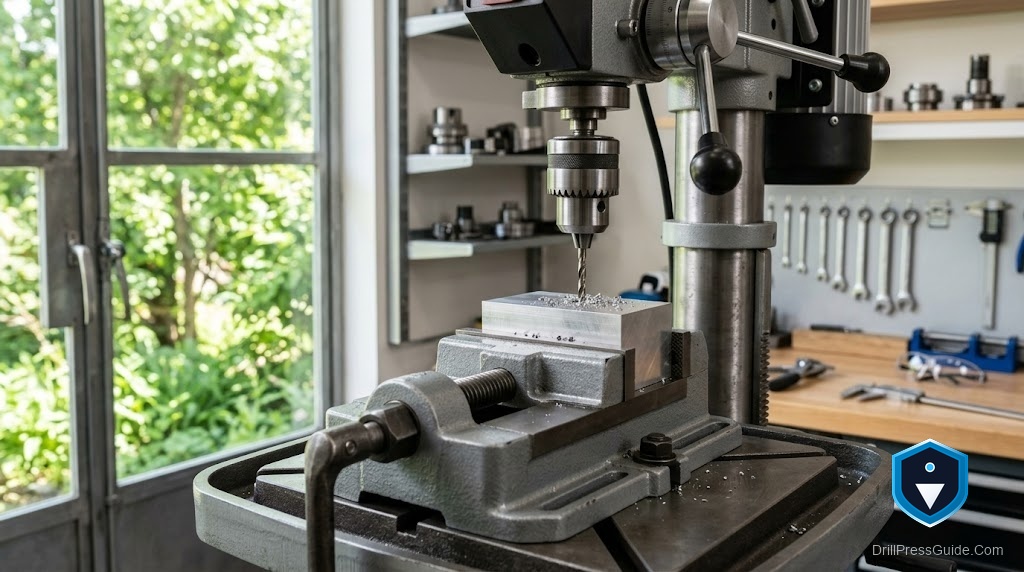
A vise makes drilling safer, and used well it makes drilling more accurate too. Used carelessly, it does neither: the work shifts a hair between holes, the jaws mar the part, or the whole thing spins on breakthrough. The gap between a vise that just holds and a vise that holds precisely comes down to a handful of habits. Get them right and your holes land where the layout says, every time.
Using a drill press vise means securing the work in the jaws, fixing or positioning the vise so the drilling point sits under the spindle, and drilling without the work or the vise moving. A 4-inch drill press vise clamps the part between its jaws; the accuracy comes from how you seat the work, back the exit, and keep the vise from shifting.
Short answer: seat the work flat and square in the jaws, position the drilling point under the spindle, secure the vise so it cannot move, and back the exit with support. Small habits, flat seating, secured vise, backed exit, are what keep accuracy from slipping.
Seat the work square
Accuracy starts with how the part sits in the jaws. Seat it flat on the vise bed, or on parallels, so it sits level and the hole goes in perpendicular. If the part rocks on a burr or chip, the hole tilts. Clean the jaws and bed, and for round stock, use a V-groove or a V-block so the part cannot roll.
Square seating is the difference between a hole that is where you marked it and one that wanders off layout.
Secure the vise, then the work
A vise that slides ruins accuracy as surely as it creates hazard. For precise or repeated holes, fix the vise to the table through its mounting holes or with hold-down clamps so it cannot creep between holes. Then clamp the work firmly in the jaws. The order matters: a secured vise gives you a fixed reference, so moving the table or the layout, not a drifting vise, sets each hole.
Use these habits for accuracy
- Flat seating. Seat the work on the bed or parallels so it sits level and square.
- Backed exit. Put a sacrificial piece under the hole so the bit exits clean, without tear-out or burr.
- Secured vise. Fix the vise so it cannot creep, giving a fixed reference between holes.
- Layout check. Lower the bit to the mark before drilling to confirm the point.
Fixed vise versus hand-positioned vise
Against hand-positioning a loose vise for each hole, a fixed vise wins on repeatability and accuracy, and loses on quick freehand moves. Fixing the vise gives a stable reference for a row of holes; leaving it loose invites drift and is unsafe on breakthrough. For anything precise, fix it. You can compare a drill press vise with a drill press vise with parallels for level seating.
Common mistakes
- Seating on a chip or burr, which tilts the hole. Clean the jaws and bed first.
- Leaving the vise loose, so it creeps between holes and can spin on breakthrough. Fix it.
- No exit backing, which tears out or burrs the back. Back the hole with a sacrificial piece.
- Marring the work, from bare hard jaws. Use soft jaw liners on finished parts.
Who should read this
If your holes wander or your parts come out marred, these habits fix it, seat flat, secure the vise, back the exit. If you only ever drill one rough hole at a time, a clamp may be simpler, but the vise wins for repeatable, accurate work.
Bottom line
To use a drill press vise without losing accuracy, seat the work flat and square, secure the vise so it cannot creep, back the exit, and check the layout before drilling. The vise’s job is to give you a fixed, square reference; these habits are what keep that reference honest hole after hole.
- Seat the work flat and square, on parallels or a V-block as needed.
- Secure the vise so it cannot creep, giving a fixed reference.
- Back the exit and check the layout before each hole.
FAQ
How do I keep holes from wandering? Seat the work flat and square in clean jaws, secure the vise so it cannot creep, and confirm the bit meets the mark before drilling.
Should I fix the vise to the table? For precise or repeated holes, yes. A fixed vise gives a stable reference and is far safer than a loose one on breakthrough.
How do I drill round stock in a vise? Use a V-groove in the jaws or a V-block so the part cannot roll, and seat it so the hole goes in on center.
How do I avoid marring finished parts? Use soft jaw liners over the hard jaws, and clamp only as tight as needed to hold the work securely.
Why back the exit? A sacrificial piece under the hole lets the bit exit cleanly, preventing tear-out and burrs and reducing grab on breakthrough.
Vise or clamp for accuracy? A secured vise wins for repeatable, precise holes in small parts. A clamp suits large, flat, or awkward work the jaws cannot span.
References
- TEKTON 4-Inch Drill Press Vise Manual: https://media.tekton.com/manuals/manual_53994.pdf
- CCOHS, Metalworking Machines - Drill Presses: https://www.ccohs.ca/oshanswers/safety_haz/metalworking/drillpresses.html
- OSHA Woodworking eTool, Drill Press: https://www.osha.gov/etools/woodworking/production/machines-tools/drill-press


