How to Use a Drill Press Clamp: A Clear, Shop-Ready Method
A drill press clamp is the humblest accessory in the shop and quietly one of the most important. It is the thing standing between a securely held workpiece and a spinning metal helicopter. Plenty of people own clamps and still hold parts by hand out of habit, which works fine until the bit grabs. Learning to use a clamp properly, where it presses, how hard, and against what, makes every hole safer and more accurate at once.
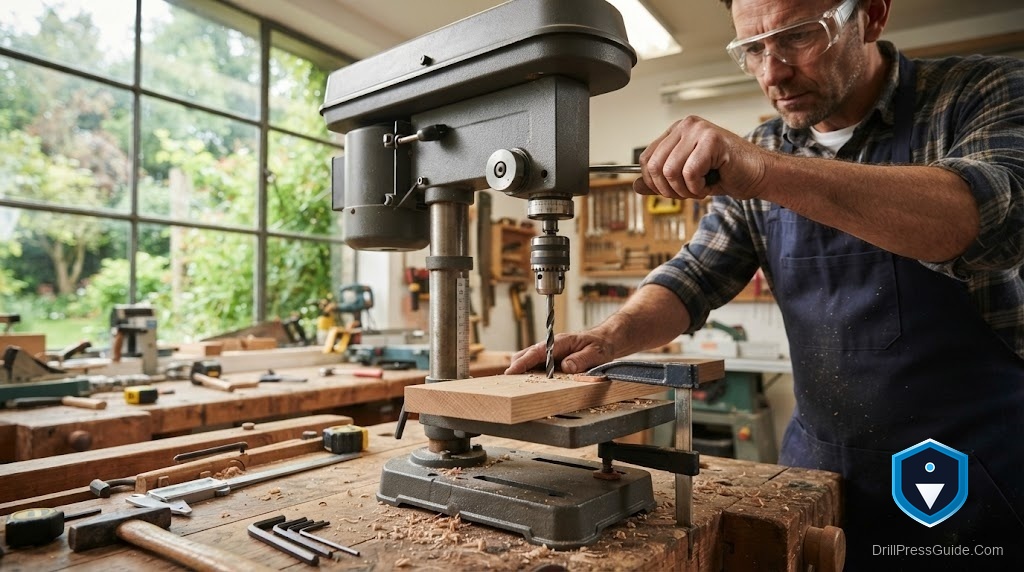
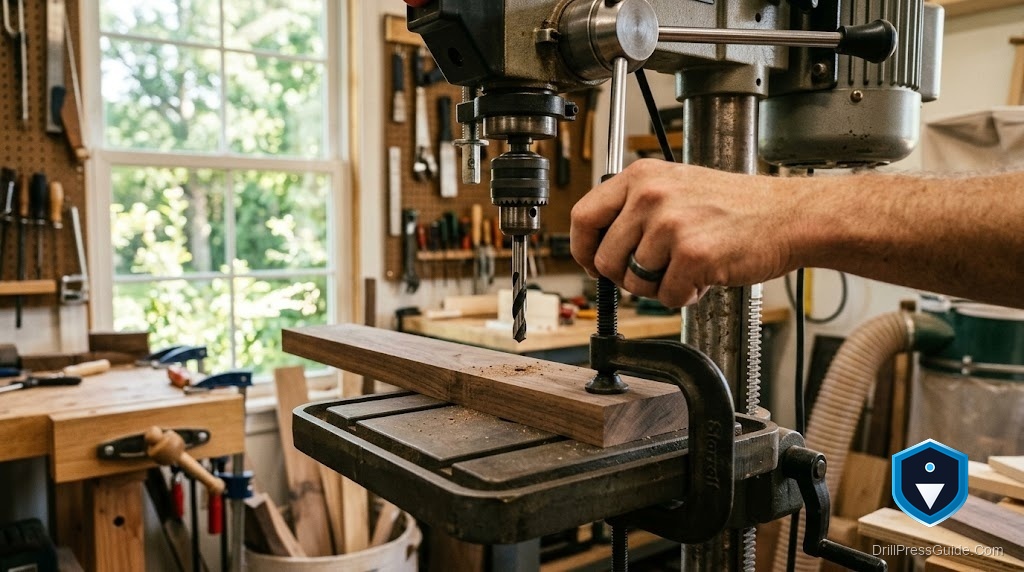
A drill press clamp, whether a hold-down that slides in the table slots or a clamp that pins the work to the table, holds the workpiece so it cannot lift or spin when the bit bites. It works with, or in place of, a vise, using the table slots for anchorage. Used well, it turns a hand-held part into a held one.
Short answer: seat the clamp in the table slot, position it to press the work firmly against the table near the hole, tighten it so the part cannot lift or rotate, and keep it clear of the bit’s path. Never hold a workpiece by hand when a clamp will do it.
Why hand-holding fails
When a drill bit breaks through the back of a part, it grabs and tries to spin the work. A hand cannot reliably resist that, and the part becomes a spinning edge. A clamp, anchored in the table slots, holds the work down and stops the rotation. OSHA and CCOHS both call for work to be secured at the point of operation, and a clamp is often the simplest way to do it, especially for flat parts a vise does not suit.
How to use the clamp
- Mark the hole and set the work on the table where the bit will meet it.
- Seat the clamp in a table slot near the work, on the side that lets it press without blocking the bit.
- Position the pad on a solid part of the work, close to the hole, not on a thin overhang.
- Tighten until the work is pressed firmly to the table and cannot lift or rotate.
- Confirm the bit path is clear of the clamp, then drill with eye protection, per CCOHS and OSHA.
Where the pad goes
The pad should press near the hole, because clamping force falls off with distance. Clamp far from the drilling point and the work can still flex or lift where the bit is. On thin or uneven parts, back the work with a sacrificial board so the clamp presses evenly and the bit exits into wood, not air.
Hold-down clamp versus a vise
Against a vise, a hold-down clamp wins on holding large, flat, or awkward panels the vise jaws cannot span, and loses on gripping small parts and repeatable positioning. A vise excels at small, regular work; clamps excel at big or odd shapes. Many shops keep both. You can compare drill press hold down clamps with a drill press table clamp kit for slot mounting.
Common mistakes
- Clamping far from the hole, so the work still flexes where the bit is. Press near the hole.
- Pressing on a thin overhang, which bends instead of holding. Clamp on solid material.
- Under-tightening, so the part creeps. Snug it until it cannot lift or rotate.
- Leaving the clamp in the bit’s path, which the bit can hit. Confirm clearance first.
Who should read this
If you drill flat panels, brackets, or odd shapes, a clamp holds what a vise cannot. If your work is small and regular, a vise may serve better, but keep clamps for the parts that do not fit jaws.
Bottom line
To use a drill press clamp, seat it in a table slot, press the work firmly to the table near the hole, and tighten until the part cannot lift or spin, keeping the clamp clear of the bit. It is the simplest way to secure flat and awkward work, and it removes the single most common drill press risk: holding by hand.
- Seat the clamp in a slot and press near the hole, not far from it.
- Tighten until the work cannot lift or rotate, on solid material.
- Keep the clamp clear of the bit’s path and back thin parts with a board.
FAQ
When should I use a clamp instead of a vise? For large, flat, or awkward parts the vise jaws cannot span. A vise suits small, regular work; a clamp suits panels and odd shapes.
Where do I position the clamp pad? On solid material near the hole, since clamping force drops with distance. Avoid thin overhangs that bend instead of holding.
How tight is tight enough? Until the work is pressed firmly to the table and cannot lift or rotate when the bit grabs. Snug it, then test that it does not move.
Can a clamp replace a vise? For flat and large work, often yes. For small parts and repeatable positioning, a vise is better. Many shops use both.
Do I still need a backer board? For thin parts or clean exit holes, yes. A sacrificial board lets the bit exit into wood and helps the clamp press evenly.
Why keep the clamp clear of the bit? So the bit does not strike the clamp. Confirm the bit’s full travel is clear of the clamp before powering on.
References
- TEKTON 4-Inch Drill Press Vise Manual: https://media.tekton.com/manuals/manual_53994.pdf
- CCOHS, Metalworking Machines - Drill Presses: https://www.ccohs.ca/oshanswers/safety_haz/metalworking/drillpresses.html
- OSHA Woodworking eTool, Drill Press: https://www.osha.gov/etools/woodworking/production/machines-tools/drill-press