
How to Attach a Drill Press Vise: Setup, Checks, and Common Mistakes
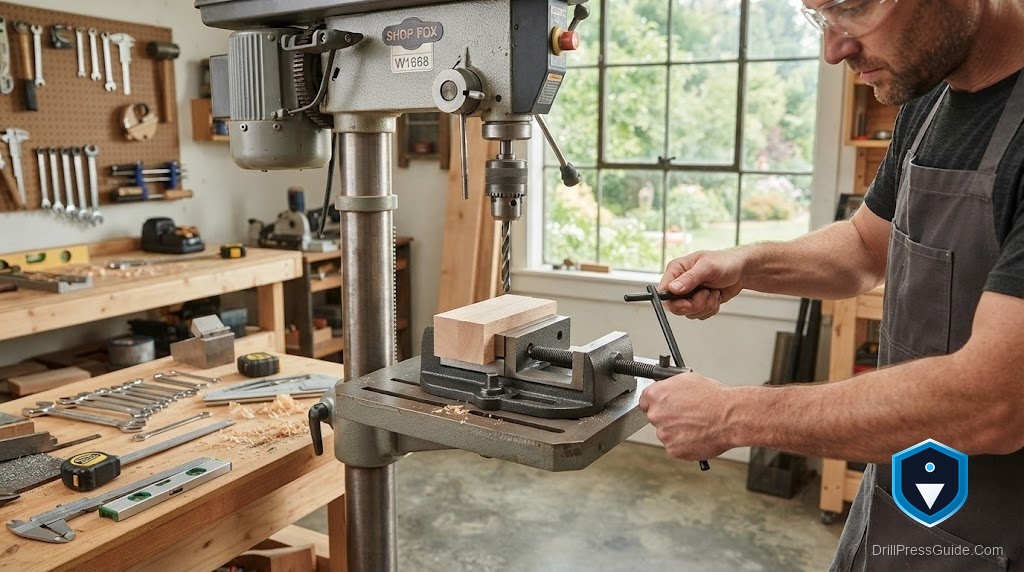
The first time a workpiece spins out of an unclamped vise, you learn the lesson permanently: the vise itself is only half the safety story. The other half is how it is attached to the table. A vise that sits loose is a projectile waiting for a reason, and a vise bolted crooked drills crooked. Attaching a drill press vise correctly takes a few minutes and a couple of checks, and it is the difference between clean, safe holes and a scary afternoon.
Attaching a drill press vise means fixing it to the table through its mounting holes so it cannot move under the bit, then confirming it sits flat and lines the work up with the spindle. A 4-inch drill press vise has mounting holes cast into its base for exactly this, and using them, rather than trusting the vise’s weight, is what keeps it and the work put.
Short answer: bolt or clamp the vise to the table through its mounting holes, seat it flat, confirm it cannot slide, and position the work under the bit before drilling. Never rely on the vise’s weight alone to hold it during a cut.
Why attaching matters
When a bit grabs, especially breaking through the back of a part, it tries to spin the work and the vise with it. A vise that is only resting on the table will lift and spin, flinging the work and the vise. Bolting the vise through its mounting holes stops that. This is standard practice for a reason: an unsecured vise is a recognized hazard, and OSHA and CCOHS both call for the work to be held so it cannot move at the point of operation.
How to attach it
- Clean the table and vise base so nothing holds them apart and the vise sits flat.
- Position the vise so the work will sit under the spindle, with the jaws oriented for your part.
- Fix it through the mounting holes. Bolt through the table slots with T-bolts or hardware, or use hold-down clamps in the slots pressing on the vise base.
- Seat it flat and snug it down so the base does not rock and cannot slide.
- Check alignment by lowering the bit to confirm it meets the work where you want the hole.
Bolt-through versus clamp-down
Against clamping the vise with hold-downs, bolting through the mounting holes wins on a rock-solid, permanent hold, and loses on quick repositioning. Clamps in the table slots are faster to move and fine for lighter work; bolts are best when the vise stays put and for heavier cuts. Either is far safer than an unsecured vise. You can compare a drill press vise with mounting holes with drill press table hold down clamps for slot mounting.
Common mistakes
- Trusting the vise’s weight. A heavy vise still spins when the bit grabs. Always fix it down.
- Bolting it crooked. A vise set askew drills askew. Align it to the spindle first.
- Leaving grit under the base. Chips under the vise rock it. Clean the table and base.
- Over-tightening one bolt first. Snug both evenly so the base does not lift a corner.
Who should read this
If you have been resting a vise on the table and holding your breath, this is the fix, use the mounting holes every time. If your work varies and you reposition often, clamps in the slots give you a fast, secure alternative to permanent bolts.
Bottom line
To attach a drill press vise, fix it to the table through its mounting holes, seat it flat, confirm it cannot slide, and line the work up under the bit. Bolt it for a permanent hold or clamp it for quick moves, but never leave it loose. That single habit prevents the most common and most dangerous drill press mishap.
- Fix the vise through its mounting holes; never trust its weight.
- Seat it flat on a clean table and confirm it cannot slide.
- Align the vise to the spindle before drilling, and clamp the work.
FAQ
Do I really need to bolt down a heavy vise? Yes. When the bit grabs, even a heavy vise can spin and fling the work. Fix it through its mounting holes every time.
Bolts or clamps, which is better? Bolts give a permanent, rock-solid hold; clamps in the table slots move faster for varied work. Both beat an unsecured vise.
How do I line the vise up? Position it so the work sits under the spindle, then lower the bit to confirm it meets the work where you want the hole.
Why does my vise rock? Usually grit under the base or an uneven table. Clean both surfaces and snug the fasteners evenly so no corner lifts.
Can I attach a vise to any drill press table? If the table has slots or holes, yes. Use T-bolts through the slots or hold-down clamps pressing on the vise base.
What does the safety guidance say? OSHA and CCOHS call for the work to be held so it cannot move at the point of operation, which is exactly why the vise must be fixed down.
References
- TEKTON 4-Inch Drill Press Vise Manual: https://media.tekton.com/manuals/manual_53994.pdf
- CCOHS, Metalworking Machines - Drill Presses: https://www.ccohs.ca/oshanswers/safety_haz/metalworking/drillpresses.html
- OSHA Woodworking eTool, Drill Press: https://www.osha.gov/etools/woodworking/production/machines-tools/drill-press


