Choosing a 6-Inch Cross Slide Drill Press Vise That Fits the Work and the Table
A 6-inch cross slide vise promises the best of two tools: the secure grip of a big vise and the dial-in positioning of a cross-slide table, in one unit that bolts to your drill press. It is a genuinely useful combination for repeatable, positioned holes in metal. The mistake people make is treating it like a milling vise and feeding sideways into the cutter. Choosing the right one, and using it within its limits, is what turns it into a precision helper instead of a broken quill.
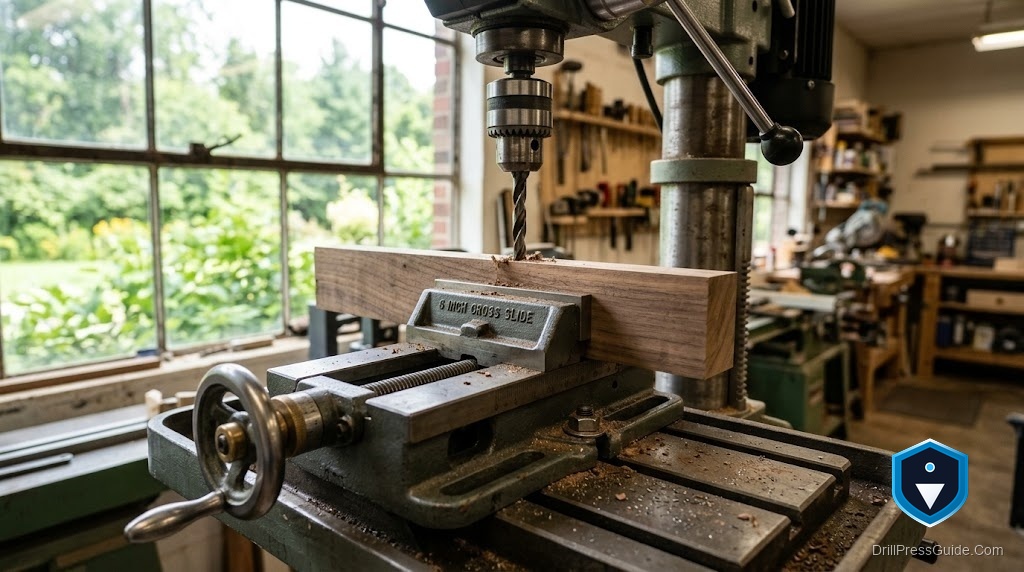
A cross slide drill press vise is a vise mounted on two lead-screw slides, so you can clamp the workpiece and then move it in X and Y by turning dials to position each hole. A 6-inch model refers to the jaw width, giving a wide grip. That combination of firm clamping and two-axis positioning is exactly its appeal.
Short answer: choose a 6-inch cross slide vise that bolts to your table, whose X-Y travel covers your hole pattern, and whose added height leaves you spindle travel. Use it to clamp and position for drilling, never to feed sideways and mill, because a drill press quill takes downward thrust, not side loads.
What the cross slide vise does well
It unites holding and positioning. The 6-inch jaws grip a substantial part securely, and the two slides let you place each hole by dialing a known distance in X and Y. For a bolt pattern or a row of holes in a metal plate, you clamp once and position each hole precisely, without re-clamping or re-marking.
The lead screws also resist drift. Where a hand-fed part can creep as the bit bites, the screws hold the vise, so the hole stays where you set it.
The limit you must respect
Here is the honest line. The slides make it look like a milling vise, but the machine underneath is still a drill press. Its quill is built for straight-down thrust, not the sideways force of milling. Clamp the work and move it between holes with the power off or the bit clear; do not feed the work sideways into a spinning bit to cut a slot. Do that and the quill flexes, the bit can grab, and the setup fails. Position for drilling, full stop.
Choose by these measurements
- Jaw width and opening. The 6-inch jaws span wide; confirm the opening fits your workpiece thickness.
- X and Y travel. Match the slide travel to your largest hole pattern.
- Mounting. Confirm the base bolts to your drill press table’s slots or holes.
- Added height versus spindle travel. Stack the vise height and workpiece and confirm the quill reaches.
Cross slide vise versus a plain vise plus a fence
Against a plain 4-inch vise with a fence, the cross slide vise wins on true two-axis positioning without re-clamping and loses on height and weight. If you mostly drill single holes or a straight line, a plain vise and a fence are simpler and lower. If you drill true grids and patterns in metal, the cross slide’s dial-in positioning earns its place. You can compare a cross slide drill press vise with a simpler 4 inch drill press vise.
Setting it up so it stays accurate
- Square the drill press table to the bit before mounting the vise.
- Bolt the cross slide vise to the table so its base cannot shift.
- Clamp the workpiece low and flat in the jaws on clean faces.
- Zero the dials on a reference edge and drill a test grid in scrap.
- Position between holes only; never feed sideways into the bit. Wear eye protection and keep clear of the chuck, per CCOHS and OSHA.
Who should skip it
If your work is single holes or straight rows, a plain vise and fence do the job with less height and fuss. If you drill true two-axis patterns in metal and want to dial each hole in, a 6-inch cross slide vise is the right tool, as long as you position rather than mill.
Bottom line
A 6-inch cross slide drill press vise combines a wide, secure grip with dial-in X-Y positioning, ideal for patterned holes in metal. Choose one that bolts to your table, has the travel your work needs, and leaves you spindle travel. The one rule that keeps it working: clamp and position for drilling, never feed sideways to mill.
- It unites a 6-inch grip with two-axis positioning for patterned holes.
- Confirm mounting, X-Y travel, and remaining spindle travel before buying.
- Position between holes, never feed sideways into the bit.
FAQ
What is a 6-inch cross slide drill press vise? A vise with 6-inch jaws mounted on X and Y lead-screw slides, so you clamp the work and dial each hole into position on the drill press.
Can I mill with a cross slide vise on a drill press? No. The quill takes downward thrust, not sideways cutting force. Use the slides to position between holes, not to mill slots.
Will it fit my drill press? If its base bolts to your table, its X-Y travel covers your hole pattern, and its added height leaves spindle travel, yes.
Why not just use a plain vise? A plain vise holds but does not position. The cross slide lets you dial each hole in without re-clamping, which matters for patterns and grids.
Does the cross slide reduce drilling depth? Yes. It raises the work, so a tall part plus the vise can run out of quill on a short-travel press.
How do I keep it accurate? Square the table, bolt the vise down, clamp the work low and flat, and zero the dials on a reference edge before drilling.
References
- TEKTON 4-Inch Drill Press Vise Manual: https://media.tekton.com/manuals/manual_53994.pdf
- CCOHS, Metalworking Machines - Drill Presses: https://www.ccohs.ca/oshanswers/safety_haz/metalworking/drillpresses.html
- OSHA Woodworking eTool, Drill Press: https://www.osha.gov/etools/woodworking/production/machines-tools/drill-press