2 1/2 Drill Press Vise: What to Measure Before You Buy
The number in a vise’s name, 2 1/2, sounds precise, and people assume it tells them the size of part they can hold. It does not, quite. That figure is the jaw width, and it is only one of three measurements that decide whether a vise suits your work. Buy on the jaw-width number alone and you may end up with a vise that grips too shallow or opens too narrow for the parts you actually drill.
A 2 1/2 inch drill press vise is a compact bench vise built to bolt to a drill press table, with jaws about two and a half inches wide that squeeze the workpiece against a fixed jaw. It gives you secure clamping for small parts without eating table space. That compact size is the appeal, and also the constraint.
Short answer: before buying, measure the jaw width against your parts, the jaw opening against how thick your work is, and the jaw depth against how deep it needs to grip, then confirm the base bolts to your table. A 2 1/2 inch vise is right for small work; size up if any of those numbers falls short.
What the size number does and does not tell you
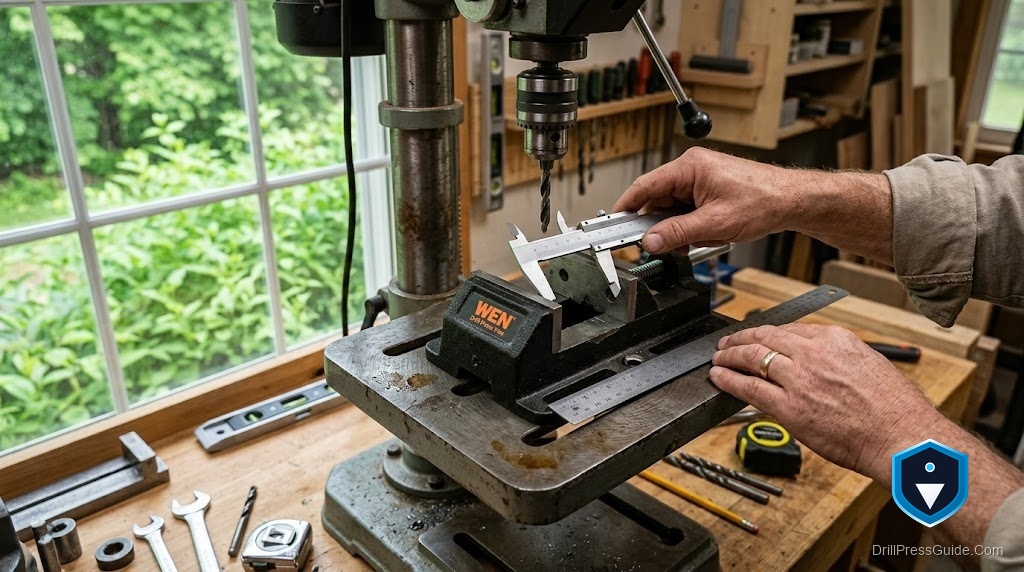
Jaw width, the 2 1/2, is how wide a part the jaws can span. But two other numbers matter just as much.
Jaw opening is how far the jaws separate, which caps how thick a workpiece you can fit. Jaw depth is how far down the jaws grip, which decides how securely a tall part is held. A vise can have the right width and still be wrong if it opens too little or grips too shallow for your parts.
The honest limitation: a 2 1/2 inch vise is a small tool. Ask it to hold a big or heavy workpiece and the part will overhang the jaws and lever loose. Match the vise to small parts and it excels; push past its size and it fights you.
Measure these before you buy
- Jaw width. Span it against your typical parts; 2 1/2 inches suits small stock.
- Jaw opening. Confirm it opens wider than your thickest workpiece.
- Jaw depth. Deeper jaws grip tall parts more securely; shallow jaws suit thin stock.
- Base and mounting holes. Confirm the base bolts to your drill press table’s slots or holes so it cannot walk.
A 2 1/2 inch vise versus a 4 inch vise
Against a 4 inch drill press vise, the 2 1/2 inch model wins on compactness and fitting a small table and loses on capacity and grip on larger parts. The 4 inch vise spans wider, opens further, and grips deeper, so it handles a broader range of work at the expense of table space. If your parts are consistently small, the compact vise is the better fit; if they vary, the larger vise is more versatile.
Against a quick hold-down clamp, the vise wins on squeezing the sides of a part square, while the clamp only presses down. You can compare a compact vise with a 4 inch drill press vise and a drill press hold down clamp to cover both small and wide work.
Setting it up so it holds
- Bolt the vise to the table through its mounting holes so it cannot move under the bit.
- Seat the workpiece flat on the vise floor, low in the jaws, so downward force presses it in.
- Tighten the jaws squarely on clean faces, then push the part by hand to test.
- Position the hole over a table slot or solid support, never over bare casting.
- Keep the start/stop button in reach and wear eye protection against swarf and hot chips, per CCOHS.
Who should skip it
If you drill larger or heavier parts, skip the 2 1/2 inch vise and get a 4 inch or bigger, because small jaws will let big work lever loose. If your work is consistently small, model parts, small brackets, thin stock, a compact vise holds it securely without crowding the table.
Bottom line
A 2 1/2 inch drill press vise is defined by more than its jaw width. Measure the opening and depth against your parts too, and confirm the base bolts down. Matched to small work, it is a tidy, secure holder; asked to grip big parts, it is the wrong size.
- Jaw width is one of three numbers; check opening and depth too.
- It suits small parts; size up to a 4 inch vise for larger work.
- Bolt it down and seat the work flat and low for a secure grip.
FAQ
What does the 2 1/2 in a drill press vise mean? It is the jaw width, how wide a part the jaws span. It does not tell you the jaw opening or depth, which matter just as much.
Is a 2 1/2 inch vise big enough? For small parts, yes. For larger or heavier work, a 4 inch or bigger vise grips more securely because small jaws let big parts lever loose.
What else should I measure besides jaw width? Jaw opening, how thick a part fits, and jaw depth, how deeply it grips, plus the base holes for mounting.
Do I need to bolt down a small vise? Yes. A vise that can slide under the bit is a hazard. Bolt it through its mounting holes, per OSHA and CCOHS practice.
Why does my part lever loose? Usually the part is too big or sits high in the jaws. Seat it low and flat, or step up to a larger vise.
2 1/2 inch or 4 inch vise? Compact vise for consistently small work; 4 inch for versatility across a range of part sizes.
References
- TEKTON 4-Inch Drill Press Vise Manual: https://media.tekton.com/manuals/manual_53994.pdf
- CCOHS, Metalworking Machines - Drill Presses: https://www.ccohs.ca/oshanswers/safety_haz/metalworking/drillpresses.html
- OSHA Woodworking eTool, Drill Press: https://www.osha.gov/etools/woodworking/production/machines-tools/drill-press