How to Install a Drill Press Vise Without Losing Accuracy
A drill press vise is only as good as its installation. Set it down, crank the work, and drill, and it feels fine, right up until the bit grabs and the whole vise skids across the table with the work still in it. That moment is both a ruined part and a genuine hazard. Installing the vise properly, bolted, aligned, and supported, is what turns it from a heavy paperweight into a fixture you can trust.
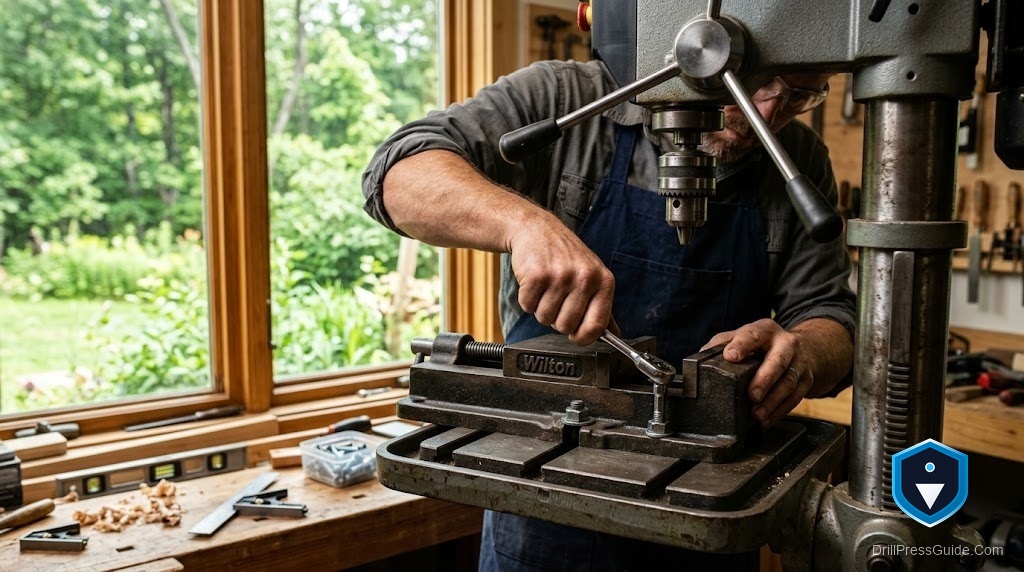
Installing a drill press vise means anchoring its base to the table so it cannot move, positioning it so the bit lands where you want over solid support, and setting it up so the work sits square. The vise is the jawed clamp that holds the workpiece; the mounting holes and the table slots are what tie it down. Done right, the vise becomes part of the machine.
Short answer: position the vise so the hole lands over the table’s clearance area, bolt it down through its mounting holes into the table slots, and confirm it sits flat and square before drilling. Skip the bolting and you have a vise that can walk, which is the exact hazard clamping is meant to remove.
Why bolting it down is not optional
Many people use a drill press vise unbolted, resting on the table, and get away with it until they do not. When the bit breaks through or grabs, it can spin the whole vise, turning the work into a swinging hazard.
OSHA frames the drill press danger around the rotating chuck and the point of operation, and both OSHA and CCOHS say to secure the work rather than hold it. A bolted vise is how you satisfy that: the work is clamped in the vise, and the vise is clamped to the table. Break that chain and the safety goes with it.
The honest tradeoff: a bolted vise cannot be nudged to reposition. If you drill holes in many spots, you either reposition and re-bolt or add a quick clamp for the fast work. That is the price of a fixture that cannot move.
Installing the vise
- Switch off the press and set the vise on the table where the bit will land.
- Position it so the hole falls over a table slot or clearance hole, not solid casting, so the bit exits into clear space, and over solid support for the work.
- Line up the vise’s mounting holes with the table slots.
- Drop bolts with wide washers through the vise base into the slots, adding T-nuts or step blocks as needed.
- Snug both sides evenly so the base does not cock, then tighten fully.
- Push the vise hard by hand; if it shifts, add washers, move to a better slot, or step up the bolt size.
Setting the work square in the vise
With the vise anchored, the work still needs to sit right. Seat the piece flat on the vise floor or on parallels, low in the jaws, so the bit’s downward push presses it in rather than levering it out. Clean the jaw faces so they grip across their full width, not on chips or burrs.
Bolt-down vise versus a quick clamp
Against a quick hold-down clamp, the bolted vise wins on rigidity and squeezing the sides of a part, and loses on speed of repositioning. For precise metal work, the bolted vise is right; for fast, varied drilling, keep a clamp handy too. You can compare a 4 inch drill press vise with the drill press vise mounting kit hardware to anchor it.
Who should read this
If you have been using a vise unbolted, this is the habit to change today. If you already bolt down but parts still shift, the fix is usually seating the work flat and cleaning the jaws, not a new vise.
Bottom line
Installing a drill press vise correctly is the difference between a fixture and a hazard. Position it so the bit exits into clear space, bolt it through its mounting holes, seat the work flat and low, and hand-test before drilling. A vise that cannot move is a vise you can trust.
- Bolt the vise to the table; an unbolted vise can walk under the bit.
- Position the hole over a slot so the bit exits into clear space.
- Seat the work flat and low, on clean jaws, and hand-test before drilling.
FAQ
Do I have to bolt down a drill press vise? Yes, for anything but the lightest work. A bolted vise cannot spin under the bit, which is the hazard clamping is meant to prevent.
Where should the hole land relative to the vise? Over a table slot or clearance area so the bit exits into open space, and over solid support for the work, never over bare casting.
How do I keep the vise from cocking when I tighten it? Snug both bolts evenly before tightening fully, and use wide washers so the base seats flat.
My vise still slides after bolting. Why? Often bolts too short, no washers, or uneven tightening. Add wide washers, use a better slot, and tighten both sides evenly.
Can I leave the vise unbolted for quick jobs? Use a quick hold-down clamp instead for fast work. An unbolted vise that can spin is a hazard, per OSHA and CCOHS.
How should the workpiece sit in the vise? Flat on the vise floor or parallels, low in the jaws, so the downward force presses it in rather than levering it out.
References
- TEKTON 4-Inch Drill Press Vise Manual: https://media.tekton.com/manuals/manual_53994.pdf
- OSHA Woodworking eTool, Drill Press: https://www.osha.gov/etools/woodworking/production/machines-tools/drill-press
- CCOHS, Metalworking Machines - Drill Presses: https://www.ccohs.ca/oshanswers/safety_haz/metalworking/drillpresses.html