
Getting Better Results from a Drill Press Vise Grip
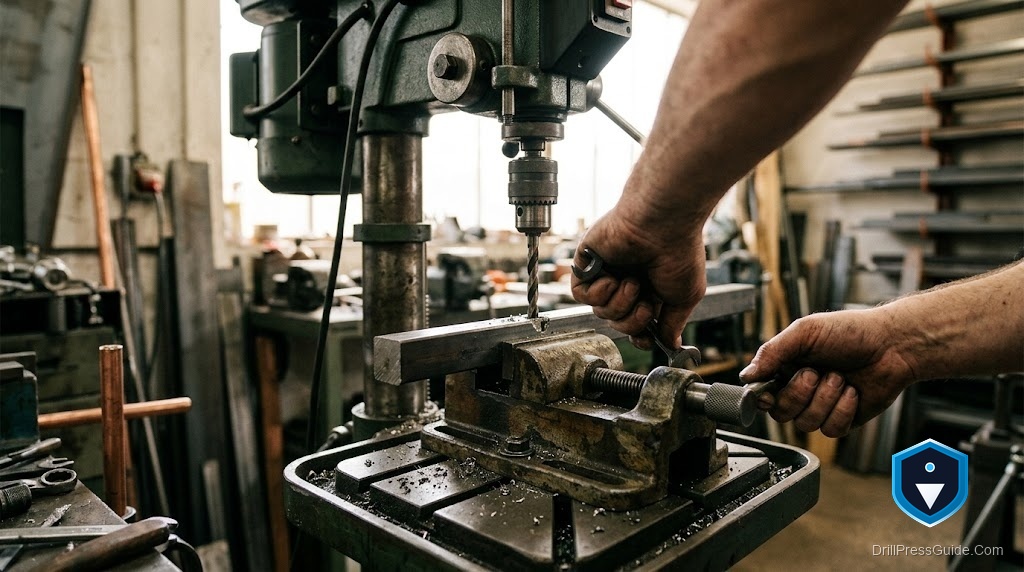
There is a reason the phrase “drill press vise grip” gets typed into search bars: people want their vise to actually grip, and too often it does not. The work shifts a hair under the bit, the hole comes out oval, or the part pops loose and spins. The fix is rarely a new vise. It is understanding how the jaws, the seating, and the mounting work together to turn clamping force into a genuine hold.
Grip on a drill press vise comes from the jaws pressing the workpiece squarely against the fixed jaw and the vise floor, while the vise itself stays bolted to the table. When any link in that chain is loose, the grip fails. Tightening the whole chain, not just the handle, is what gets better results.
Short answer: you get a real grip when the workpiece sits flat on the vise floor or a parallel, the jaws contact it squarely with clean faces, and the vise is bolted to the table so it cannot walk. Fix those three and most gripping complaints disappear.
Why a vise loses its grip
A vise can feel tight and still let the work move, which is what frustrates people.
The usual causes: the part is only touching the jaw tips instead of sitting flat, so it rocks. The jaw faces are dinged or dirty, so they grip on high spots. Or the vise itself is not bolted down, so the whole thing creeps when the bit grabs. A 4-inch drill press vise with clean, square jaws and a solid mount holds far better than a bigger vise used carelessly.
The honest limitation: smooth jaws can slip on hard, polished stock no matter how hard you crank them. For those parts you need jaw liners, a machinist’s grip trick, or a part sitting on the vise floor so downward force helps hold it.
The three things that build grip
Seat the work flat. Rest the part on the vise floor or on parallels so the bit’s downward push presses it into the vise, not out of it. A part clamped high in the jaws levers loose.
Square, clean jaw faces. Contact across the whole jaw beats contact on a few high spots. Clean off swarf and dress any burrs.
Bolt the vise down. A vise that can slide across the table is not really gripping the work, it is just riding along with it. Anchor it through its mounting holes.
Vise grip versus hold-down clamp versus locking pliers
Against a hold-down clamp, the vise wins on squeezing the sides of a part and holding it square, while the clamp only presses down. For a part the bit can spin, the vise’s side grip is what you want.
Against locking pliers clamped to the work, a real vise wins on rigidity and repeatability every time; pliers are a last resort, not a method. You can compare current 4 inch drill press vise options and add a drill press hold down clamp for wide flat parts the jaws cannot reach.
Setting up for a grip that holds
- Bolt the vise to the table through its mounting holes so it cannot walk.
- Clean the jaw faces and the vise floor of chips and burrs.
- Seat the workpiece flat on the floor or parallels, low in the jaws.
- Tighten the jaws squarely, then push the part hard by hand to test.
- Position the hole over solid support, keep the start/stop button in reach, and wear eye protection.
This is also the clamping practice OSHA and CCOHS call for: secure the work rather than holding it, keeping hands clear of the rotating chuck.
Who should read this
If your vise holds fine and your holes are clean, you are already doing this. If parts keep shifting or popping loose, the fix is almost always seating, jaw condition, or a vise that is not bolted down, not a bigger vise.
Bottom line
A drill press vise grips when the whole chain is tight: work seated flat, clean square jaws, and the vise bolted to the table. Chase those before you blame the tool, and add a hold-down for the wide parts a vise cannot reach.
- Seat the work low and flat so downward force helps hold it.
- Clean, square jaw faces grip far better than dinged ones.
- Bolt the vise down; a sliding vise is not really gripping.
FAQ
Why does my drill press vise keep slipping? Usually the work sits high in the jaws, the jaw faces are dirty or burred, or the vise is not bolted down. Fix all three.
Do I need to bolt the vise to the table? Yes. A vise that can slide is not truly gripping and can walk under the bit, which is the hazard clamping is meant to remove.
How do I grip smooth, hard stock? Use jaw liners or seat the part on the vise floor so downward force helps hold it, since smooth jaws can slip on polished metal.
What size vise grips best? Jaw condition and mounting matter more than size. A clean, bolted 4-inch vise holds better than a neglected larger one.
Can I use locking pliers instead of a vise? Only as a last resort. A bolted vise is far more rigid and repeatable and much safer.
Why is my hole coming out oval? Often the work is shifting mid-cut. Reseat it flat, tighten squarely, and confirm the vise is anchored.
References
- TEKTON 4-Inch Drill Press Vise Manual: https://media.tekton.com/manuals/manual_53994.pdf
- CCOHS, Metalworking Machines - Drill Presses: https://www.ccohs.ca/oshanswers/safety_haz/metalworking/drillpresses.html
- OSHA Woodworking eTool, Drill Press: https://www.osha.gov/etools/woodworking/production/machines-tools/drill-press


