Drill Press Locking Clamp: Fit, Capacity, and Setup Explained
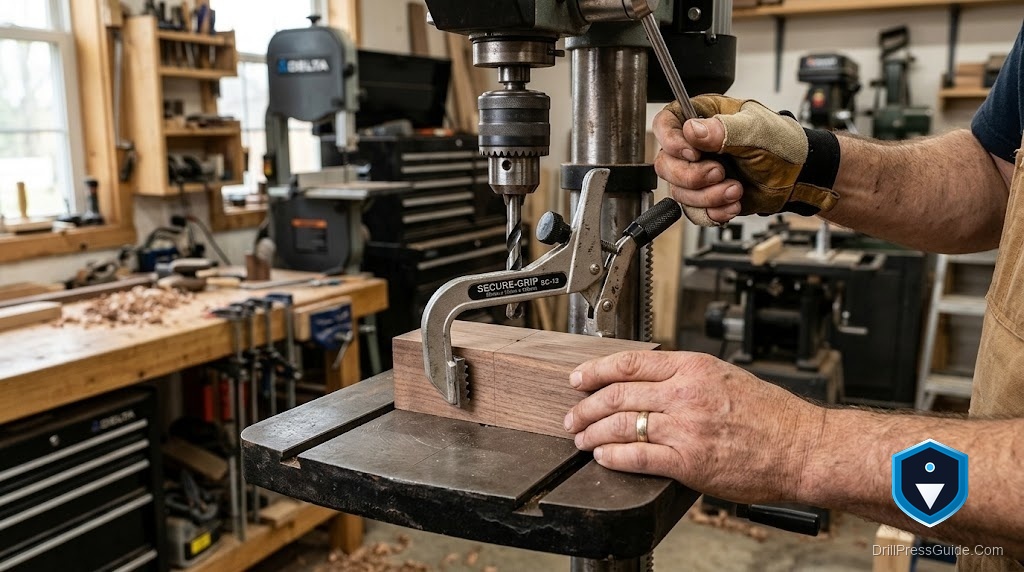
Some workpieces refuse to cooperate. A round bar rolls, a thin plate skates, and a full vise is more clamp than the job needs. That is where a drill press locking clamp earns its keep, a quick-set clamp that pins the work to the table and locks with a lever instead of a wrench. The reason people reach for one is speed. The reason some end up disappointed is that they bought a size that does not match their table or their parts.
A locking clamp for a drill press is a fast-action hold-down that grips the work against the table and holds with a cam or a threaded lever you can set by hand. It fills the gap between a bare table and a heavy bolt-down vise, giving you secure clamping in seconds. That speed is the whole appeal, and it is real.
Short answer: choose a locking clamp sized to reach over your typical workpiece and to anchor in your table slots or over its edge. A 9-inch clamp handles most benchtop parts; go larger only if your work is tall or your table is deep. Match the anchor style to your table and it will serve you for years.
What a locking clamp is good at
The strength of a locking clamp is repetition. When you drill a batch of identical parts, loosening and retightening a vise every time is slow. A cam-lock clamp drops, locks, and releases in one motion, so you keep a rhythm.
It also handles awkward shapes a vise fights: a wide flat panel, an irregular casting, a part that needs to sit at the table edge. The clamp presses straight down wherever you place it.
The honest weakness: a locking clamp holds the work down but does not squeeze it sideways the way vise jaws do. On a part that wants to spin, a single hold-down can let it pivot around the clamp point. For anything the bit can grab and rotate, back it with a fence or a second clamp.
Size and anchor: measure before you buy
- Reach and opening. The clamp must span from its anchor to over your workpiece and open tall enough to clear the part. A 9-inch clamp is a common, versatile size.
- Anchor style. Some clamps drop a bolt into a table slot; others grip the table edge. Confirm your table has slots the right width, or an accessible edge.
- Clamp foot. A swiveling or padded foot sits flat on uneven work; a fixed foot can rock on a curved surface.
- Table thickness. Edge-gripping clamps have a jaw depth. Measure your table so the clamp actually closes on it.
Locking clamp versus vise versus hold-down bar
Against a drill press vise, the locking clamp wins on speed and flexibility and loses on sideways grip. The vise squeezes the work between jaws and stays square; the clamp only presses down. For metal and precise repeat holes, the vise wins; for fast, varied work, the clamp does.
Against a stepped hold-down bar in the slots, the locking clamp wins on convenience since it sets by hand instead of by wrench, and it costs a little more for that lever mechanism. You can compare current drill press locking clamp options and a matching 4 inch drill press vise for the jobs that need a real squeeze.
Setting it up so it holds
- Place the workpiece on the table over solid support, never over an open slot the bit can dive into.
- Anchor the clamp in a slot or on the edge close to the hole so leverage works for you.
- Lock the lever, then push the part by hand. If it pivots, add a fence or a second clamp.
- Keep the start/stop button in reach and wear eye protection, since swarf and hot chips fly off the cut.
CCOHS and OSHA both make the same point in different words: secure the work rather than holding it, and keep the point of operation and the rotating chuck clear of your hands. A locking clamp makes that easy, but only if it is actually locked before the chuck spins.
Who should skip it
If you drill precise metal parts that must stay dead square, a vise serves you better than a hold-down clamp. If you drill a lot of varied wood parts and value speed, or your table has no room for a permanent vise, a locking clamp is one of the handiest accessories on the bench.
Bottom line
A drill press locking clamp trades the vise’s squeeze for speed and reach, and for most varied shop work that is a good trade. Size it to your parts and your table, anchor it close to the hole, and back it with a fence whenever the bit might spin the work.
- Locking clamps hold down fast but do not grip sideways; add a fence for spinnable parts.
- Match the anchor style to your table’s slots or edge.
- Lock it, then hand-test before you drill.
FAQ
What is a drill press locking clamp used for? It quickly pins a workpiece to the table and locks with a lever, giving fast, secure holding for varied or awkward parts without bolting down a vise.
What size locking clamp should I get? A 9-inch clamp suits most benchtop work. Size up only for tall parts or a deep table, and check the opening against your typical workpiece.
Does it hold as well as a vise? It holds down well but does not squeeze sideways like vise jaws. For parts the bit can spin, add a fence or a second clamp.
My locking clamp broke. Why? Often from overloading a light clamp or drilling into an unsupported area so the work levers against it. Match the clamp to the load and support the work.
Can I use one with no table slots? Yes, if you choose an edge-gripping clamp sized to your table thickness.
Do I still need eye protection? Always. CCOHS lists eye and face protection as basic drill press practice against chips and swarf.
References
- CCOHS, Metalworking Machines - Drill Presses: https://www.ccohs.ca/oshanswers/safety_haz/metalworking/drillpresses.html
- OSHA Woodworking eTool, Drill Press: https://www.osha.gov/etools/woodworking/production/machines-tools/drill-press
- TEKTON 4-Inch Drill Press Vise Manual: https://media.tekton.com/manuals/manual_53994.pdf