
Drill Press Column Clamp: What to Measure Before You Buy
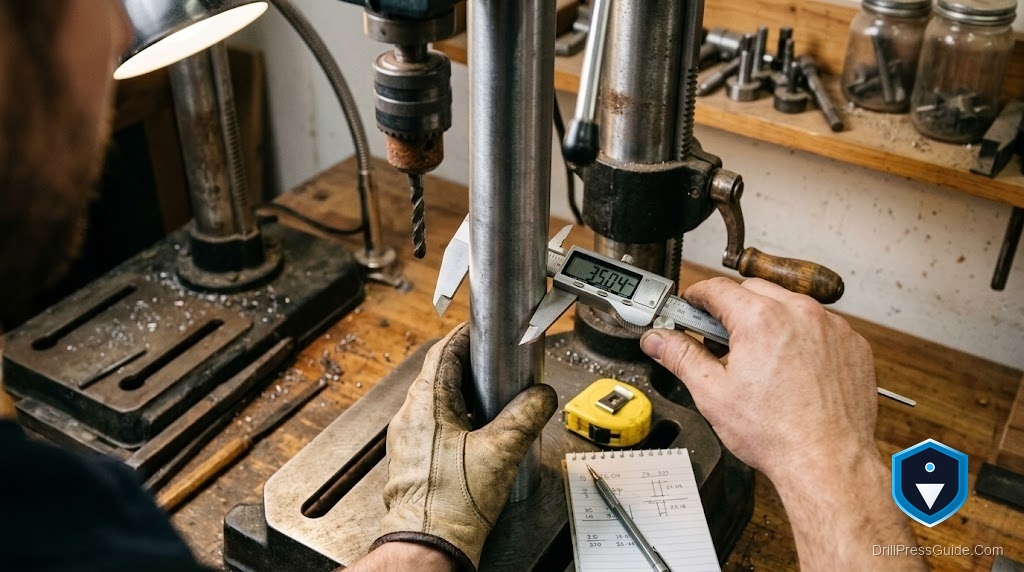
There is a moment every drill press owner meets eventually: you have a workpiece that will not sit still, no free hand to hold it, and a column right there begging to be used as an anchor. A drill press column clamp turns that bare post into a mounting point, and it is one of the cheapest ways to add holding power to a machine that shipped with a small table. The catch is that a column clamp only works if it matches the diameter of your column, and that number is easy to guess wrong.
A column clamp is a collar or bracket that wraps the drill press column and gives you a fixed point to attach a support arm, a light, or a hold-down. Because it grips the round post rather than the table, it works on machines whose tables are too small or too crowded to bolt anything to. That is its whole reason to exist.
Short answer: measure your column diameter first, because a column clamp is sized to that post and nothing else. Get the diameter right and almost any decent clamp will serve. Get it wrong and no amount of tightening will save a collar that does not fit.
What a column clamp does that a table clamp cannot
Most holding accessories anchor to the table. A column clamp anchors to the column, which changes what you can do.
On a benchtop press with a tiny table, the table fills up fast. Mount a vise and there is no room for a fence. A column clamp adds a second anchor point above or beside the table, so you can hang a support arm for long stock or a hold-down without stealing table space.
The honest weakness: a clamp on a round column can rotate if you do not seat it hard, and the further your load hangs from the post, the more leverage works against you. It is a support point, not a substitute for clamping the work itself. Treat it as an extra hand, not the main grip.
Measure these before you buy
One number matters more than all the others, so start there.
- Column diameter. Wrap a tape around the column, divide the circumference by pi, or just caliper the post. Column clamps are sold to fit a specific diameter, and a collar even slightly loose will spin under load. This is the make-or-break spec.
- Column length above the table. You need clear post to slide the clamp on and room to position it where the work is.
- Load direction. Decide whether the clamp will carry a downward hold-down force or a sideways support, because that tells you how hard you need to seat it.
- Table-to-column clearance. On some presses the table casting crowds the column, leaving little room for a collar.
Column clamp versus the alternatives
Against a table locking clamp, the column clamp wins where the table is small or slotless and loses on rigidity. A clamp bolted flat to a table resists twisting better than a collar on a round post. If your table has slots and space, use them first.
Against a drill press vise, these are not really competitors. The vise grips the workpiece; the column clamp supports the setup around it. Many shops use both at once, the vise holding the part and a column-mounted arm steadying a long overhang. You can look through drill press column clamp options and pair them with a drill press hold down clamp for the work itself.
Setting it up so it holds
Seat the collar squarely on a clean column, then tighten in stages so it does not cock to one side. A clamp that grips only on one edge will creep. Once it is set, load it gently and check for rotation before you trust it.
The safety basics do not change because you added a support point. CCOHS still calls for the workpiece itself to be clamped and for eye protection against swarf and hot chips, and OSHA still treats the rotating chuck and point of operation as the hazards to keep clear of. The column clamp helps you keep hands away from the bit; it does not replace securing the actual work.
Who should skip it
If your press has a large slotted table and you rarely drill long overhanging stock, you may never need a column clamp. If you own a benchtop machine with a small table, or you fight long workpieces that tip off the table edge, a column clamp is one of the better few-dollar additions you can make.
Bottom line
A drill press column clamp is a simple fix for a small or crowded table, and it lives or dies on one measurement. Caliper your column, buy the clamp that fits that diameter, seat it square, and use it to support the setup while the vise or a hold-down grips the work.
- Column diameter is the spec that decides fit; measure it first.
- Use the clamp as a support point, not as the primary grip on the work.
- Seat it square and check for rotation before loading it.
FAQ
What is a drill press column clamp for? It clamps around the column to add a fixed mounting point for a support arm, light, or hold-down, which helps when the table is too small or crowded to bolt anything to.
How do I know what size column clamp I need? Measure the column diameter with calipers, or measure the circumference and divide by pi. Column clamps fit a specific diameter, so this number decides everything.
Why does my column clamp keep spinning? Usually the fit is loose or it was tightened unevenly. Confirm it matches your column diameter and seat it square, tightening in stages.
Can a column clamp hold my workpiece by itself? No. It supports the setup. The workpiece should still be clamped in a vise or under a hold-down, as both OSHA and CCOHS advise.
My table column cracked. Is a clamp related? A collar that is overtightened or misfit can stress a casting. Fit the correct diameter and tighten only enough to stop movement.
Column clamp or table clamp? Use a table clamp when your table has slots and space; use a column clamp when the table is small, slotless, or already full.
References
- CCOHS, Metalworking Machines - Drill Presses: https://www.ccohs.ca/oshanswers/safety_haz/metalworking/drillpresses.html
- OSHA Woodworking eTool, Drill Press: https://www.osha.gov/etools/woodworking/production/machines-tools/drill-press
- TEKTON 4-Inch Drill Press Vise Manual: https://media.tekton.com/manuals/manual_53994.pdf


