
Choosing a 6 Drill Press Vise That Fits the Work and the Table
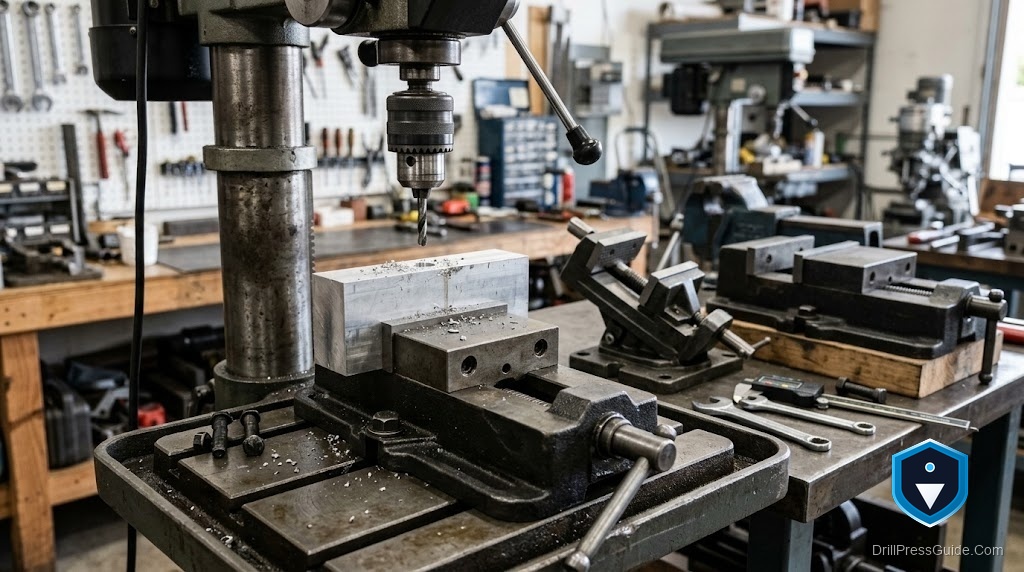
A 6 inch drill press vise looks like the obvious upgrade until you set it on a benchtop table and watch it hang off both edges. The extra jaw width buys you real capacity, but it also asks more of your machine, your table, and your patience during setup. Before you size up, it helps to know exactly what that number buys and what it costs you.
A drill press vise is a two-jaw clamp that bolts to the table and squeezes a workpiece between a fixed jaw and a moving jaw, holding it square to the bit. The “6” refers to jaw width, the span of metal doing the gripping, not the size of the opening or the machine. A 6-inch vise grips wider stock and longer parts than a 4-inch, which is the whole reason to want one.
Short answer for the impatient: a 6-inch vise is the right call if you regularly clamp wide flat stock or long parts and your table has the mounting holes and surface area to carry it. If you run a benchtop press and mostly drill small blocks, a 4-inch vise is easier to live with and leaves room to actually reach the work.
What the 6 inch number really means
Jaw width tells you how much of the workpiece the jaws contact across their span. Wider jaws spread the clamping load, so a 6-inch vise holds a long bar with less chance of it pivoting than a 4-inch would. That is genuinely useful for anything wide and flat.
What the number does not tell you is the opening. Two 6-inch vises can open very differently, and the opening is what decides whether your part fits between the jaws at all. Check that spec separately, every time.
The honest drawback: a 6-inch vise is heavy and it eats table real estate. On a small benchtop machine it can cover the mounting holes you need and force the bit toward the edge of your usable table. That is the tradeoff for the capacity.
6 inch versus the sizes around it
Buyers rarely choose in a vacuum, so compare honestly.
Against a 4-inch or 3-inch vise, the 6 wins on capacity and loses on nimbleness. The smaller vises sit neatly on a benchtop table, leave the mounting holes clear, and let you get the bit close to the column where the table is stiffest. If your parts are small, the small vise is not a compromise, it is the better tool.
Against an X-Y or cross-slide vise, a plain 6-inch is simpler and more rigid but cannot move the work under the bit. If you need to reposition a hole a known distance, the cross-slide earns its extra cost and its extra slop. For straight clamp-and-drill, the plain vise is stiffer.
Brand versions like a Wilton, Delta, or Palmgren 6-inch vise mostly differ in casting quality and jaw finish rather than the core geometry. You can weigh the current 6 inch drill press vise options against the lighter 4 in drill press vise choices to see which footprint suits your table.
Measure these before you buy
- Jaw opening, not just jaw width, so your actual parts fit.
- Base slot spacing against your table’s mounting holes, because a wide base that misses every hole cannot be bolted down.
- Table surface area, since a 6-inch vise needs room to sit flat without overhanging the bit’s reach.
- Jaw height, because a tall part in a shallow jaw tips under the bit.
Setting it up to hold square
Secure clamping is the point of a vise, so bolt it down rather than letting it float. A vise that walks across the table under load is more dangerous than no vise, because it invites you to chase the work with your hands.
CCOHS lists clamps and drill vises as basic practice and pairs them with eye protection, since swarf and hot chips leave the cut regardless of how careful you are. OSHA frames the same idea around the point of operation and the rotating chuck: keep the work fixed and your hands clear. Seat the workpiece on the vise floor or a parallel so the bit has support where it breaks through, snug the jaws, then push the part by hand to confirm it will not move under power.
Who should skip the 6 inch
If you own a benchtop press with a small table and you drill mostly small parts, skip the 6 and buy a 4. You will fight the overhang every session otherwise. If you drill wide plate, long bar, or big flat workpieces on a floor machine with a generous table, the 6 is exactly right and the smaller vise would frustrate you.
Bottom line
The 6-inch drill press vise is a capacity tool, not a default upgrade. Buy it when your work is genuinely wide or long and your table can carry it, and step down to a 4-inch when your parts are small and bench space is tight.
- Jaw width buys capacity; the opening decides what fits.
- A 6-inch vise needs table area and matching mounting holes.
- Bolt it down and hand-test before every drill.
FAQ
What does the 6 in a 6 inch drill press vise measure? It is the jaw width, the span of the gripping faces. It does not tell you how far the jaws open, which you should check separately.
Is a 6 inch vise too big for a benchtop drill press? Often, yes. On a small table it can cover the mounting holes and push the bit toward the edge. A 4-inch usually fits benchtop machines better.
6 inch or a cross-slide vise? Choose the plain 6-inch for rigidity and simple clamp-and-drill work. Choose a cross-slide when you need to move the workpiece a set distance under the bit.
Can any 6 inch vise bolt to my table? Only if its base slots line up with your table’s mounting holes. Measure both before buying.
Do I need to bolt the vise down? Yes. A floating vise can shift under the bit, which is exactly the hazard clamping is meant to remove.
Will a 6 inch vise hold round stock? With V-grooved jaws or a V-block, yes. Flat jaws alone only touch a round part at two points.
References
- CCOHS, Metalworking Machines - Drill Presses: https://www.ccohs.ca/oshanswers/safety_haz/metalworking/drillpresses.html
- OSHA Woodworking eTool, Drill Press: https://www.osha.gov/etools/woodworking/production/machines-tools/drill-press
- TEKTON 4-Inch Drill Press Vise Manual: https://media.tekton.com/manuals/manual_53994.pdf


