
Harbor Freight Drill Press Clamp: Fit, Capacity, and Setup Explained
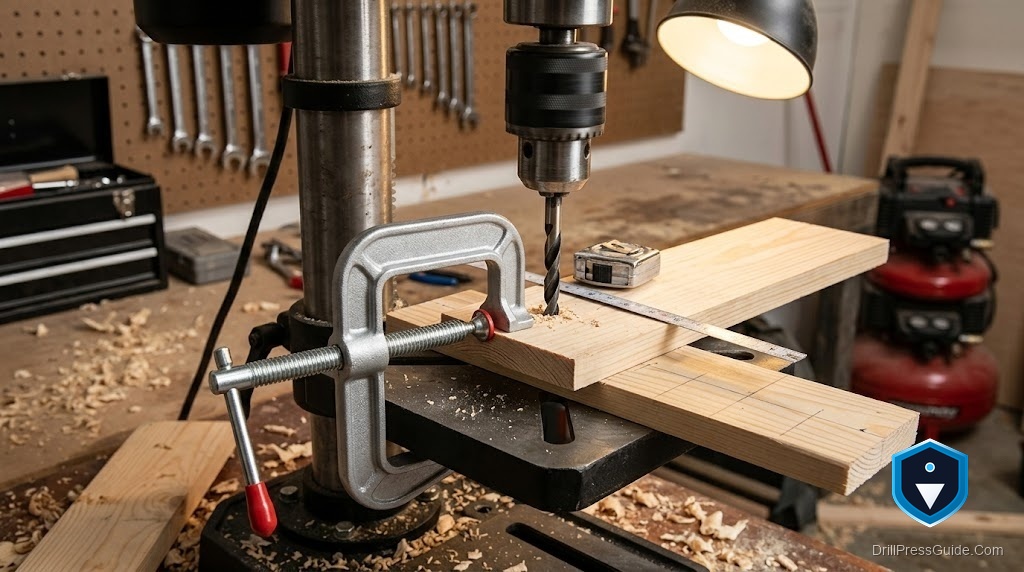
The first time a piece of flat steel spins loose on a drill press, you don’t forget the sound. The bit grabs, the workpiece becomes a propeller, and your knuckles learn a lesson your eyes should have caught first. A clamp is the cheap insurance against that moment, and the accessory rack at Harbor Freight is where a lot of shops start looking. The real question is which harbor freight drill press clamp actually holds your work, and whether it bolts to your particular table.
A drill press clamp is any device that pins a workpiece to the table so the bit does the cutting instead of the spinning. That single phrase hides three different tools people lump together: the hold-down clamp that slides into a table slot, the locking clamp that grips the table edge, and the drill press vise that squeezes the work between two jaws. Each one solves a slightly different problem.
Here is the short version. If you drill metal or small parts, you want a drill press vise. If you drill wide boards or awkward shapes, you want hold-down clamps that ride in the table slots. If your table has no slots at all, you want an edge locking clamp. Most shops end up owning all three, but you should buy for the work in front of you, not the work you picture yourself doing someday.
The three “clamps” people mean by this term
Start here, because the wrong category is the number one reason a clamp goes back in the box.
A hold-down clamp is a stepped bar or a swiveling arm that anchors in the table slots and presses down on top of the workpiece. It shines on flat stock that is too wide for a vise: a cabinet door, a shelf, a long rail. It does almost nothing for a small round part.
A drill press vise grips the sides of the work with two jaws and bolts to the table through its own mounting holes. For metal, small blocks, and anything you want repeatably square to the bit, this is the tool. A 4-inch vise handles most benchtop work.
A locking clamp, sometimes sold as a table clamp, bites the edge of the table and is the answer when your table is a plain plate with no slots. It trades some rigidity for the ability to grab almost anywhere.
The honest tradeoff: the budget hold-down sets that fill the Harbor Freight bin are stamped steel, and the thin ones flex under a real push. They hold fine for drilling wood; lean on them while boring steel and you will feel the bar spring. If you work metal often, spend the extra on a cast vise and skip the light stamped clamps. You can compare the range of drill press hold down clamp sets and 4 inch drill press vises side by side before you commit.
What to measure before you buy
Three numbers decide whether a clamp fits, and none of them are printed on the front of the package.
- Table slot width and spacing. Hold-down kits ship with T-bolts or step blocks sized to a slot. Measure the width of your slot and the distance between slots. A bolt that is a hair too wide simply will not drop in.
- Mounting hole pattern. A vise bolts through its base into the table’s mounting holes. Measure the hole spacing on your table and the slot spacing on the vise base. They have to overlap.
- Jaw capacity and jaw height. A 4-inch vise refers to jaw width, not opening. Check how wide the jaws open and how tall they are, because a tall part clamped by a shallow jaw tips under the bit.
Write those numbers on a piece of tape and take them with you. It saves the second trip.
Setting it up so it actually holds
Secure clamping is not about brute force, it is about direction. The clamp has to resist the bit’s tendency to lift and spin the work, so the clamping force should point down and toward the fixed jaw or the table.
Safety authorities are blunt about why this matters. OSHA’s woodworking guidance treats the rotating chuck and the point of operation as the hazards to design around, and it calls for the work to be secured rather than hand held. Canada’s CCOHS guidance says the same in plainer words: clamp the workpiece, keep the table clear of loose tools, and wear eye protection because hot chips and swarf come off the cut whether you expect them or not.
A setup that behaves:
- Seat the workpiece flat on the table or on a sacrificial backer so the bit has support where it breaks through.
- Position the clamp or vise so the bit enters over solid table, never over an open slot your bit can dive into.
- Snug the clamp, then push the part by hand to test it. If it shifts, it will shift under power.
- Keep the start/stop button within reach before you ever spin the chuck.
Who should skip the cheap clamp
If you only ever drill pilot holes in framing lumber, a full clamp kit is overkill and a single locking clamp will do. If you drill hardened steel, thick plate, or anything where a grab could hurt you, skip the light stamped hold-downs entirely and buy a cast vise that bolts down hard. The middle group, hobby woodworkers drilling cabinet parts and jigs, is exactly who the inexpensive hold-down kits are built for.
Bottom line
A drill press clamp is the least glamorous accessory you will buy and the one most likely to save a finger. The Harbor Freight versions are honest value for wood and light duty, and a poor choice for steel. Buy the category that matches your work, measure your slots and mounting holes before you pay, and set the clamp so its force fights the bit instead of feeding it. Get those three right and the propeller moment never happens.
Three things to remember:
- Match the clamp type to the shape of your work, not the price tag.
- The slot width and mounting-hole spacing on your table decide what fits.
- Clamp down and toward the table, then hand-test before you drill.
FAQ
What is a drill press clamp used for? It pins the workpiece to the table so the bit cuts instead of catching and spinning the part. That protects your hands and keeps the hole where you marked it.
Are Harbor Freight drill press clamps any good? For wood and light drilling they are reasonable value. The thin stamped hold-downs flex under heavy metal work, so serious metalworking calls for a cast vise instead.
What size drill press vise should I buy? A 4-inch vise covers most benchtop drilling. The number is the jaw width, so check the opening and jaw height against your actual parts.
How do I clamp a workpiece with no table slots? Use an edge locking clamp that grips the rim of the table, or bolt a slotted auxiliary table on top and clamp to that.
Can I just hold the piece by hand? No. Both OSHA and CCOHS call for the work to be secured because a bit that grabs can turn a small part into a spinning hazard.
Will a hold-down clamp work on round stock? Poorly. Round parts want a vise with matching jaws or a V-block, since a flat hold-down only touches one point.
Do I need eye protection for drilling? Yes, every time. Swarf and hot chips leave the cut fast, and CCOHS lists eye and face protection as basic drill press practice.
References
- OSHA Woodworking eTool, Drill Press: https://www.osha.gov/etools/woodworking/production/machines-tools/drill-press
- CCOHS, Metalworking Machines - Drill Presses: https://www.ccohs.ca/oshanswers/safety_haz/metalworking/drillpresses.html
- TEKTON 4-Inch Drill Press Vise Manual: https://media.tekton.com/manuals/manual_53994.pdf


