Choosing a Vise Grip Drill Press Clamp That Fits the Work and the Table
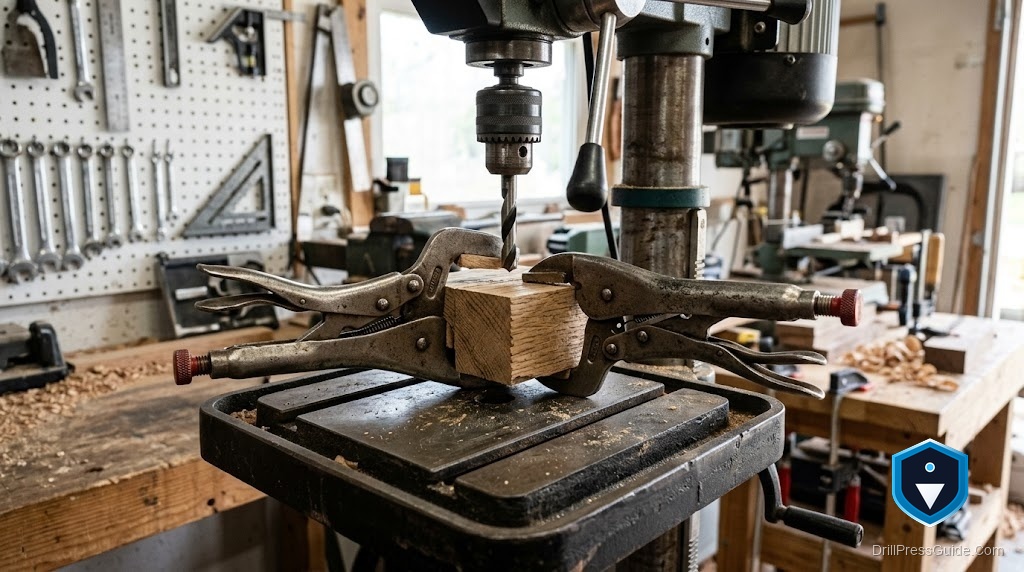
Here is a scene I bet you know. You are drilling a hole in a small metal bracket, the bit grabs, and suddenly the workpiece spins like a helicopter blade and flings itself across the shop. If you were holding it by hand, that is a trip to urgent care. This is the entire reason a drill press clamp or vise exists, and it is the one accessory I refuse to be casual about. Let me help you pick the right one for how you actually work.
First, get the terms straight
People use “vise grip drill press clamp,” “drill press vice grip,” and “hold-down clamp” interchangeably, but they are really two different tools that solve the same safety problem in different ways.
- A drill press vise is a jawed clamp that grips the workpiece itself. You set the part between two jaws, tighten, and then either bolt the vise to the table or brace it. Best for small parts, round stock, and metal.
- A hold-down clamp presses the workpiece down onto the table from above, usually anchored in a T-track or slot. Best for larger, flatter boards and panels where a jawed vise would be too small.
Which one you need depends entirely on the size of your work and whether your table has slots or T-track.
If your work is small: get a drill press vise
For brackets, dowels, pipe, small metal parts, and anything you would otherwise pinch with your fingers, a jawed vise is the answer.
- The PONY 4-inch Drill Press Vise is a cast-iron classic with a 4 inch jaw and mounting slots on each side, so it bolts down to most drill press tables. It is a sensible medium-duty pick that will not flex on you.
- The PALMGREN 9612401 4-inch Drill Press Vise is a heavier industrial option for drilling, tapping, and reaming when you want more mass under the part.
- The Forward Q194A 4-inch Drill Press Vise advertises textured jaws and strong grasping pressure, a solid general-purpose choice.
- If you want a true “vise grip” feel with a quick-release action, the LLDSIMEX Quick Grip Release Drill Press Vise uses a fast-adjusting jaw so you can reposition parts without cranking a screw the whole way.
The catch with vises
A drill press vise stops the workpiece from spinning, but it does not stop the vise itself from spinning unless you bolt or clamp it to the table. Use the mounting slots. Bolt it down, or clamp the vise to the table. Every time.
If your work is large or flat: use hold-down clamps
For wide boards, plywood, and panels, a jawed vise is the wrong tool. You want clamps that press the work down onto the table and anchor in slots or a T-track.
- The POWERTEC 71168 T-Track Hold-Down Clamp set includes two hold-down clamps, T-bolts, washers, and 5-star knobs, and it drops straight into a standard T-track for quick, high-tension clamping.
- For lower-profile clamping in tight spots, the POWERTEC 71082 Mini Hold-Down Clamp uses a compact lever profile with non-marring rubber pads.
- If you prefer a quick-release cam action rather than a threaded knob, the POWERTEC 71165 Cam Lever Clamp lets you lock and release with a flip of the lever.
Does your table even have T-track?
This is the question that decides everything. Many drill press tables have cast slots but no T-track. If yours does not, you either add a T-track onto an auxiliary wood table, or you use clamps that grip the edge of the table or the existing slots. Do not buy T-track clamps assuming they will magically fit a slotless table.
How to clamp a drill press vise correctly
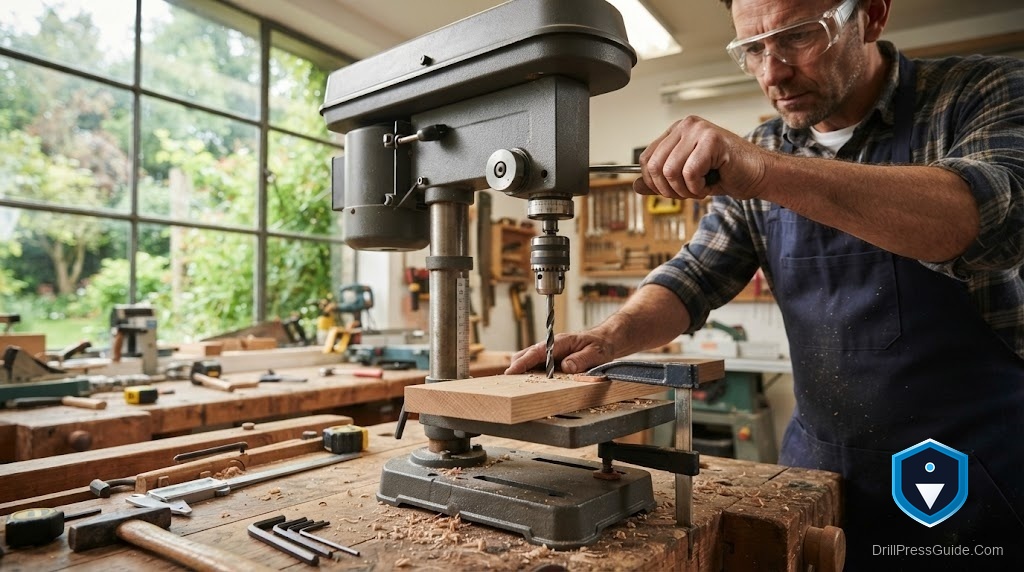
- Position the workpiece so the drill bit will enter over the cutting area, not over the solid table or over your clamp hardware.
- Support the workpiece from underneath with a backing board so the bit exits cleanly.
- Tighten the jaws or hold-downs firmly against the workpiece so there is no movement at the point of operation.
- Anchor the vise or clamp to the table through the mounting holes or table slots. Weight alone is not enough.
- Keep your hands well away from the rotating chuck and the cutting area, and clear swarf and hot chips with a brush, never your fingers.
- Wear eye protection and keep the start/stop button within easy reach before you power up.
The comparison, in plain terms
- Jawed vise (PONY, PALMGREN, Forward, LLDSIMEX): best for small parts, round stock, and metal. Must be bolted or clamped to the table.
- Threaded T-track hold-downs (POWERTEC 71168, 71082): best for flat boards and panels, strong and steady.
- Cam lever clamps (POWERTEC 71165): fastest to lock and release, ideal when you are repositioning often.
The verdict
Buy for the work in front of you, not for a generic idea of “a clamp.” If you drill small metal and round parts, get a real jawed vise like the PONY 4-inch Drill Press Vise and bolt it down, or step up to the heavier PALMGREN 9612401 if you want more mass. If you drill wide boards and your table has T-track, the POWERTEC 71168 hold-down set is the dependable choice.
Whatever you pick, remember the one rule that keeps all ten fingers attached: never trust weight, always anchor to the table.
FAQ
What is the difference between a drill press vise and a hold-down clamp? A vise grips the workpiece between jaws and suits small parts and metal. A hold-down clamp presses a flat workpiece down onto the table from above and suits larger boards and panels.
Do I have to bolt down a drill press vise? Yes. A vise stops the part from spinning, but if the vise itself is not anchored, the bit can grab and swing the whole vise.
Will T-track clamps fit my drill press table? Only if your table has a compatible T-track or slot. Check your table first, and add an auxiliary T-track table if needed.
What size drill press vise should I buy? A 4 inch jaw width covers most home and small-shop work. Choose a heavier cast-iron model if you drill a lot of metal.
How do I clamp a workpiece so it does not blow out on the bottom? Support the underside with a backing board and position the bit over the cutting area, then tighten the jaws or hold-downs firmly before drilling.
References
- PONY 4-inch Drill Press Vise: Check on Amazon
- PALMGREN 9612401 4-inch Drill Press Vise: Check on Amazon
- Forward Q194A 4-inch Drill Press Vise: Check on Amazon
- LLDSIMEX Quick Grip Release Drill Press Vise: Check on Amazon
- POWERTEC 71168 T-Track Hold-Down Clamp: Check on Amazon
- POWERTEC 71082 Mini Hold-Down Clamp: Check on Amazon
- POWERTEC 71165 Cam Lever Clamp: Check on Amazon