
Choosing a 6-Inch Drill Press Vise That Fits the Work and the Table
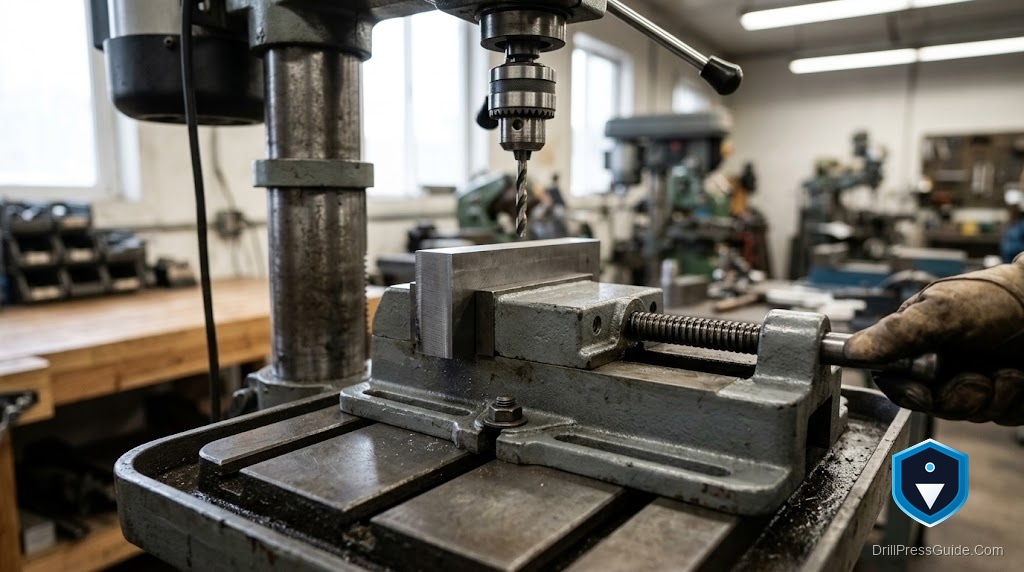
Here is the thing nobody tells you when you go searching for a “6 inch drill press vise”: most of what you actually need is decided before you ever clamp a workpiece. It is decided by your table. I learned this the slow way, by buying a wide vise that looked great in photos and then discovering the mounting slots did not line up with a single T-slot on my press. So before we talk about brands, let me walk you through how I pick one now, and which real vises I trust.
What “6-inch” really means (and why it trips people up)
When people say 6 inch, they usually mean one of three different things: a 6-inch jaw width, a 6-inch jaw opening, or a vise that suits a press with a roughly 6 inch stroke. Those are not the same spec, and shopping by the headline number alone is how you end up with the wrong tool.
For most home and small-shop drilling, a 4-inch drill press vise handles the majority of jobs, and a true wide-jaw 6-inch casting is heavier and more press than a lot of benchtop tables want. So if you searched for 6 inch expecting more capacity, ask yourself first whether you need wider jaws or simply a more secure clamp.
Measure these before you buy
- Table slots. Find the spacing and width of your table slots, then compare them to the vise mounting holes. This one check prevents the most common return.
- Jaw width vs jaw opening. Jaw width is how much face grips the workpiece. Jaw opening is the widest gap. You want both to match your typical stock.
- Throat depth. A deep throat lets you drill farther from the edge of the workpiece.
- Clearance under the chuck. A tall vise on a small press eats your working height fast.
The vises I actually recommend
For a clean, honest starting point, the WEN Drill Press Vise, 4-Inch (DPA424) is the one I hand to people who just want something that works. Cast iron body, four onboard mounting slots, and a 1 inch throat depth. It grips wood, metal, and plastic without drama. The honest flaw: the base pattern does not line up squarely on every press, and some owners end up mounting it at an angle. Check your slots first and you will be fine.
If your parts are small, the WEN Drill Press Vise, 3-Inch (DPA423) is lighter and easier to reposition. It is not the tool for big workpiece support, but for hobby parts it keeps things tidy.
The PONY Drill Press Vise, 4-inch is my pick when someone wants a step up in feel. The cast iron is powder coated, the slots mount to most tables, and it simply feels planted. It is medium duty, so do not ask it to behave like an industrial casting, but for secure clamping on a home press it earns its spot.
When headroom is tight, the Wilton Low-Profile Drill Press Vise, 4-Inch (11744) shines. The low profile gives you more room between the workpiece and the rotating chuck, which matters on presses with short quill travel. It is built for drilling, tapping, and reaming, and it is the one I reach for when the cutting area is cramped.
Now, if what you truly want is more capacity and travel, look at a cross slide instead of a wider fixed jaw. The HFS 6-Inch Cross Slide Vise moves your workpiece along two axes, so you can position holes precisely without unclamping. Its smaller sibling, the HFS 3-Inch Cross Slide Vise, does the same trick for tighter benches. The trade-off is real: cross slides sit taller and add flex compared to a squat fixed vise, so treat them as positioning tools, not brute clamps.
My verdict
For most readers, buy the WEN 4-inch and stop overthinking the “6 inch” label. Step up to the PONY 4-inch if you want a more solid feel, choose the Wilton low-profile if headroom under the chuck is tight, and reach for an HFS cross slide only if two-axis positioning is the actual goal. Wider is not automatically better. The right vise is the one your table can hold flat and square.
Safety habits that matter more than the vise
No vise saves you from bad habits. Always fasten the vise to the table with a hold-down clamp or bolts through the mounting holes, never hand-hold stock near a spinning bit. Keep eye protection on, keep the point of operation clear, and know where the start/stop button is before you begin. Brush swarf and hot chips away with a tool, never your fingers, and give long parts real workpiece support so they cannot spin.
FAQ
Is a 6-inch vise better than a 4-inch drill press vise? Not for most people. A 4-inch vise covers typical benchtop drilling. Go wider only when your workpieces genuinely exceed a 4 inch grip.
Will a Delta 20-619 style 6-inch vise fit any press? No. Mounting patterns differ. Match the vise slots to your table slots regardless of brand or model number.
Do I need a cross slide vise? Only if you want to move the workpiece precisely along two axes without unclamping. For straight drilling, a fixed vise is more rigid.
What about a Dayton 4 and 6 inch vise install? The install steps are the same idea for any brand: line the base slots to the table, seat it flat, and bolt or clamp it down before drilling.
References
- WEN Drill Press Vise 4-Inch (DPA424): Check on Amazon
- WEN Drill Press Vise 3-Inch (DPA423): Check on Amazon
- PONY Drill Press Vise 4-inch: Check on Amazon
- Wilton Low-Profile Drill Press Vise 4-Inch (11744): Check on Amazon
- HFS 6-Inch Cross Slide Vise: Check on Amazon
- HFS 3-Inch Cross Slide Vise: Check on Amazon


