Drill Press Table Clamp: Compatibility and Setup Guide
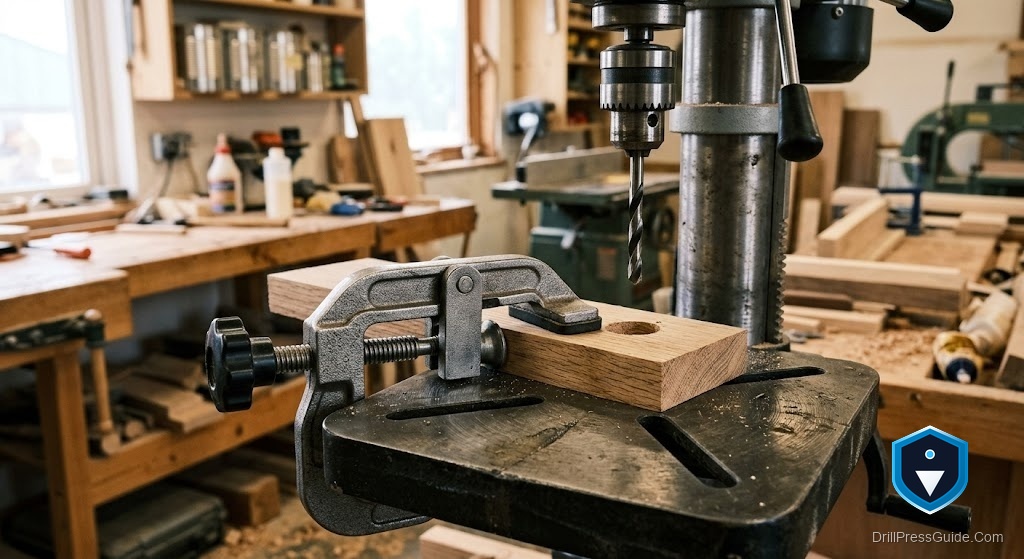
You bought a slick set of clamps because a video made it look easy, and now they are sitting on your drill press table doing nothing, because the bolts don’t drop into anything. This is the most common frustration with a drill press table clamp, and it is entirely about compatibility. The clamp that transforms one person’s setup is useless on the next table over, and the difference is the slots.
A drill press table clamp is any device that holds your workpiece down against the table so it cannot spin, lift, or walk while you drill. Some thread into slots milled into the table, some ride in an add-on T-track, and some are freestanding quick clamps that grip the table edge or a fence. The right one depends entirely on what your table is built to accept.
Short answer before the details: look at your table first. If it has T-slots or you can add a T-track, T-track hold-down clamps are the cleanest solution. If it only has open radial slots or a plain cast surface, a freestanding hold-down clamp or a drill press vise is the safer bet. Match the clamp to the table, not the other way around.
Read your table before you buy anything
Drill press tables come in three broad flavors, and each one accepts different hardware.
- Cast tables with T-slots or straight slots. These have channels designed to capture a bolt head or a T-bolt. T-track and slot clamps thread right in. This is the friendliest setup.
- Cast tables with open radial slots. The slots are open-ended and often angled, meant mostly for bolting a vise. Some hold-down clamps work, but many T-bolts will not seat properly. Adding an aftermarket T-track fixes this.
- Plain or shop-built tables. A flat surface with no channels at all. Here you either add a T-track, drill and tap mounting holes, or use freestanding clamps that grab the edge.
Spend two minutes measuring your slot width and the distance between slots before ordering. A clamp that needs a 3/4-inch channel will not help a table with narrow radial slots.
The clamps that actually earn a place on the table
For tables set up with a T-track, the POWERTEC 71168-P2 T-Track Hold Down Clamps (4 Pack) are the workhorse choice. Each clamp is about 5-1/2 inches long, comes with the T-bolt, washer, and star knob, and gives you solid downward pressure right where you need it. Buying four means you can pin a workpiece from two directions at once, which is what stops a part from pivoting around a single clamp. The obvious limitation: they need a compatible T-track or T-slot to seat in. Drop them onto a plain cast table and they have nothing to grab.
If your parts are smaller and you are working in tight quarters near the bit, the POWERTEC 71082 T-Track Mini Hold-Down Clamp sits lower and reaches into spaces the full-size clamp fouls. The trade is clamping force. These are for holding light stock steady, not for pinning a heavy steel plate that wants to fight the bit. Use them for delicate or small work, and step up to the larger clamps for anything with real mass.
For tables without a track, or for people who do not want to build one, a freestanding option like the Elsjoy 9-Inch Drill Press Hold-Down Clamp (2 Pack) is the practical answer. These heavy-duty clamps lock the workpiece down and don’t depend on a matching slot pattern. The flaw is bulk: at nine inches they can crowd the cutting area, and the foot wants a flat reference to press against, so odd-shaped stock can be awkward.
Notice the pattern. The T-track clamps give you the cleanest, most repeatable hold but demand the right table. The freestanding clamps work almost anywhere but cost you space around the bit. There is no single best clamp, only the best clamp for your table and your parts.
When a clamp is not enough: add a vise
For round stock, small metal parts, or anything you want to reposition precisely, a 4-inch drill press vise beats loose clamps. The vise jaws grip the workpiece, and you bolt or clamp the vise itself to the table through its mounting holes. This keeps your hands away from the point of operation entirely, which matters most with metal, where a grabbed part becomes a spinning hazard the instant the bit breaks through.
A good habit: clamp the vise to the table too. A vise that is only holding the part, but is itself free to slide, is still a part that can spin.
Setup that keeps the work still and your fingers clear
- Position the workpiece and mark the hole under the bit, using your center punch or laser.
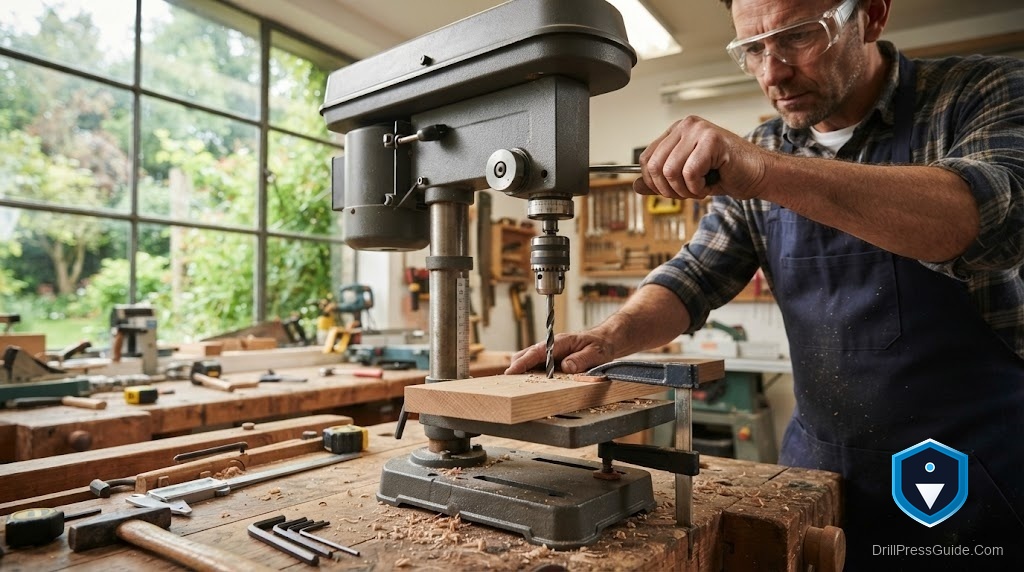
- Set the clamps on opposite sides of the drill point so the part cannot pivot. One clamp is a hinge; two clamps are a hold.
- Snug, then check, then tighten. Confirm nothing rocks before you commit.
- Set the depth stop so you don’t drill into the table or your fasteners.
- Clear the cutting area of the chuck key and loose tools, put on eye protection, and keep the start and stop button within reach of your non-drilling hand.
- Manage the chips. Metal drilling throws swarf and hot chips. Never brush them away with a bare hand while the spindle turns, and never with the machine running.
A note on breakthrough and hot chips
The moment a bit exits the bottom of the work is when clamps prove their worth. That is when torque spikes and an unheld part lurches. It is also when swarf comes off sharpest and hottest on metal. A sacrificial backing board under the work supports the fibers on breakthrough for cleaner exit holes and protects the table. Combine that with clamps on two sides, and the ugly surprises mostly disappear.
FAQ
Will any T-track clamp fit my drill press? No. T-track and slot clamps only fit tables with a matching channel or an installed T-track. Measure your slot width and spacing first, or plan to add a T-track to a plain table.
How many clamps do I need for one workpiece? At least two, placed on opposite sides of the drill point. A single clamp lets the part pivot around it. Two clamps lock it against rotation.
Can I just hold the workpiece by hand? Not for metal or small parts. When the bit breaks through it can catch and spin the piece into a hazard. Use clamps or a drill press vise for anything you would not want thrown.
What is the difference between a hold-down clamp and a drill press vise? A hold-down clamp presses a workpiece flat against the table. A vise grips the piece between jaws and is itself mounted to the table. Vises are better for round stock, small parts, and metal; clamps are better for flat panels and boards.
How do I deal with the metal chips? Let them fall, then clear them with a brush after the spindle stops. Swarf is sharp and hot. Never wipe chips with a bare hand, and never while the machine is running.
References
- POWERTEC 71168-P2 T-Track Hold Down Clamps: Check on Amazon
- POWERTEC 71082 T-Track Mini Hold-Down Clamp: Check on Amazon
- Elsjoy 9-Inch Drill Press Hold-Down Clamp: Check on Amazon